Hi, what do you want to do?






NASA
Explore New Hubble Images of Celestial Objects From the Caldwell Catalog
Hubble turned 30 this year, and it has a birthday present to share with you! Newly released Hubble images of 30 celestial objects from the Caldwell Catalog show stunning cosmic sights, many of which you can see with a backyard...
NASA
A New Portrait of the Cosmos is Coming
The Nancy Grace Roman Space Telescope, formerly known as WFIRST, is an upcoming space telescope designed to perform wide-field imaging and spectroscopy of the infrared sky. One of the Roman Space Telescope's...
NASA
WFIRST Will See the Big Picture of the Universe
Scheduled to launch in the mid-2020s, the Wide Field Infrared Survey Telescope (WFIRST) will function as Hubble’s wide-eyed cousin. While just as sensitive as Hubble's cameras, WFIRST's 300-megapixel Wide Field...
Next Animation Studio
How the Large Underground Xenon detector finds dark matter
The Large Underground Xenon Detector is a two-phase liquid xenon detector designed to pick up dark matter particles. The Large Underground Xenon detector, or LUX, is located about a mile underground. Its outer tank is filled with...
NASA
NASA | Turning Black Holes into Dark Matter Labs
A new computer simulation tracking dark matter particles in the extreme gravity of a black hole shows that strong, potentially observable gamma-ray light can be produced. Detecting this emission would provide astronomers with...
NASA
Hubble Views Galaxy Lacking Dark Matter
NASA's Hubble Space Telescope took an image of a bizarre, ghostly looking galaxy called NGC 1052-DF2 that astronomers calculate to have little to no dark matter. This is the first galaxy astronomers have discovered to be so...
Professor Dave Explains
The End of the Universe: Hot or Cold?
We've talked at great length about the beginning of the universe, everything we know, and what we don't yet know. But everything that has a beginning must have an end. How will the universe end? How can we tell? When will it happen?...
Physics Girl
World’s Largest Camera Lens
The world's largest digital camera is currently being assembled at a warehouse in California. We caught the short window of time to see the camera's massive lens.
Science360
National Science Foundation - EHT Press Conference Revealing First Image of Black Hole
View, Learn, Share, this National Science Foundation webcast.
Science360
Dark Matter Detection with XENON100
Dark matter has so far foiled most means of detection, but researchers are continuing to pursue its mysteries. They're using the most sensitive detector yet, called XENON100, to try to glimpse the particles. See how it works in this...
Professor Dave Explains
Dark Matter and Dark Energy: The Frontier of Astronomy
For a while now, we've been discussing all of things we know about the universe. What about some of the things we don't know? If we look to the current frontier of astronomy, we find two mystifying concepts, dark matter and dark energy....

MinutePhysics
Minute Physics: What Is Dark Matter?
It's hard to explain stuff you can't see! But, this animated stick-figure drawing describes dark matter and how we know it exists. It likens the galaxy to a merry-go-round, holding the stars on their circular path. The one-minute...

TED-Ed
String Theory and the Hidden Structures of the Universe
When we take things apart, we can learn how they work. Physicist Clifford Johnson explains how we break down all objects into elementary particles of matter and forces. Patterns have been identified with the particles, the existence dark...
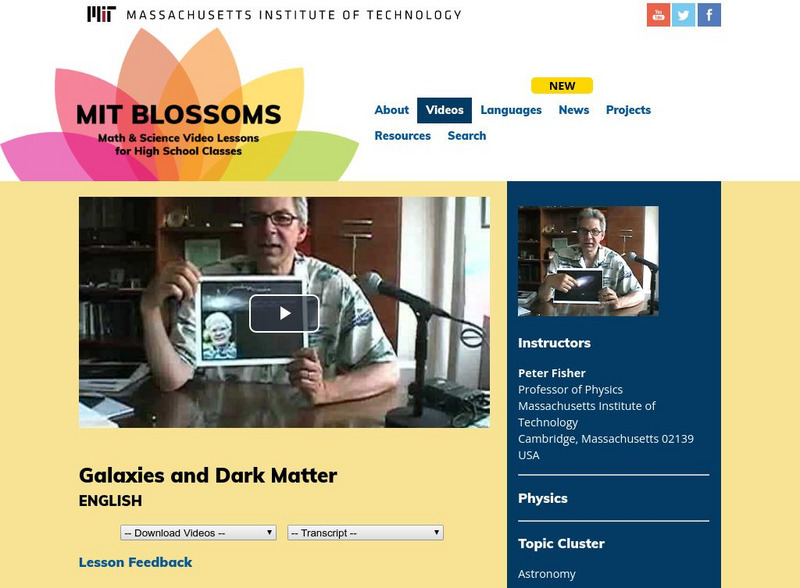
Massachusetts Institute of Technology
Mit: Blossoms: Galaxies and Dark Matter
This video lesson has the goal of introducing students to galaxies as large collections of gravitationally bound stars. It explores the amount of matter needed for a star to remain bound and then brings in the idea of Dark Matter, a new...

Khan Academy
Khan Academy: Crash Course Big History: The Big Bang
Crash Course is a fast, funny, irreverent look at history beginning with the Big Bang Theory. In this episode, brothers John and Hank Green gives us their take on what makes Big History so darn important. [13:55]

NASA
Science at Nasa: Science Casts: Big Mystery in the Perseus Cluster
A mysterious X-ray signal from the Perseus cluster of galaxies, which researchers say cannot be explained by known physics, could be a key clue to the nature of Dark Matter. (July 21, 2014) [3:42]
NASA
Science at Nasa: Science Casts: 600 Mysteries in the Night Sky
The Fermi Gamma-ray Space Telescope recently produced a map of the night sky. Out of 1873 new sources, nearly 600 were complete mysteries. In this week's ScienceCast, researchers speculate on the nature of the mystery objects - including...
PBS
Pbs Learning Media: Crash Course Astronomy: Dark Matter
Today on Crash Course Astronomy, Phil dives into some very dark matters. The stuff we can actually observe in the universe isn't all there is. Galaxies and other large structures in the universe are created and shifted by a force we...

Crash Course
Crash Course Astronomy #41: Dark Matter
Find out that the matter we can actually observe in the universe isn't all there is. Galaxies and other large structures in the universe are created and shifted by a force we detect mostly indirectly, by observing its impact, dark...
Science Friday Initiative
Science Friday: More to the Universe Than Meets the Eye
Much of what exists in the universe is believed to be invisible, and that there may be other dimensions. A scientist discusses research into dark matter and what we know so far. Aired June 22, 2009 [12:07 min]

Khan Academy
Khan Academy: Ways of Knowing Introduction to Cosmology
The history of the Universe decorates the night sky. Learn how to watch this history by studying cosmic light emissions. [6:22]

Science Friday Initiative
Science Friday: Dark Energy Confirmed
This week scientists announced that they have confirmation on the presence of dark energy in the universe. We'll talk about their study and what it means.

Science Friday Initiative
Science Friday: Dark Matter Just Got More Mysterious
A smashup between two galaxy clusters left an unexpected amount of dark matter in its wake.