Hi, what do you want to do?






MinuteEarth
The Species That Broke Evolution?
The ancestors of gars, horseshoe crabs and coelacanths looked almost the same as their modern relatives. Darwin called species like these “living fossils'' because they seem like they are evolutionarily frozen in time. But Darwin was wrong.
PBS
How the Starfish Got Its Arms
The story of how the starfish got its arms reminds us that even animals that might be familiar to us today can have incredibly deep histories - ones that stretch back almost half a billion years.
SciShow
Why Humans May Actually Be Fish
Is there a chance that more species may actually be closer to fish than we originally thought?
SciShow
This Is What Peak Crustacean Looks Like
We may think of a lot of critters with crab-like body plans as crabs, but, technically, many of them are other types of crustaceans. So why do they share so many physical traits?
SciShow
5 of the Strangest Prehistoric Crocs
Over the years, scientists have found evidence for a lot of weird prehistoric animals, but some of the strangest have been the crocodyliformes!
Cha
pters
MOURASUCHUS: THE W
HALE CRO
CS
1:26
...
Cha
pters
MOURASUCHUS: THE W
HALE CRO
CS
1:26
...
Curated Video
A Few Of My Friends -Unscripted
Jessi picks a few animals to share and does an impromptu talk about their personalities and how they communicate. <br/>
--
--
Nature League
Exploring Communication | Compilation
Brit looks back on our eighth month on Nature League, when we explored the theme of communication. Get your Critically Endangered Sharks poster here! Only on sale through May 30th.
Nature League
Exploring Biodiversity | Compilation
Brit looks back on our second month on Nature League, when we explored the theme of biodiversity.
Nature League
Exploring Invertebrates | Compilation
Brit looks back on our third month on Nature League, when we explored the theme of invertebrates.
Nature League
Can We Talk to Sharks? - From A to B
In this episode of "From A to B", Adrian asks Brit if understanding shark communication could make sharks less scary.
Nature League
Biodiversity and Complex Life Forms - From A to B
In this episode of "From A to B", Adrian asks Brit about the relationships between intelligence, evolution, biodiversity, and tool use.
Crash Course
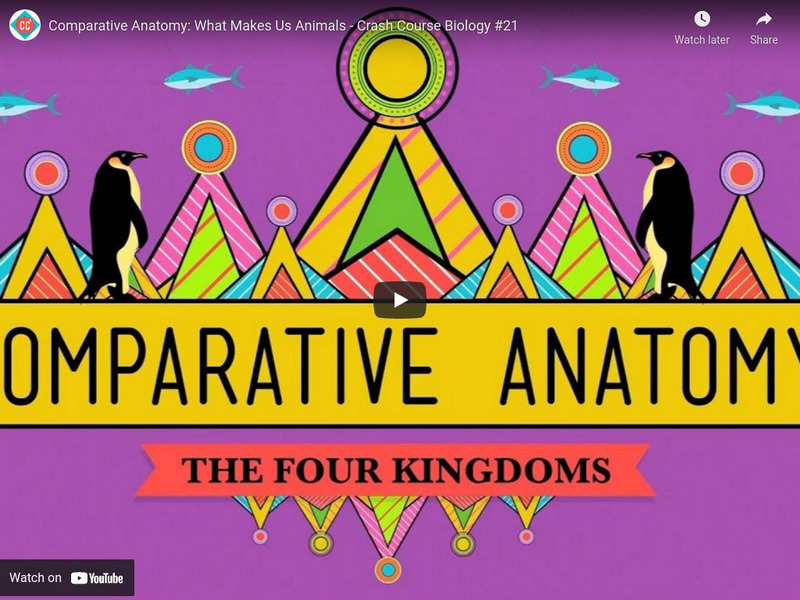
Crash Course Biology #21: Comparative Anatomy: What Makes Us Animals
Hank introduces us to comparative anatomy, which studies the similarities and differences in animal anatomy to support the theory of evolution and the shared ancestry of living things. [8:51]

Sophia Learning
Sophia: Animals: Vertebrates
A screencast tutorial which describes the major characteristics of animals with backbones called vertebrates. [1:38]
Sea Studios Foundation
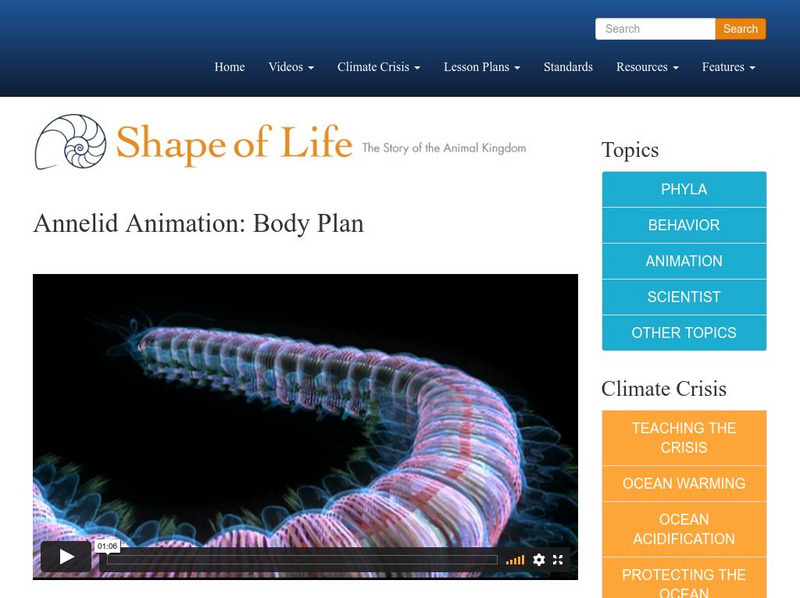
Shape of Life: Annelid Animation: Body Plan
Investigate an annelids' body plan in this video. Annelids have segmented bodies with powerful muscles, a one-way gut that runs through the body, a circulatory system and nervous system. [1:06]

Sea Studios Foundation
Shape of Life: Marine Arthropod Animation: Body Plan
Animation of the lobster's jointed leg that shows how muscles and tendons work to move the joint. A separate animation shows how the jointed appendages and body segments can easily evolve into new forms. [1:41]
Sea Studios Foundation
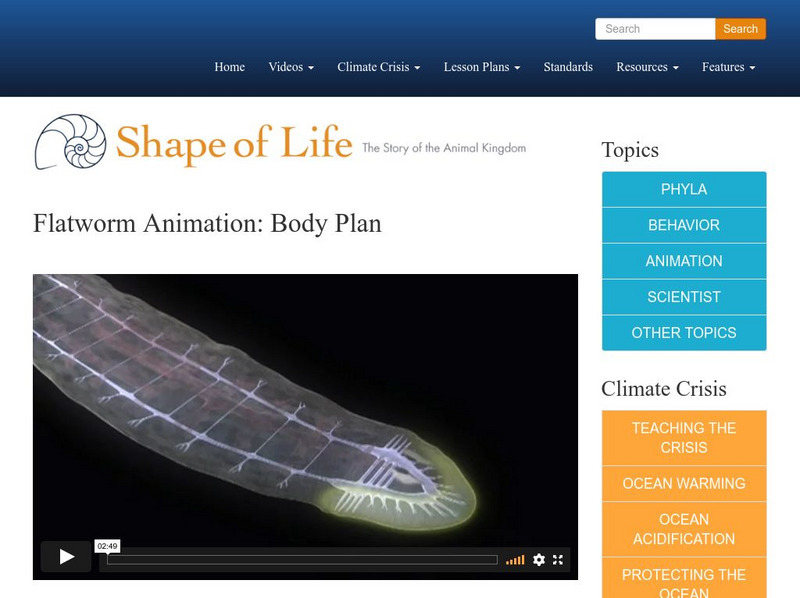
Shape of Life: Flatworm Animation: Body Plan
The flatworm's bilateral body plan has a head with a brain and stereo eyes that enable it to actively hunt. Its mouth and pharynx are in the center of its underside. With no circulatory system, the gut distributes food to all parts of...