Hi, what do you want to do?

Curated Video
Alkali metal
A highly reactive group of metals that make up group one in the periodic table.
<
br/>
A Twig Science
Glossary Film.
Key scientific terms defined in just 60 seconds using stunning images and concise textual...
<
br/>
A Twig Science
Glossary Film.
Key scientific terms defined in just 60 seconds using stunning images and concise textual...
Curated Video
GCSE Chemistry - Group 1 Alkali Metals #11
What are alkali metals? Why are they so reactive? What are the trends as you go down the group? How do they react with water, oxygen and chlorine? Learn all this and more!
Curated Video
Alkali Metals Song Periodic Table
Learn about the Periodic Table of elements and the group alkali metals with Alkali Metals Song Periodic Table by KLT
msvgo
Position of Hydrogen in the Periodic Table
This nugget justifies the position of Hydrogen in the modern periodic table and discusses the occurrence of isotopes of Hydrogen.
TMW Media
Periodic Table of Elements Part 3: The Creation of the periodic table
How did scientists make sense of the characteristics of elements? What is the periodic table? How are elements classified? What are the major categories of elements? What are exceptions regarding the periodic table?
Periodic Table...
Periodic Table...
Getty Images
Cutting sodium metal with a scalpel.
The shiny exposed metal surface reacts rapidly with oxygen and water in the air, forming a duller layer of sodium oxide and hydroxide. Then the sodium metal is dropped into water. The reaction produces hydrogen gas and sodium hydroxide....
Getty Images
Sodium metal reacting with water.
The reaction produces hydrogen gas and sodium hydroxide. The heat of the reaction melts the sodium, which forms a sphere. The indicator phenolphthalein has been added to the water, which turns pink due to the presence of the strongly...
Getty Images
Sodium metal reacting with water.
The reaction produces hydrogen gas and sodium hydroxide. The heat of the reaction melts the sodium, which forms a sphere. The indicator phenolphthalein has been added to the water, which turns pink due to the presence of the strongly...
Getty Images
Cutting potassium metal with a scalpel. The shiny exposed metal surface reacts rapidly with oxygen and water in the air, forming a duller layer of potassium oxide and hydroxide
Getty Images
Cutting potassium metal with a scalpel. The shiny exposed metal surface reacts rapidly with oxygen and water in the air, forming a duller layer of potassium oxide and hydroxide
Getty Images
Potassium metal reacting with water.
The reaction produces hydrogen gas and potassium hydroxide. The heat of the reaction ignites the hydrogen gas produced, which burns with a lilac flame. The indicator phenolphthalein has been added to the water, which turns pink due to...
Getty Images
Potassium metal reacting with water.
The reaction produces hydrogen gas and potassium hydroxide. The heat of the reaction ignites the hydrogen gas produced, which burns with a lilac flame. The indicator phenolphthalein has been added to the water, which turns pink due to...
Getty Images
Potassium metal reacting with water.
The reaction produces hydrogen gas and potassium hydroxide. The heat of the reaction ignites the hydrogen gas produced, which burns with a lilac flame. The indicator phenolphthalein has been added to the water, which turns pink due to...
Getty Images
Potassium metal reacting with water.
The reaction produces hydrogen gas and potassium hydroxide. The heat of the reaction ignites the hydrogen gas produced, which burns with a lilac flame. The indicator phenolphthalein has been added to the water, which turns pink due to...
Getty Images
Potassium metal reacting with water.
The reaction produces hydrogen gas and potassium hydroxide. The heat of the reaction ignites the hydrogen gas produced, which burns with a lilac flame. The indicator phenolphthalein has been added to the water, which turns pink due to...
University of Nottingham
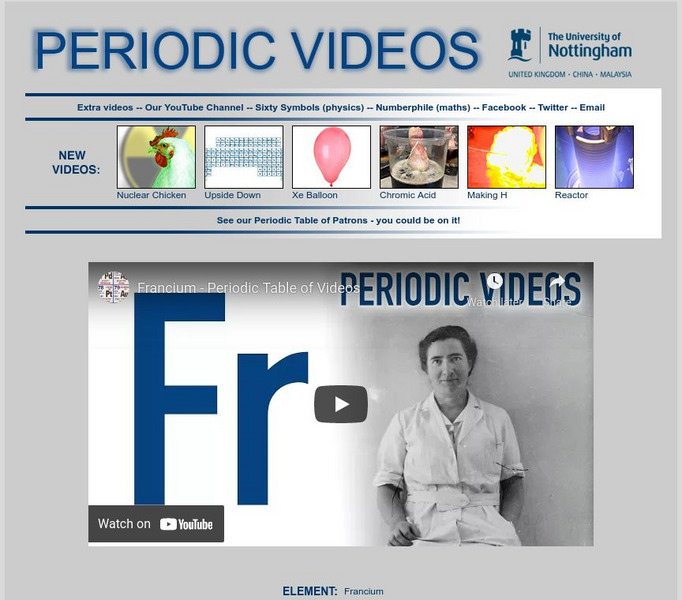
University of Nottingham: Periodic Table of Videos: Francium
The properties of francium are discussed in relation to other alkali metals. [12:59]




