Hi, what do you want to do?





Have Fun With History
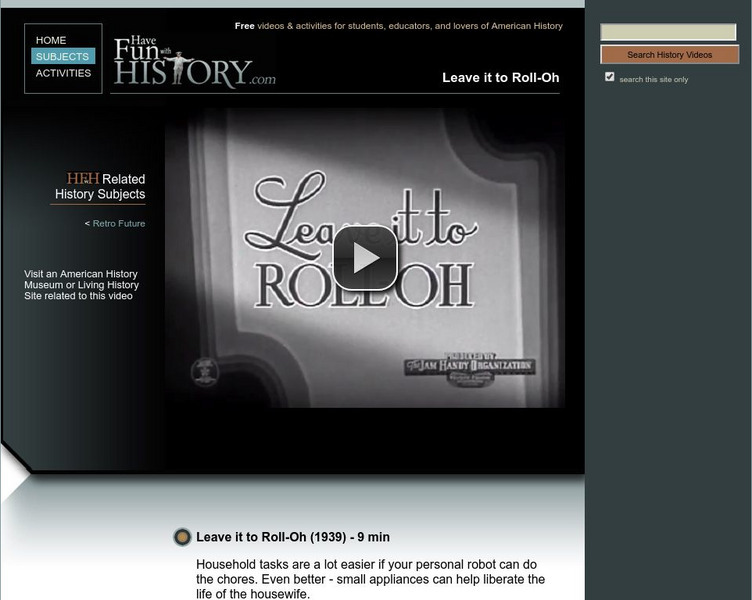
Have Fun With History: Leave It to Roll Oh: Household Robot
Household tasks are a lot easier if your personal robot can do the chores. Even better - small appliances can help liberate the life of the housewife- circa 1939. [3:00]

PBS
Pbs Learning Media: Civil Rights: Internet Activism and Social Change
Examine social media's influence in America's Civil Rights movement and its role in democratizing the media, in this video from Eyes on the Prize: Then and Now. Activists, including DeRay McKesson, use social media to support the work of...
Science Friday Initiative
Science Friday: Online Office Applications
Hear about a new suite of office programs -- running in your web browser.
PBS
Pbs Learning Media: Crash Course Computer Science: Programming Basics: Statements & Functions
Today, Carrie Anne is going to start our overview of the fundamental building blocks of programming languages. We'll start by creating small programs for our very own video game to show how statements and functions work. We aren't going...
PBS
Pbs Learning Media: Crash Course Computer Science: Machine Learning & Artificial Intelligence
From spam filters and self-driving cars, to cutting edge medical diagnosis and real-time language translation, there has been an increasing need for our computers to learn from data and apply that knowledge to make predictions and...
PBS
Pbs Learning Media: Crash Course Computer Science: Representing Numbers and Letters With Binary
Today, we're going to take a look at how computers use a stream of 1s and 0s to represent all of our data - from our text messages and photos to music and webpages. We're going to focus on how these binary values are used to represent...
PBS
Pbs Learning Media: Crash Course Computer Science: The Cold War and Consumerism
Today we're going to step back from hardware and software, and take a closer look at how the backdrop of the cold war and space race and the rise of consumerism and globalization brought us from huge, expensive codebreaking machines in...
PBS
Pbs Learning Media: Crash Course Computer Science: The Personal Computer Revolution
Today we're going to talk about the birth of personal computing. Up until the early 1970s components were just too expensive, or underpowered, for making a useful computer for an individual, but this would begin to change with the...
PBS
Pbs Learning Media: Crash Course Computer Science: Files & File Systems
Today we're going to look at how our computers read and interpret computer files. We'll talk about how some popular file formats like txt, wave, and bitmap are encoded and decoded giving us pretty pictures and lifelike recordings from...
PBS
Pbs Learning Media: Crash Course Computer Science: Advanced Cpu Designs
So now that we've built and programmed our very own CPU, we're going to take a step back and look at how CPU speeds have rapidly increased from just a few cycles per second to gigahertz! Some of that improvement, of course, has come from...
PBS
Pbs Learning Media: Crash Course Computer Science: Screens & 2 D Graphics
Today, we begin our discussion of computer graphics. So, we ended last episode with the proliferation of command line (or text) interfaces, which sometimes used screens, but typically electronic typewriters or teletypes onto paper. But...
PBS
Pbs Learning Media: Crash Course Computer Science: Educational Technology
Today we're going to go a little meta and talk about how computer science can support learning with educational technology. We here at Crash Course are big fans of interactive in-class learning and hands-on experiences, but we also...
PBS
Pbs Learning Media: Crash Course Computer Science: Psychology of Computing
So today, we're going to discuss some psychological considerations in building computers, like how to make them easier for humans to use, the uncanny valley problem when humanoid robots gets more and more humanlike, and strategies to...
PBS
Pbs Learning Media: Crash Course Computer Science: Software Engineering
Today, we're going to talk about how HUGE programs with millions of lines of code like Microsoft Office are built. Programs like these are way too complicated for a single person, but instead require teams of programmers using the tools...
PBS
Pbs Learning Media: Crash Course Computer Science: Computer Networks
We're going to begin with computer networks, and how they grew from small groups of connected computers on LAN networks to eventually larger worldwide networks like the ARPANET and even the Internet we know today. [11:57]
PBS
Pbs Learning Media: Crash Course Computer Science: Operating Systems
So, as you may have noticed from last episode, computers keep getting faster and faster, and by the start of the 1950s they had gotten so fast that it often took longer to manually load programs via punch cards than to actually run them!...
PBS
Pbs Learning Media: Crash Course Computer Science: Early Programming
Since Joseph Marie Jacquard's textile loom in 1801, there has been a demonstrated need to give our machines instructions. In the last few episodes, our instructions were already in our computer's memory, but we need to talk about how...
PBS
Pbs Learning Media: Crash Course Computer Science: The World Wide Web
The World Wide Web is built on the foundation of simply linking pages to other pages with hyperlinks, but it is this massive interconnectedness that makes it so powerful. But before the web could become a thing, Tim Berners-Lee would...
PBS
Pbs Learning Media: Crash Course Computer Science: Electronic Computing
We ended last episode at the start of the 20th century with special purpose computing devices such as Herman Hollerith's tabulating machines. But the scale of human civilization continued to grow, as did the demand for more sophisticated...
PBS
Pbs Learning Media: Crash Course Computer Science: Robots
Robots are often thought of as a technology of the future, but they're already here by the millions in the workplace, our homes, and pretty soon on the roads. We'll discuss the origins of robotics to its proliferation, and even look at...
PBS
Pbs Learning Media: Crash Course Computer Science: Compression
So last episode we talked about some basic file formats, but what we didn't talk about is compression. Often files are way too large to be easily stored on hard drives or transferred over the Internet - the solution, unsurprisingly, is...
PBS
Pbs Learning Media: Crash Course Computer Science: Cybersecurity
Cybersecurity is a set of techniques to protect the secrecy, integrity, and availability of computer systems and data against threats. In today's episode, we're going to unpack these three goals and talk through some strategies we use...
PBS
Pbs Learning Media: Crash Course Computer Science: Computer Vision
Today, we're going to talk about how computers see. We've long known that our digital cameras and smartphones can take incredibly detailed images, but taking pictures is not quite the same thing. For the past half-century, computer...
PBS
Pbs Learning Media: Crash Course Computer Science: Early Computing
Hello, world! Welcome to Crash Course Computer Science! So today, we're going to take a look at computing's origins, because even though our digital computers are relatively new, the need for computation is not. [11:35]