Hi, what do you want to do?





Annenberg Foundation
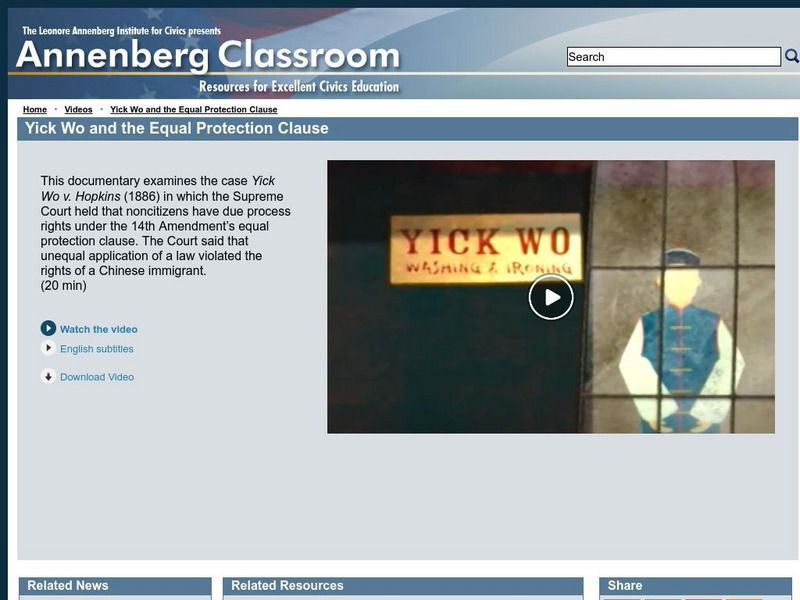
Annenberg Classroom: Yick Wo and the Equal Protection Clause
A documentary that looks at the Supreme Court decision in the case Yick Wo v. Hopkins from 1886. The decision upheld the right of a noncitizen Chinese immigrant to equal protection under the 14th Amendment. [20:00]

Center For Civic Education
60 Second Civics: Equal Protection: Controversy
Controversy always arises when groups that have been discriminated against in the past are favored in efforts to provide them equal protection and opportunities.
Center For Civic Education
60 Second Civics: The Elements of Democracy Part 93: The Law Applies to Everyone
The law applies to everyone: this is the essence of the concept of the "rule of law."
Center For Civic Education
60 Second Civics: Equal Protection of the Laws
An early Supreme Court decision in the case of Strauder v. West Virginia (1880) concluded that West Virginia violated the equal protection of the law rights in the Fourteenth Amendment.
Center For Civic Education
60 Second Civics: Equal Protection: Strict Scrutiny
Laws that can potentially violate a person's equal protection under the laws are the subject of strict judicial scrutiny by the courts.
Center For Civic Education
60 Second Civics: Equal Protection: Intermediate Scrutiny
Intermediate judicial scrutiny of laws is applied where laws create categories of people, to ensure that everyone receives equal protection under the law. The case of Craig v. Boren (1976) is discussed as an example.
Center For Civic Education
60 Second Civics: Equal Protection: Rational Basis
If a person or group decides to challenge an existing law, the onus is on them to prove that the law is not rational.
Center For Civic Education
60 Second Civics: Rational Basis: Stanton v. Stanton
In the Stanton v. Stanton (1975) case, the Supreme Court ruled that there was no rational basis in that situation to discriminate based on age.
Center For Civic Education
60 Second Civics: Equal Protection and the States
The due process clause in the Fifth Amendment can be invoked if the parties feel they have not been given equal protection under the laws, and want to mount a court challenge against the national government.