Hi, what do you want to do?






Khan Academy
Khan Academy: Sunni and Shia Islam Part 1
The video lesson from Khan Academy is intended for students who are taking a high school or college level world history course. This section provides an introduction to the Sunni and Shia schism that formed in Islam after the death of...

Khan Academy
Khan Academy: Comparing Roman and Byzantine Empires
The video lesson from Khan Academy is intended for students who are taking a high school or college level world history course. This section provides similarities and differences between the Roman Empire and the "Byzantine Empire" (which...

Khan Academy
Khan Academy: Justinian and the Byzantine Empire
The video lesson from Khan Academy is intended for students who are taking a high school or college level world history course. This section provides an overview of the Byzantine Empire under its greatest strength under Justinian I; the...

PBS
Pbs Learning Media: Empowerment
This video from Women, War & Peace demonstrates the power of women and suggests that in today's world, especially with the evolution of communication, the presence of women at peace talks is necessary and inevitable. [7:44]

BBC
Bbc Podcasts: Episode 1: Mummy of Hornedjitef 18 Jan 2010
This ornate Egyptian coffin holds secrets to the understanding of their priests' religion, Egyptian society and its connections to the rest of the world. At the age of eight, Neil MacGregor visited the British Museum for the first time...
BBC
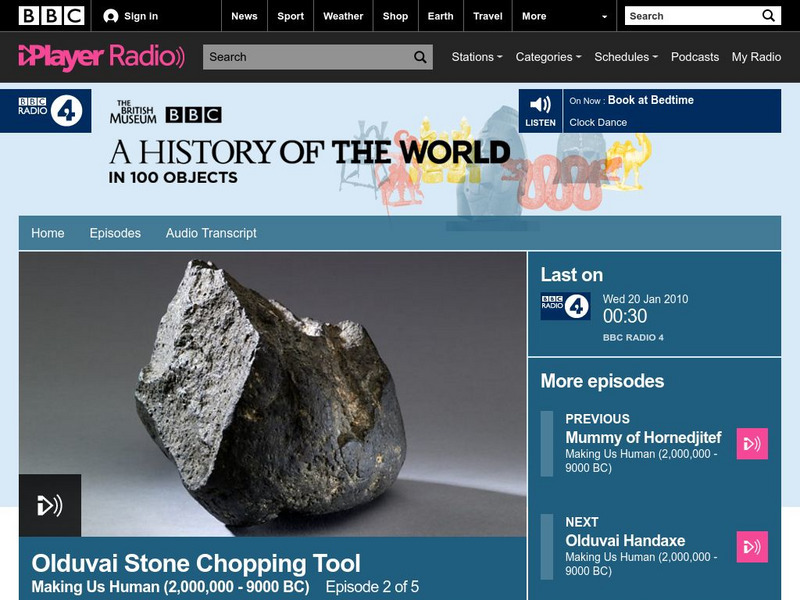
Bbc Podcasts: Episode 2: Olduvai Stone Chopping Tool 19 Jan 2010
A simple chipped stone from the Rift Valley in Tanzania marks the emergence of modern humans. Faced with the needs to cut meat from carcasses, early humans in Africa discovered how to shape stones into cutting tools. From that one...
BBC
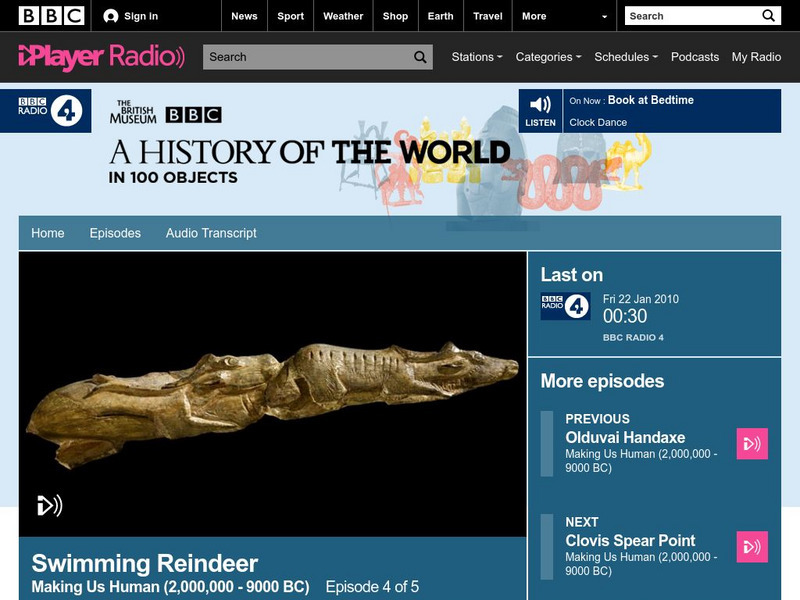
Bbc Podcasts: Episode 4: Swimming Reindeer 21 Jan 2010
Found in France and dating back 13,000 years, this is a carving of two swimming reindeer. The creator of this carving was one of the first humans to express their world through art. But why did they do it? Neil MacGregor, Director of the...
BBC
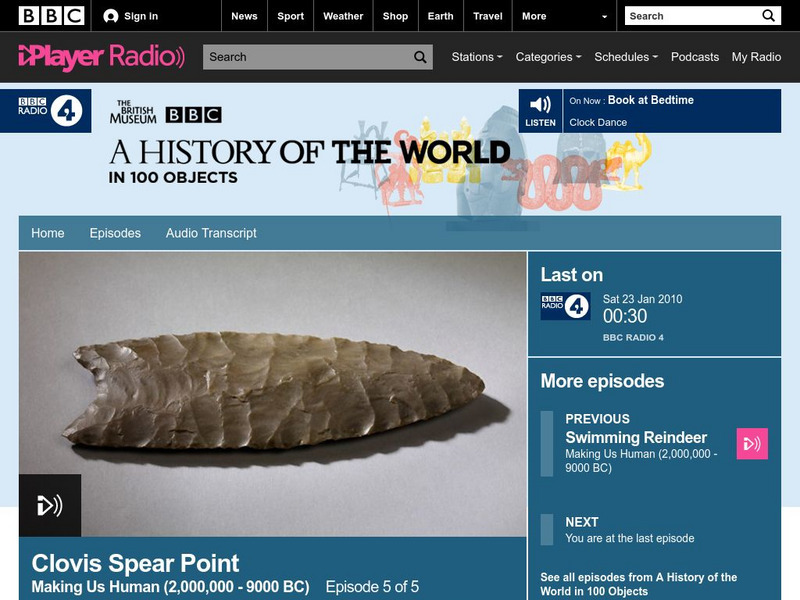
Bbc Podcasts: Episode 5: Clovis Spear Point 22 Jan 2010
This sharp spearhead helps us understand how humans spread across the globe. By 11,000 BC humans had moved from north-east Asia into the uninhabited wilderness of north America. Within 2,000 years they had populated the whole continent....

BBC
Bbc Podcasts: Episode 6: Bird Shaped Pestle 25 Jan 10
At the end of the Ice Age, one of the most important parts of human existence was finding enough food to survive. Taking a pestle from Papua New Guinea as an example, Neil MacGregor, Director of the British Museum, asks why our ancestors...
BBC
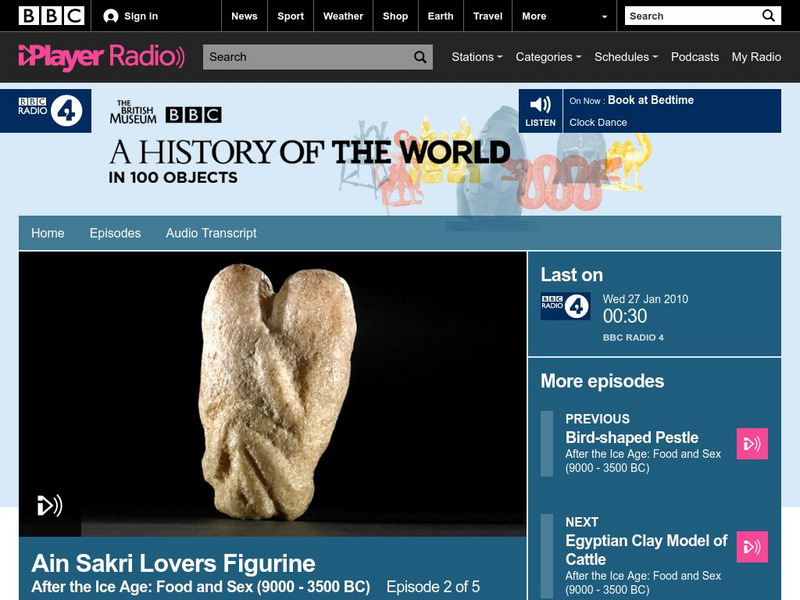
Bbc Podcasts: Episode 7: Ain Sakhri Lovers Figurine 26 Jan 10
A palm-sized stone sculpture made in Northern Israel 12,000 years ago clearly shows a couple entwined in the act of love. Sculptor Marc Quinn responds to the stone as art, and archaeologist Dr Ian Hodder considers the Natufian society...

BBC
Bbc Podcasts: Episode 8: Egyptian Clay Model of Cattle 27 Jan 10
Four frail-looking cows were made from Nile mud in Egypt 5,500 years ago, long before the time of the pyramids or the pharaohs. They show the major changes that early man was undergoing at the end of the Ice Age. Why did the Egyptians...
BBC
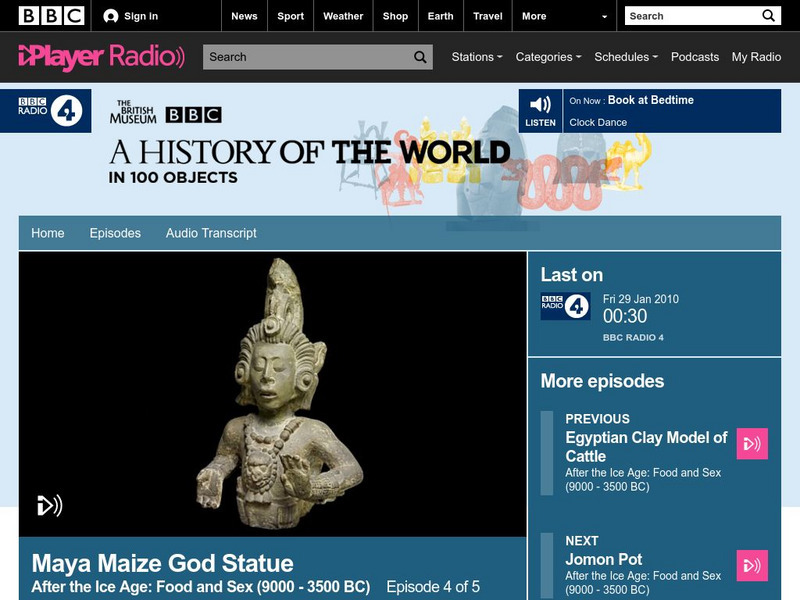
Bbc Podcasts: Episode 9: Maya Maize God Statue 28 Jan 10
This stone Maize God was discovered on the site of a major Mayan city in present-day Honduras and is wearing a headdress in the shape of a giant corn cob. Maize was not only worshipped at that time but the Maya also believed that their...
BBC
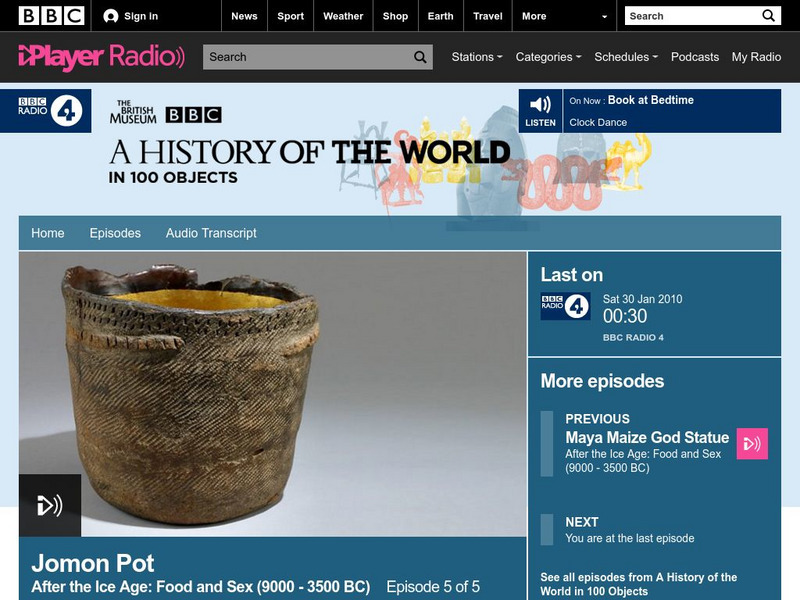
Bbc Podcasts: Episode 10: Jomon Pot 29 Jan 10
A 7,000-year-old Japanese clay pot has managed to remain almost perfectly intact. Pots began in Japan around 17,000 years ago and by the time this pot was made had achieved a remarkable sophistication. This simple clay object makes a...
BBC
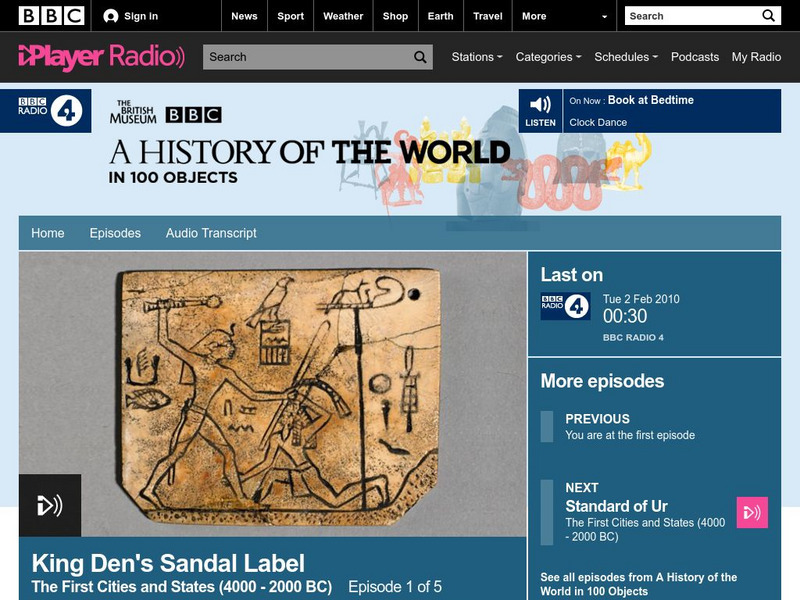
Bbc Podcasts: Episode 11: King Den's Sandal Label 1 Feb 2010
A small label, made from hippopotamus ivory and attached to the sandals of one of the earliest known kings of Egypt. Neil MacGregor, Director of the British Museum, looks at what this label, with its hieroglyphs describing the king and...

BBC
Bbc Podcasts: Episode 12: Standard of Ur 2 Feb 2010
A set of mosaic scenes, mounted on a single box, show powerful images of battle and regal life. The Standard of Ur was found nearly 100 years ago at a royal burial site in the city of Ur, in southern Iraq, and remains remarkably well...

BBC
Bbc Podcasts: Episode 13: Indus Seal 3 Feb 2010
The ancient city of Harappa lies around 150 miles north of Lahore, in Pakistan. It was once one of the great centres of a civilisation with vast trade connections, which built over 100 cities, some with sophisticated sanitation systems,...

BBC
Bbc Podcasts: Episode 14: Jade Axe 4 Feb 2010
A 6,000-year-old, polished, stone axe found in Canterbury but made in the Alps. Between 5,000 and 2,000BC Mesopotamia built the royal city of Ur, the Indus valley boasted the city of Harappa, and the great early civilisation of Egypt...

BBC
Bbc Podcasts: Episode 15: Early Writing Tablet 5 Feb 2010
A small clay tablet made in Mesopotamia about 5,000 years ago. It is covered with sums but also some of the world's earliest writing - about beer rationing. Neil MacGregor, Director of the British Museum, looks at how humans invented...

BBC
Bbc Podcasts: Episode 16: Flood Tablet 8 Feb 2010
A small tablet, found in modern Iraq, tells of a plan by the gods to destroy the world by means of a great flood. Pre-dating the story of Noah, when it was translated in 1872, this fragment of the Epic of Gilgamesh caused a storm around...

BBC
Bbc Podcasts: Episode 17: Rhind Mathematical Papyrus 9 Feb 2010
An ancient Egyptian papyrus from around 1550 BC, used to train scribes. It contains 84 different calculations to help with various aspects of Egyptian life, from pyramid building to working out how much grain it takes to fatten a goose....

BBC
Bbc Podcasts: Episode 18: Minoan Bull Leaper 10 Feb 2010
A small, bronze sculpture of a man leaping over a bull from the island of Crete is the starting point for an exploration of the Minoans, their rich bronze making tradition and the role of the bull in myth and legend. Neil MacGregor,...

BBC
Bbc Podcasts: Episode 19: Mold Gold Cape 11 Feb 2010
A gold cape made almost 4,000 years ago and discovered in 1833, by a group of workmen looking for stones in a field near the village of Mold in North Wales. This sheet of pure gold, found wrapped around a skeleton, inspires Neil...

BBC
Bbc Podcasts: Episode 20: Statue of Ramesses Ii 12 Feb 2010
Colossal statue of Ramesses II, one of ancient Egypt's most famous and successful pharaohs. Neil MacGregor, Director of the British Museum, considers the achievements of Ramesses II, a ruler who built monuments all over Egypt, inspired a...

BBC
Bbc Podcasts: Episode 21: Lachish Reliefs 15 Feb 2010
Stone carvings from the palace of King Sennacherib of Assyria, showing his army attacking the town of Lachish, near Jerusalem. The Assyrian war machine was to create the largest empire that the world had ever seen and used the terror...