Hi, what do you want to do?






Bozeman Science
Work and Energy
In this video Paul Andersen explains how the mechanical energy added or removed from a system results from work. For work to occur a force must act parallel to the displacement of the system. Since work and energy are equivalent the...
Curated Video
Law of Conservation of Mechanical Energy & Derivation of the Law of Conservation of Energy
Discover how mechanical energy—kinetic plus potential—remains conserved in systems under conservative forces. With real-world examples like roller coasters, this lesson simplifies a core law of classical mechanics.
Curated Video
Gravitational Potential Energy & Elastic Potential Energy
Learn how to derive gravitational and elastic potential energy using the work-energy principle. Understand how conservative forces store and transform energy in physics systems like springs and gravity
Curated Video
Physics Problem: Work-Energy Theorem for a Bullet Entering a Block
This video solves a classic physics problem using the Work-Energy Theorem, demonstrating how to calculate the force exerted on a bullet as it penetrates a block and the additional distance it travels before stopping.
Curated Video
Force and Work Done on a Box: Work-Energy Theorem Application
Learn how to calculate force, work done, kinetic energy, and speed of a box being lowered. This video applies the Work-Energy Theorem to a real-world physics problem, ideal for understanding energy transformations.
Curated Video
Work Done by Forces and Change in Kinetic Energy: Physics Problem Solved
This video demonstrates how to calculate the net work done on an object by multiple forces and explains its relationship to the change in kinetic energy. It walks through a solved physics problem, ideal for understanding work-energy...
Curated Video
Energy Conservation Principle: Mass on a Table with a Spring and Pulley
This video illustrates the energy conservation principle by solving a physics problem involving a mass connected to a spring on a table, which then pulls a hanging mass via a pulley. It demonstrates how to calculate the speed of the mass...
Curated Video
Forces and Newton's Laws: Solved Problem on Force, Distance, and Work
This video provides a step-by-step solution to a physics problem, demonstrating the application of Newton's Laws of Motion and kinematic equations to calculate force, distance, and work done for an object under constant deceleration
Professor Dave Explains
Work and Energy
What's work? Not that place you go to earn money. In physics it means something else. And what's energy? Not like in the groovy sense. Actually, energy is one of the most improperly used words in the English language. Let physics define...
ProEdify
Understanding Work, Power, and Energy
This video provides a clear and concise explanation of the scientific definitions of work, power, and energy, and how these concepts are interconnected. It covers the formulas for calculating work and power, as well as the relationship...
Professor Dave Explains
Kinetic Energy and Potential Energy
You can put energy into an object. Wanna know how? No, you don't need a Harry Potter wand. Just lift it up above your head! By doing so, you bestow the object with more potential energy. Learn more about the energy of motion and the...

Yale University
Open Yale Courses: Physics 200: Work Energy Theorem and Conservation of Energy
The lecture addresses kinetic and potential energy. The work-energy theorem is defined and the Law of Conservation of Energy is explained using several examples.
Sophia Learning
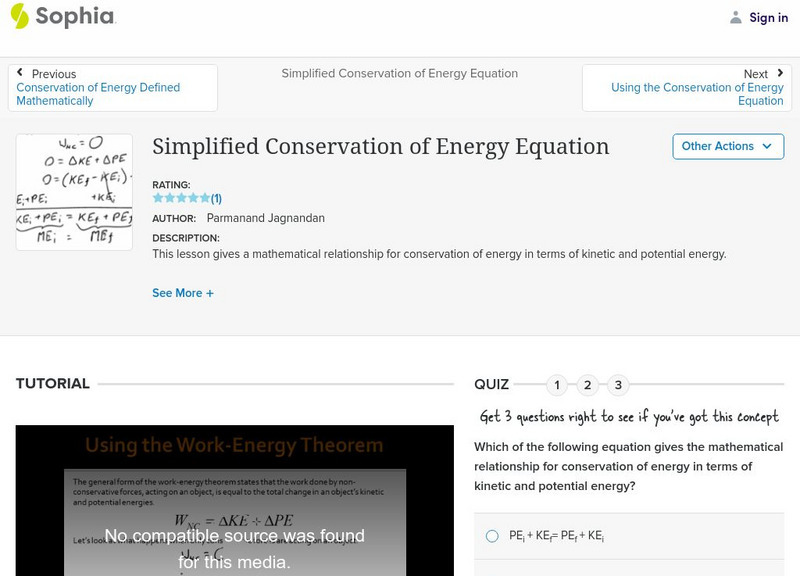
Sophia: Simplified Conservation of Energy Equation
This lesson gives a mathematical relationship for conservation of energy in terms of kinetic and potential energy.