Hi, what do you want to do?






Primer
Mutations and the First Replicators
See new kinds of creatures show up in a simulation. Talks about RNA world hypothesis at the end.
Higgsino Physics
Tides Explained with Simulations
Simulating why there are 2 tidal bulges. The differential gravity causes what seems to be to bulges of water on both sides of the earth. Why? A better explanation is to see these bulges as vector forces. I'm also explaining why there...
Physics Girl
Calculating Pi with Darts
Pi can be calculated using a random sample of darts thrown at a square and circle target. The problem with this method lies in attempting to throw "randomly." We explored different ways to overcome our errors. A million thanks to Derek...
Curated Video
Exploring the World of 3D Graphics
Learn about the origins of three dimensional images and some techniques animators use to bring 2D images to life, from the first 3D graphics produced in the 1960s to their use in animation and film. Understand the process of creating 3D...
Let's Tute
Build an Atom | Science Simulator | How tiny atom is? | Simulator Explained | PhET | letstute|
We know everything is made up of atoms, but have you ever wondered how an atom is made? If you want to know how to click on the link below where we explain HOW TO BUILD AN ATOM with the help of a simulator.
Curated Video
Designing Simulations Using Random Number Generators
In this video, the teacher explains how to conduct a simulation to model the results of shots on goal in a soccer game. The simulation uses a random number generator and assigns certain numbers or outcomes to represent saving or missing...
Curated Video
Understanding the Law of Large Numbers through Coin Flips
In this video, the concept of the law of large numbers is explained, which states that as the sample size increases, the experimental probability will approach the theoretical probability. The video uses the example of flipping a coin to...
Primer
Simulating Supply and Demand
Build a simulated market from scratch and see supply and demand curves emerge.
AllTime 10s
10 Theories About The Afterlife
What happens after you die? We've all wondered what happens to us when we eventually pass on 'to the other side', but what exactly is there to pass on to? Here are our 10 Theories About The Afterlife'
Curated Video
Analyzing the Likelihood of a Hypothesis through Sampling Distribution
In this video, the teacher explains how to determine the likelihood that a hypothesis is reasonable by approximating a sampling distribution and analyzing the results. The example used is whether a majority of students in a state are in...
Curated Video
Using Simulation to Test the Fairness of a Coin
In this video, the teacher explains how to determine if a model is consistent with the results by performing a simulation with random numbers. The example used is flipping a coin to determine who washes the dishes, and the teacher...
Virtual Nerd
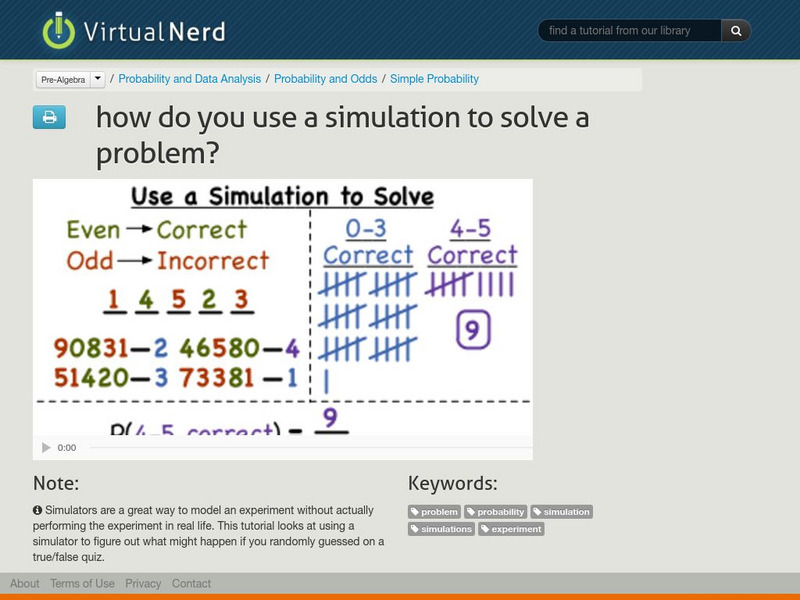
Virtual Nerd: How Do You Use a Simulation to Solve a Problem?
Simulators are a great way to model an experiment without actually performing the experiment in real life. This tutorial looks at using a simulator to figure out what might happen if you randomly guessed on a true/false quiz. [7:13]
Learnbat
Show Me: Simulations With Random Number Trials
Demonstrates how to use a simulation with random number tables to find the probability that someone will win a prize in a cereal box contest. [9:46]

Khan Academy
Khan Academy: Damping
In this video [2:37] lesson explains adding a damper to our spring and shows the effect of damping in hair simulation.

Khan Academy
Khan Academy: Multiple Spring Mass System
This video [3:37] lesson focuses on adding another spring and mass to our system to simulate curly hair.

Khan Academy
Khan Academy: Support Springs
This video [1:43] lesson explores a method to develop curly looking hair using support springs.

Khan Academy
Khan Academy: Stiffness and Damping
In this video [2:01] lesson students will learn how to add spring stiffness and damping for controlling hair simulation.

Khan Academy
Khan Academy: Hair Simulation Overview
In this video [2:06] a Pixar engineer discusses how they simulated Merida's curly hair using the computer in the movie "Brave." This serves as an introduction to topic of hair simulation.

Khan Academy
Khan Academy: Spring Mass System
This video [3:06] lesson explores how we can use springs to represent hair.

Khan Academy
Khan Academy: Getting to Know Hayley Iben
This video [4:08] is an interview with Hayley Iben, computer programmer at Pixar who designed some hair simulations. Find out more about Hayley's background and the work she is doing.

Khan Academy
Khan Academy: Case Study: The Good Dinosaur
In this video [4:36] students will find out how hair simulation tools were used in the Pixar film "The Good Dinosaur."

Khan Academy
Khan Academy: Introduction to Parabolic Arcs
This video [1:14] lesson is an introduction to Parabolic Arcs. What do parabolic arcs have to do with blades of grass?

Khan Academy
Khan Academy: Midpoint Formula (Video)
In this video [2:43] lesson, students explore how midpoints are used to describe the "string art construction."

Khan Academy
Khan Academy: String Art (Video)
In this video [2:55] lesson, they talk about some of the ways that math was used to create the forest in Brave. So the question is, how are they going to represent parabolic arcs in a way that artists can deal with, but computers can...