Hi, what do you want to do?






Bozeman Science
Vector Sum of Forces
In this video Paul Andersen explains how the vector sum of forces can be used to identify the net force on an object. The net force can be used to determine the overall acceleration of the object using Newton's Second Law.
Bozeman Science
Newton's Third Law
In this video Paul Andersen explains how Newton's Third Law applies to all objects. When an object applies a force to another object (Action) and equal and opposite force (Reaction) is applied to the original object. Several scenarios...
Flipping Physics
Free-Body Diagram Tips Every AP Physics Student Needs
Drawing accurate free-body diagrams is essential for scoring points on the AP® Physics Exams. In this video, Mr. P, an actual AP® Physics Reader, shows you exactly how to draw free-body diagrams the way exam graders want to see them....
Professor Dave Explains
Practice Problem: Box Sliding Down a Ramp
Lisa, are you serious? Alright, just one more favor. This one is a little trickier than the previous, because there is some trigonometry involved, beyond the kinematics and friction from the previous problems. What will become of your...
Professor Dave Explains
Mass vs. Weight and the Normal Force
Mass is just a fancy sciency word for weight, right? Wrong! Although related, they aren't the same thing. You'd better find out exactly what the difference is so that you don't look foolish around the water cooler!
Professor Dave Explains
Newton's Third Law of Motion: Action and Reaction
Are you tired of Newton's laws of motion yet? Well, lucky you, this is the last one. And it's the most misunderstood as well! People love making inappropriate metaphors with scientific principles, unfortunately. Watch this to make sure...
Professor Dave Explains
Frictional Forces: Static and Kinetic
Newton's first law tells us that an object in motion will remain in motion, but we don't really see that on earth, do we? If you throw a ball, or push a hockey puck, these things do eventually stop. Why? To answer this we must learn...
Professor Dave Explains
Dynamics: What are Forces?
What's a force? No, not THE force. That's from Star Wars. I'm talking about the forces in the universe that make things move. Yes, I know Yoda moved the X-Wing with The Force. Will you quit it? We are talking about the real universe...

Sophia Learning
Sophia: Representing Forces in a Rope & Pulley System: Lesson 1
This lesson demonstrates how to draw a free-body diagram for a rope and pulley system. It is 1 of 2 in the series titled "Representing Forces in a Rope & Pulley System."
Sophia Learning
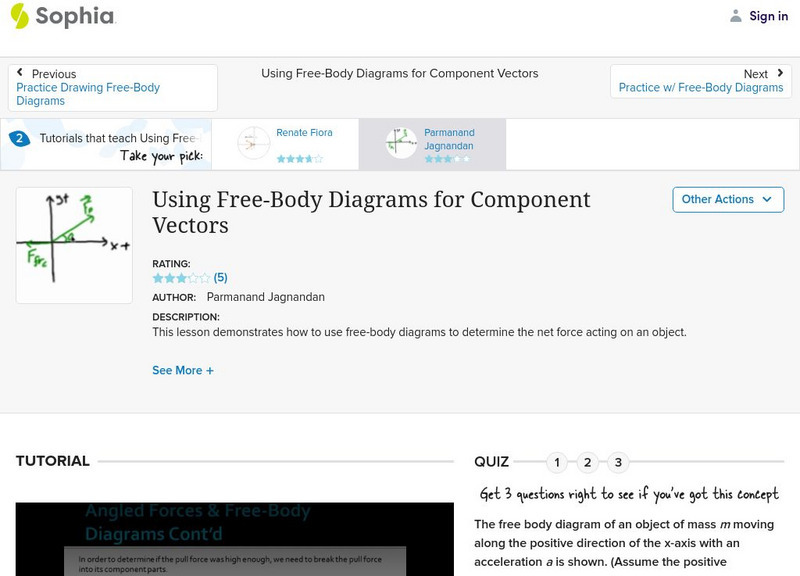
Sophia: Using Free Body Diagrams for Component Vectors
Watch this video tutorial, and learn how to use free-body diagrams to determine the net force acting on an object. [8:56]

Sophia Learning
Sophia: Free Body Diagram: Lesson 1
This lesson introduces the concept of the free-body diagram. It is 1 of 2 in the series titled "Free-Body Diagram."

Sophia Learning
Sophia: Representing Forces on a Free Body Diagram: Lesson 1
This lesson demonstrates how to represent the forces acting on an object using a free-body diagram. It is 1 of 2 in the series titled "Representing Forces on a Free-Body Diagram."
Sophia Learning
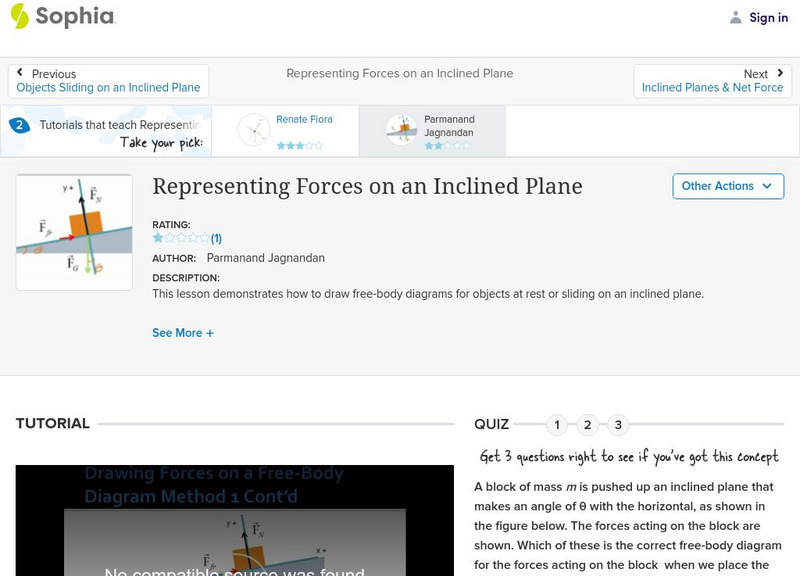
Sophia: Representing Forces on an Inclined Plane: Lesson 1
This lesson demonstrates how to draw free-body diagrams for objects at rest or sliding on an inclined plane. It is 1 of 2 in the series titled "Representing Forces on an Inclined Plane."