Hi, what do you want to do?






Bozeman Science
Wave-Particle Duality of Light
In this video Paul Andersen explains how light can be treated as both a particle and a wave. Physicists use scale to determine which model to use when studying light. When the wavelength of light is equivalent to the size of the object...
SciShow
3 Physics Experiments that Changed the World
Physics investigates why the universe behaves the way that it does, and today, Hank tells us about the three physics experiments that he thinks were the most awesome at helping us understand how the universe works.
Curated Video
Light Waves: Understanding the Wave Nature
We deal with light on a daily basis, and it has wave-like characteristics that are essential to many natural and technological processes. The wave nature of light aids in the explanation of a number of important optical phenomena,...
Curated Video
Heisenberg's Uncertainty principle : The Limits of Precision
Werner Heisenberg proposed Heisenberg's Uncertainty Principle in 1927, which states that measuring a particle's momentum and position at the same time with accuracy is not possible. One can know a property less precisely the more...
Curated Video
De Broglie vs Bohr: A Quantum Debate
Niels Bohr's model of the atom introduced the idea of quantised orbits for electrons. In these, electrons occupy stable energy levels and either give off or take in photons when they move between these levels. This model was able to...
Curated Video
De Broglie's Equation: Wave-Particle Duality
De Broglie's equation, formulated by Louis de Broglie in 1924, introduces the concept of wave-particle duality, suggesting that all matter exhibits both wave-like and particle-like properties. The equation is expressed as λ=h/p; λ is...
Catalyst University
Quantum Mechanics | The Act of Measurement
The act of measurement in quantum mechanics causes "collapse of the wavefunction". Here, I explain what is meant by measurement in the discipline of quantum mechanics.<br/>
Catalyst University
Quantum Mechanics | Basic Idea of the Heisenberg Uncertainty Principle
Here, I explain the basic idea underlying Heisenberg's Uncertainty Principle; also 1 simple example is worked.<br/>
Catalyst University
Heisenberg's Uncertainty Principle: Example #1
Heisenberg's Uncertainty Principle: Example #1
Professor Dave Explains
The Quantum Barrier Potential Part 2: Defining the Transmission and Reflection Coefficients
In the previous tutorial we introduced our second quantum problem, that of the quantum barrier potential. Again, this involves a free particle that encounters a barrier of finite potential. We've already solved the Schrödinger equation...
Professor Dave Explains
Quantization of Energy Part 2: Photons, Electrons, and Wave-Particle Duality
So Max Planck kicked things off, but how does the story of modern physics continue? With none other than your favorite scientist and mine, Albert Einstein! He did more than just stick his tongue out and have crazy hair. He elucidated the...
Professor Dave Explains
The Double-Slit Experiment
This is a classic experiment that is frequently referred to when describing quantum phenomena, so we definitely have to go over it a little bit. What happens when you pass a beam of light through a screen with two slits? What about when...
Professor Dave Explains
Wave-Particle Duality and the Photoelectric Effect
Look, up in the sky, it's a particle! It's a wave! Actually it's both. It's light! How do we know about this stuff? Well, because of Einstein for one. He did more than E = mc^2, you know. But don't stare at the sun to see for yourself,...
Catalyst University
Quantum Mechanics | The Photoelectric Effect
This is an introductory video to Albert Einstein's photoelectric effect, the discipline that made him a Nobel laureate. <br/>
-For Physical chemistry & Quantum le<br/>vel studies
-For Physical chemistry & Quantum le<br/>vel studies
Khan Academy
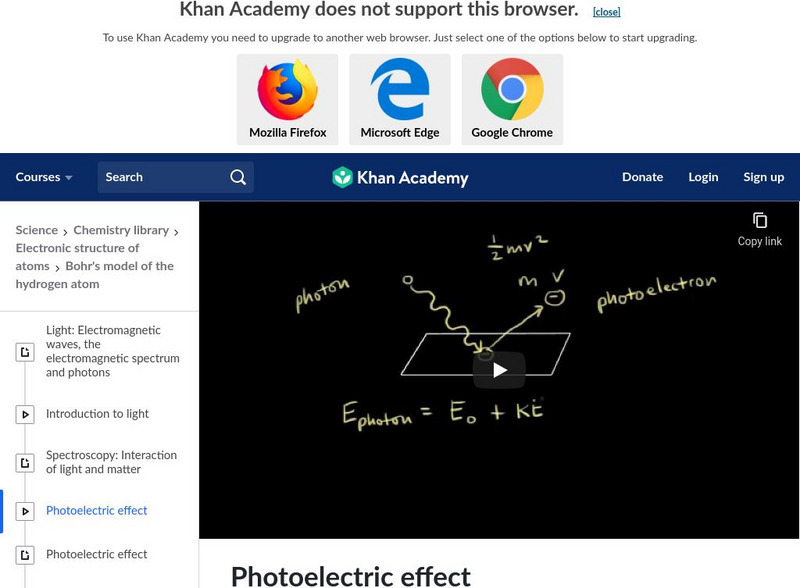
Khan Academy: Photoelectric Effect
Video tutorial explains the photoelectric effect using wave-particle duality, the work function of a metal, and how to calculate the velocity of a photoelectron. [10:23]
Crash Course
Crash Course Physics #43: Quantum Mechanics Part 1
What is light? That is something that has plagued scientists for centuries. It behaves light a wave - and a particle - what? Is it both? In this video [8:45] episode of Crash Course Physics, Shini introduces to the idea of Quantum...
Crash Course
Crash Course Physics #44: Quantum Mechanics Part 2
e=mc2. It's a big deal, right? But why? And what about this grumpy cat in a box and probability? In this video episode of Crash Course Physics, Shini attempts to explain a little more on the topic of Quantum Mechanics. [9:07]