Hi, what do you want to do?






Khan Academy
Khan Academy: Half Life of a Second Order Reaction
Recognize how to derive half-life equation of a second-order reaction starting from the integrated rate law. [7:04]

Khan Academy
Khan Academy: Second Order Reaction Example
Review this example of using integrated rate law to solve for concentration, and calculating the half-life for a second-order reaction. [8:03]

Khan Academy
Khan Academy: Zero Order Reaction (With Calculus)
Understand the process of deriving the integrated rate law for zero-order reactions using calculus. Identify how to graph zero order rate data to see a linear relationship. [9:46]
Khan Academy
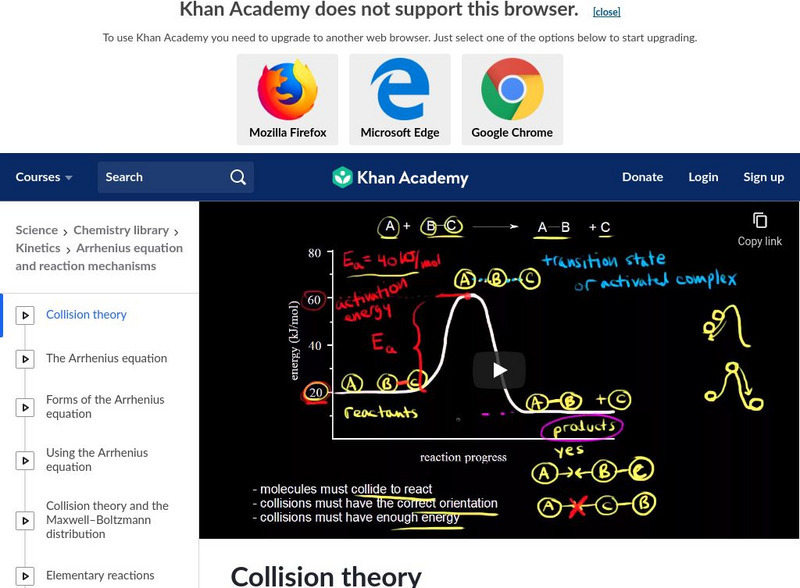
Khan Academy: Collision Theory
An introduction to collision theory and activation energy is presented. [8:42]

Khan Academy
Khan Academy: Arrhenius Equation
Definition of rate constant k, the pre-exponential factor A, and activation energy are introduced. Understand how the exponential part of the Arrhenius equation depends on activation energy and temperature. [9:21]
Khan Academy
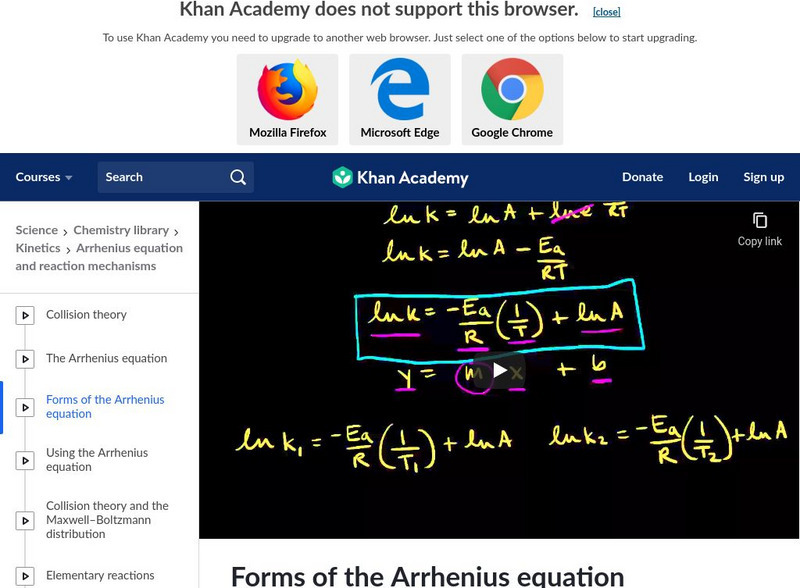
Khan Academy: Forms of the Arrhenius Equation
Know how to write different forms of the Arrhenius equation. Use the Arrhenius equation to look at how changing temperature and activation energy affects collisions. [6:36]

Khan Academy
Khan Academy: Using the Arrhenius Equation
Know how to use the Arrhenius equation to calculate the activation energy. [11:01]

Khan Academy
Khan Academy: Maxwell Boltzmann Distribution
Sal explains how to use the Maxwell-Boltzmann distribution to visualize the distribution of speeds of particles at different temperatures. [9:26]

Khan Academy
Khan Academy: Elementary Rate Laws
Sal helps viewers understand how to write rate laws for unimolecular and bimolecular elementary reactions. [5:30]

Khan Academy
Khan Academy: Mechanisms and the Rate Determining Step
An introduction to mechanisms and the rate determining step. Review the example of finding rate law of multistep reaction with an initial slow step. [8:36]
Khan Academy
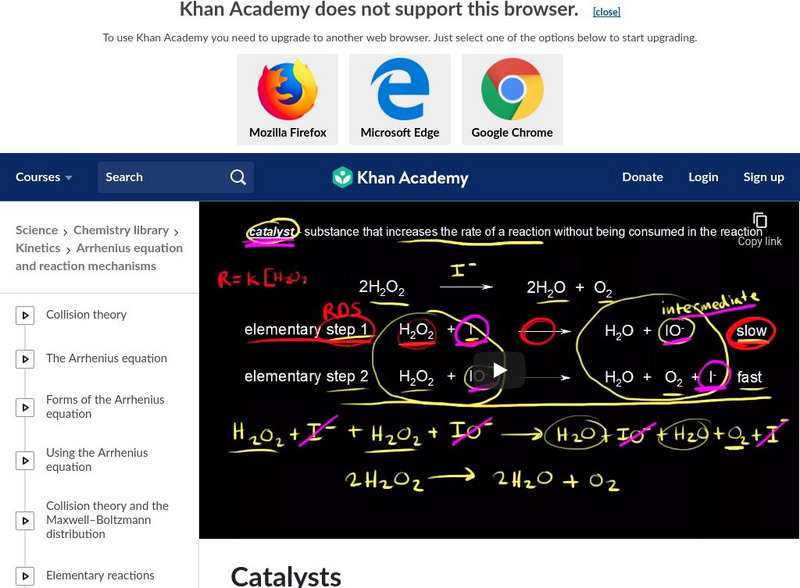
Khan Academy: Catalysts
Sal will illustrate how a catalyst speeds up a reaction by lowering the activation energy. [7:24]

Khan Academy
Khan Academy: Chemistry: Mass Defect and Binding Energy
Using the mass defect to calculate the energy released when a helium nucleus formed. Introduction to the nuclear strong force. [11:24]

Khan Academy
Khan Academy: Nuclear Stability and Nuclear Equations
Using the ratio of neutrons to protons to figure out of a nucleus will be stable or radioactive. [8:20]

Khan Academy
Khan Academy: Types of Decay
Sal illustrates the different types of decay: Alpha, Beta, Gamma Decay and Positron Emission. [17:00]
Khan Academy
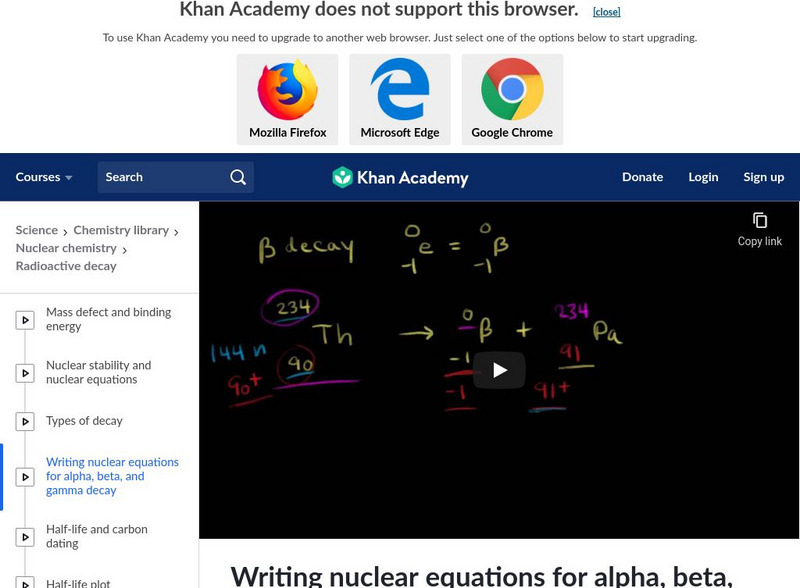
Khan Academy: Writing Nuclear Equations for Alpha, Beta, and Gamma Decay
Sal will discuss how to write nuclear equations for alpha, beta, and gamma decay when studying radioactive decay. [8:02]

Khan Academy
Khan Academy: Half Life and Carbon Dating
Carbon dating is a real-life example of a first-order reaction. This video explains half-life in the context of radioactive decay. [12:28]

Khan Academy
Khan Academy: More Exponential Decay Examples
Sal dives in even deeper with a few more examples of exponential decay. Practice calculating k from half-life, and calculating initial mass. [7:21]

Khan Academy
Khan Academy: Exponential Decay and Semi Log Plots
Practice using exponential decay equation to solve for relationship between k and half-life. Further learning by using semi-log plot to get graph of a straight line with slope of -k. [10:16]

Khan Academy
Khan Academy: Representing Structures of Organic Molecules
Sal Khan presents structures of organic molecules using line (or line-angle) diagrams. [7:28]

Khan Academy
Khan Academy: Naming Simple Alkanes
Naming simple linear and cyclic alkanes is explained by Sal Khan in a video. How do alkanes and alkenes differ? [9:27]

Khan Academy
Khan Academy: Naming Alkanes With Alkyl Groups
Sal reviews the process of naming linear alkanes with branching starting from the structure and drawing the structures based on the name. [11:04]

Khan Academy
Khan Academy: Alkane With Isopropyl Group
Sal Khan reviews the naming conventions for alkane chains that have an isopropyl group branch. [8:14]

Khan Academy
Khan Academy: Naming a Cycloalkane
Sal Khan reviews the naming conventions of cycloalkanes in a video. Cycloalkanes are molecules with carbon rings that are only single bonded to other atoms. [7:38]

Khan Academy
Khan Academy: Naming Two Isobutyl Groups Systematically
Sal Khan explains the systematic naming conventions for molecules with two isopropyl groups. [2:48]