Hi, what do you want to do?






Curated Video
Status and Style: Examining Wari Textiles and Jewelry
Wari textiles were masterpieces of color and precision, including elite tapestry tunics woven entirely by hand with complex patterns, animals, and symbols of religious power. These luxury items, along with finely crafted jewelry made...
Curated Video
Symbols of Power and Beauty: Wari Art and Ceramics
Wari art, especially their colorful and detailed pottery, reflected both their religious beliefs and political power. Influenced by coastal cultures like the Nasca, Wari ceramics featured images of the staff deity, warriors, animals, and...
Curated Video
Wari Religion and Beliefs
The Wari believed in a complex spiritual world centered on dualism and a powerful life force, which was represented in their religious art by the staff deity—a figure tied to both life and death. Religious ceremonies included offerings...
Curated Video
Farming the Mountains: Wari Agricultural Ingenuity
The Wari were master engineers who revolutionized farming in the Andes with advanced irrigation systems and expertly designed agricultural terraces. These terraces included layers for drainage, heat retention, and soil replacement,...
Curated Video
Wari Architecture
The city of Wari began as a Warpa settlement and grew into a bustling capital with somewhere between 10,000 and 70,000 residents. Its unique architecture included D-shaped buildings, multi-story buildings with patio structures, and...
Curated Video
Rise of the Wari: Peru’s First Empire Begins
The Wari emerged around 600 CE as the first true empire in the Andes, transforming from the local Warpa culture into a powerful state that united many peoples. Their success was built on smart farming systems, artistic innovation, and...
Curated Video
Wari Foundations of the Inca Empire
The Inca Empire built on Wari knowledge and infrastructure, repurposing their roads, urban planning techniques, and possibly even record-keeping tools like quipus. While the Inca did not copy Wari art styles directly, they may have...
Curated Video
Religion and Violence: How the Wari Conquered Their Rivals
The Wari spread their influence not just through diplomacy and feasting, but also with a powerful religious ideology centered on the staff deity, which legitimized their rule and appeared widely in their art. Their expansion often...
Curated Video
Feasts and Friendship: How the Wari Cultivated Loyalty
The Wari used grand feasts as a political tool to build loyalty and relationships with local leaders and communities. These celebrations included food, chicha (maize beer), and beautifully crafted vessels, sometimes enhanced with special...
Curated Video
A Patchwork Empire: How the Wari Ruled a Diverse Land
Although the Wari built impressive infrastructure, scholars still debate how their empire was ruled—whether by an emperor or a council remains unknown. Wari influence varied by region: some areas were tightly controlled, while others...
Curated Video
The Wari: First Empire of the Andes?
In the 1540s, Spanish explorer Pedro Cieza de León came across ancient ruins in Peru that didn’t match Inca design. Locals said the buildings were made by light, bearded people who lived there long before the Inca. Cieza had unknowingly...
Curated Video
Decline of the Wari Empire
The Wari Empire declined gradually in the 10th century, as administrative centers were abandoned and buildings were symbolically closed. While the exact cause is unclear, possibilities include climate change, internal unrest, or the end...
Curated Video
Wari Cities and Engineering: Building an Empire in the Mountains
Wari cities were carefully planned with grid-based layouts, multi-story buildings, and enclosed spaces that projected power and control. They used advanced engineering to build terraces, aqueducts, and a huge canal system to grow food...
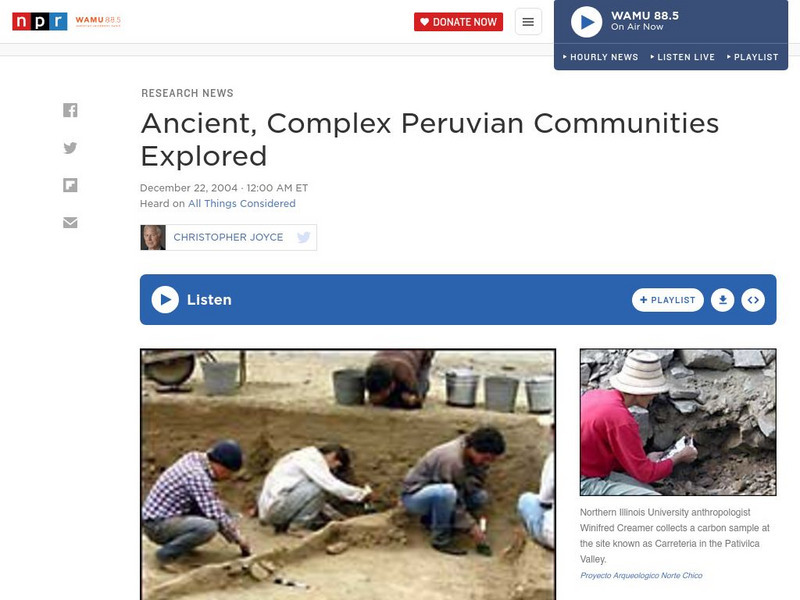
NPR: National Public Radio
Npr: Ancient, Complex Peruvian Communities Explored
Imagine a civilization in the Americas that predated the ancient Egyptians! That's what archeologist Jonathan Haas found on the coast of Peru. Read here about this remarkable discovery.