Hi, what do you want to do?






Bozeman Science
Ecological Succession
Paul Andersen describes the process of ecological succession. During this process life reestablished itself after a disturbance. During primary success all of the material is removed including the soil. For example during a volcanic...
Bozeman Science
Molecular Biology
Paul Andersen explains the major procedures in molecular biology. He starts with a brief description of Taq polymerase extracted from the hot pools of Yellowstone Park. He then uses the analogy of the ransom note to explain each of the...
Bozeman Science
Information Exchange
Paul Andersen explains how organisms use information to communicate with each other. Signals are used by bees doing the waggle dance to communicate the location of flowers. Territorial markings are used by wolves to establish...
Bozeman Science
Niche
Paul Andersen explains the niche. He gives three different pronunciations and two different definitions. He then discusses the competitive exclusion principle and the idea that a niche cannot be shared by two species.
SciShow
How Extreme Microbes Are Helping Us Test for COVID-19
Microbes that live in extreme environments, like geysers and hydrothermal vents, are able to survive in extreme temperatures. Scientists have figured out ways to use this thermostability to supercharge DNA studies, including the study of...
Bozeman Science
LS2A - Interdependent Relationships in Ecosystems
In this video Paul Andersen explains the important relationships that exist in ecosystems. He starts by delineating between organisms and their environment. He explains how food webs can be used to show energy and matter flow in a...
Bozeman Science
Biotic and Abiotic Factors
Paul Andersen differentiates between biotic and abiotic factors. He explains how both abiotic and biotic factors can affect organisms at the level of the cell, the population and even the ecosystem. The complexities of biofilms,...
Bozeman Science
ESS3B - Natural Hazards
In this video Paul Andersen explains how natural disasters (like earthquakes, tsunamis, volcanoes and flooding) have affected and will continue to affect humans on the planet. Many of the natural hazards (like volcanoes and storms) can...
Bozeman Science
r and K selection
Paul Andersen explains the differences between an r and a K selected species. He starts with a brief description of population growth noting the importance of; r or growth rate, N or number of individuals in the population, and K the...
Bozeman Science
Ecosystems
Paul Andersen explains how ecosystems interact with biotic and abiotic factors. He explains and gives examples of food chains and food webs. He shows how limiting factors eventually leads to logistic growth. Real data from Yellowstone...
Ancient Lights Media
Atlas of the United States: Wyoming
This program explores the geography, history, and some important cultural features of the Mountain Region of the United States. The individual states of Colorado, Utah, Wyoming, Idaho and Montana are presented in detail.
Ancient Lights Media
Atlas of the United States: The Mountain Region
This program explores the geography, history, and some important cultural features of the Mountain Region of the United States. The individual states of Colorado, Utah, Wyoming, Idaho and Montana are presented in detail.
Have Fun With History
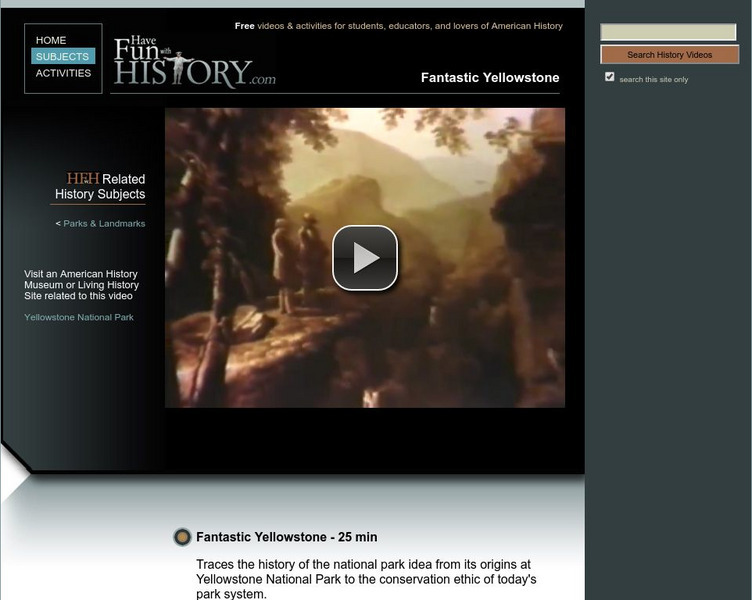
Have Fun With History: Fantastic Yellowstone
Traces the history of the national park idea from its origins at Yellowstone National Park to the conservation ethic of today's park system.