Hi, what do you want to do?






Bozeman Science
Waves
Mr. Andersen introduces the concept of waves. Both transverse and logitudinal waves are described. The relationship between wave speed, wave frequency and wavelength is also included.
Bozeman Science
Wave Speed
In this video Paul Andersen explains how the wave speed measure the speed of a wave through a medium. The medium determines the speed of the wave. The velocity of the wave is equal to the product of the wavelength and the frequency of...
Crash Course
Traveling Waves: Crash Course Physics
Waves are cool. The more we learn about waves, the more we learn about a lot of things in physics. Everything from earthquakes to music! Ropes can tell us a lot about how traveling waves work so, in this episode of Crash Course Physics,...
Bozeman Science
Doppler Effect
In this video Paul Andersen explains how the perceived frequency of a source depends on the motion of both the source and the observer. As a source approaches an observer the frequency will increase and as it moves away it will...
Curated Video
GCSE Physics - Intro to Waves - Longitudinal and Transverse Waves #61
This video covers:
- What wave
s are
- How to label a wave. E.g. amplitude, wavelength, crest, trough and ti
me period
- How to calcul
ate wave speed
- The difference between transverse an
d longitudina
l...
- What wave
s are
- How to label a wave. E.g. amplitude, wavelength, crest, trough and ti
me period
- How to calcul
ate wave speed
- The difference between transverse an
d longitudina
l...
Curated Video
GCSE Physics - Refraction of waves #63
In this video we cover the following:
- What 'refraction'
means
- When refract
ion occurs
- How to draw ray diagrams for the refr
action of light
- The idea that during refraction, the wavelength of a wave stays...
- What 'refraction'
means
- When refract
ion occurs
- How to draw ray diagrams for the refr
action of light
- The idea that during refraction, the wavelength of a wave stays...
Flipping Physics
2016 #5 Free Response Question - AP Physics 1 - Exam Solution
My solutions to Free Response Question #5 from the 2016 AP Physics 1 Exam. This is a standing waves question which requires you to determine the relationship between tension and wave speed. Also included are my reflections on how to get...
Flipping Physics
2019 #5 Free Response Question - AP Physics 1 - Exam Solution
My solutions to Free Response Question #5 from the 2019 AP Physics 1 Exam. This question is about standing waves in open and closed pipe instruments. Also included are my reflections on how to get perform better on the exam.
Visual Learning Systems
Waves: Wave Speed
This video explores the characteristics of waves. It explains the speed of waves, how this value is calculated and the four basic interaction between waves. Other terminology includes: vibration, crest, trough, amplitude, wavelength,...
Curated Video
Changes of Medium: Waves Crossing Boundaries
This video is a lecture on how waves change as they cross the boundary between different materials, also known as changes of medium. The video explains what a medium is and how it affects wave propagation. The video uses examples of...
Curated Video
Waves at a Boundary: Refraction, Reflection, and Transmission
This is a lecture video that explains what can happen to a wave as it encounters the boundary between two different media. The video discusses the changes in wave speed and wavelength at the boundary, as well as the phenomenon of...
Curated Video
Wave Speed, Wavelength, and Frequency: Understanding their Relationship
This video is a lecture that explains the relationships between wave speed, wavelength, and frequency of a wave. It starts by defining a transverse wave and discussing the amplitude, wavelength, frequency, and time period of a wave. The...
Curated Video
The Effects of Wavelength and Speed on Electromagnetic Waves
This video is a lecture on the effects of wavelength and speed on electromagnetic waves. The speaker explains what can happen to a wave at the boundary between two media, including reflection and refraction. They also discuss how...
Flipping Physics
Determining the Speed of a Standing Wave - Demonstration
The relationship between wavelength and frequency is determined. The number of waves, wavelength, and wave speed at each standing wave frequency is determined. The wave speed is measured independent from the standing waves.
Curated Video
Properties of Waves and Calculating Wave Speed
This video discusses the properties that all waves have in common, including amplitude and wavelength. It also demonstrates how to calculate the speed of a wave using the equation v = Fλ, where v is the wave speed, F is the frequency in...
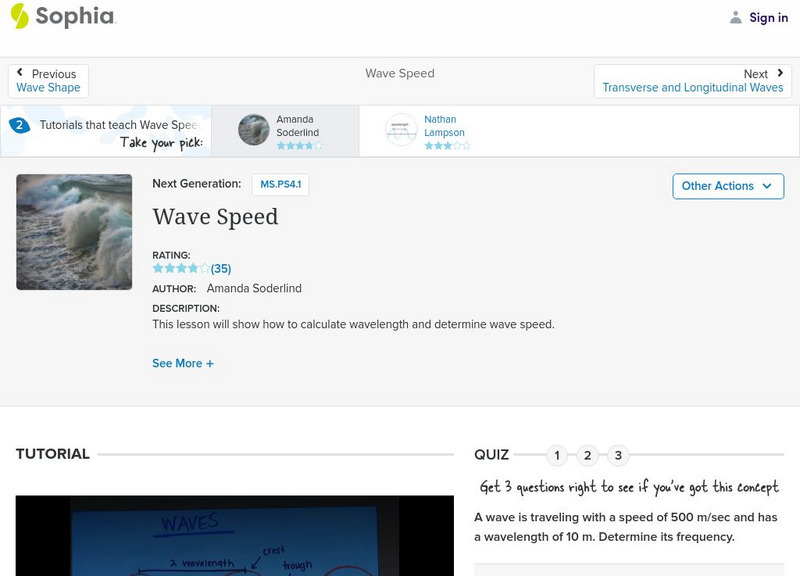
Sophia Learning
Sophia: Wave Speed: Lesson 1
This lesson will show how to calculate wavelength and determine wave speed. It is 1 of 2 in the series titled "Wave Speed."
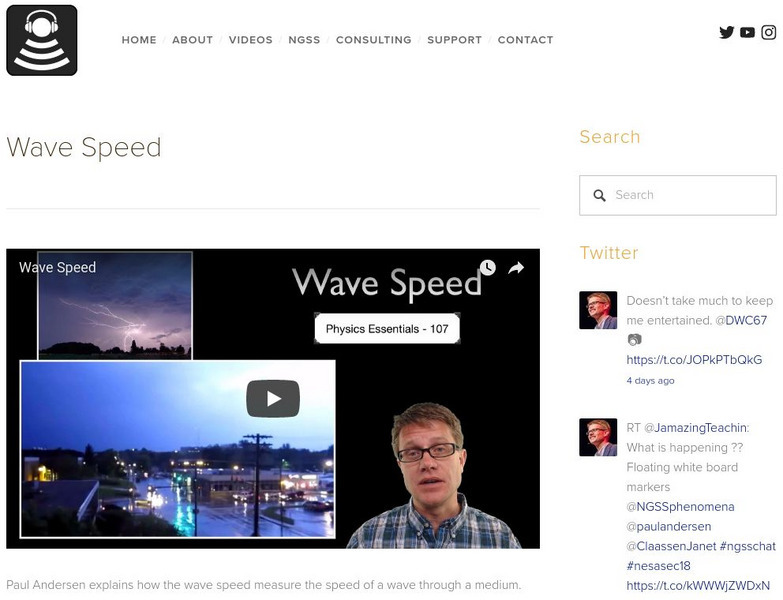
Bozeman Science
Bozeman Science: Wave Speed
In the following video Paul Andersen explains how the wave speed measure the speed of a wave through a medium. The medium determines the speed of the wave. The velocity of the wave is equal to the product of the wavelength and the...
Crash Course
Crash Course Physics #17: Traveling Waves
Waves are cool. The more we learn about waves, the more we learn about a lot of things in physics. Everything from earthquakes to music! Ropes can tell us a lot about how traveling waves work so, in this video episode of Crash Course...