Hi, what do you want to do?






Makematic
Plessy v. Ferguson
In 1892, Homer Plessy's arrest for sitting in a train car reserved for White passengers led to a Supreme Court decision that endorsed racial segregation under the "separate but equal" doctrine.
Makematic
13th Amendment
The Thirteenth Amendment abolished slavery in the United States in 1865. But it was just the beginning of a long fight for equality and civil rights.
Makematic
The Civil Rights Act of 1875
The Civil Rights Act of 1875 aimed to protect the rights of African Americans, but was struck down in 1883, paving the way for racial segregation across the South.
Makematic
The Impact of the Civil War
On April 12, 1861, Confederate forces attacked Fort Sumter, South Carolina, marking the explosive start of the Civil War. The conflict led to short-lived progress and long-term struggles for true racial equality.
Makematic
African Americans and Indigenous Peoples in the U.S. Civil War
The American Civil War wasn’t just a fight between North and South, it also involved Indigenous Peoples and African Americans, whose motivations for joining the fight had contrasting results.
Curated Video
Plessy v. Ferguson: Separate but Equal
Plessy v. Ferguson was a landmark U.S. Supreme Court decision that established the legal doctrine of “separate but equal”. It was a ruling that enabled many states to enact racial segregation laws for decades to come.
Wonderscape
History Kids: Constitutional Amendments 11 - 15
The video discusses the 11th, 12th, 13th, 14th, and 15th Amendments to the United States Constitution. It explores how these amendments have shaped our country and affected the lives of citizens, particularly focusing on issues such as...
Curated Video
Civil War
This live-action video program is about the word Civil War. The program is designed to reinforce and support a student's comprehension and retention of the word Civil War through use of video footage, photographs, diagrams and colorful,...
Annenberg Foundation
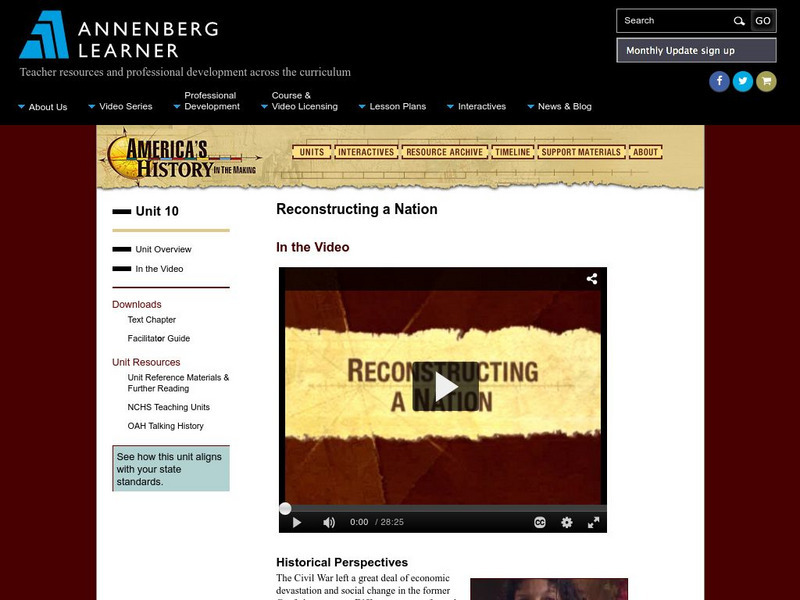
Annenberg Learner: America's History in the Making: Reconstructing a Nation
This video delves into the challenges and opportunities that arose during the Reconstruction period following the Civil War and, in particular, re-unifying the states. [28:25]

Center For Civic Education
60 Second Civics: The Thirteenth and Fourteenth Amendments
The Thirteenth and Fourteenth Amendments made critical changes to the Constitution, such as the abolition of slavery, that addressed issues not settled at the Constitutional Convention or by the Civil War.

Khan Academy
Khan Academy: Ap Us History: 1844 1877: Reconstruction: The 13th Amendment
A discussion of the 13th Amendment. [4:41]
Center For Civic Education
60 Second Civics: Rights of African Americans Pt. 8: A Reign of Terror
When Union troops left the South, a reign of terror began. And Congress could not stop it.