
Curated OER
Water Cycle
Identify and interpret the earth's different water sources. Third and fourth graders describe and demonstrate the process of the water cycle, make a model of its two main parts, and predict and infer to answer questions about the...

Curated OER
Simulating the Greenhouse Effect in a Terrarium
Learners identify what factors effect global warming and how the greenhouse effect occurs. In this environmental instructional activity students view videos then complete an experiment using a terrarium to observe greenhouse gas.

Curated OER
Ho'opiha - Growing in Knowledge: Terrarium Project
Students explore environmental protection by conducting a research experiment in class. In this botany lesson plan, students identify the necessities for growing a plant indoors and create a small terrarium for their plant. Students...

Curated OER
Water: A Neverending Story
Students investigate the water cycle. In this water cycle science lesson, students participate in a series of activities that demonstrate evaporation, precipitation, and condensation. Students describe their observations using...

Curated OER
Building a Terrarium System
Students create their own terrariums. For this ecological model lesson, students create terrariums using soil, seeds, pebbles, and two liter bottles. Students compare the elements of a terrarium to a food web.

Alabama Learning Exchange
Making and Observing Life in a Terrarium
Young scholars understand the parts of the terrarium and why they are important in establishing an ecosystem. For this ecosystem lesson, students recall background information on aquariums, terrariums and the water cycle. Young scholars...

Curated OER
Plant Systems
Second graders learn about plant systems and how plants grow and function. In this plant lesson plan, 2nd graders collect data based on roots, leaves, terrariums, plant uses, and locations of certain kinds of plants. They fill out...

Curated OER
Inventing Insects
Students explore the world of insects and discover what it might be like to live like one. They create an insect with physical characteristics and demonstrate how it moves. Students also compare and contrast insects to spiders and how...

Curated OER
Water Cycle Terrariums
Students explore the water cycle. They build a model of the water cycle in the form of a terrarium and explain how it demonstrates the water cycle. In addition, they draw a representation of the water cycle demonstrated in the terrarium.

Curated OER
Pop Bottle Terrarium
Young scholars make terrariums out of bottles, pebbles, cuttings from other plants, and water. For this terrarium lesson plan, students learn about recycling by using household items to make terrariums.

Curated OER
Water, Water Everywhere
Learners study the location of Earth's water and study the water cycle using a terrarium. In this water study lesson, students study a model globe for the Earth and find Alaska. Learners locate the bodies of water and study an overhead...

Curated OER
Making A Terrarium
Students make a terrarium from common household items that are brought to class. They can be creative with materials but the method is set for how the mini-lab is set up. Students read a book about an ecosystem to stimulate the topic for...

Curated OER
The Rainforest Community
Students create a miniature rainforest ecosystem, a terrarium. Students then explain how the continuous flow of energy and food in the ecosystem allows it to sustain itself.

Curated OER
Marine & Aquatic Habitats Activities - Habitats of Birds, Fish, and Mammals on the Island and the Pacific Region
Pupils create habitats in jars to understand integral aspects of plants' and animals' habitats.

Curated OER
Terrariums for Project Pals
Students identify the components needed by plants to survive in the terrarium. In this biology lesson, students build their own terrariums using materials available. They present their project in class.

Curated OER
Terrarium Observation
Students observe the growth of plants in their terrarium. In this social studies instructional activity, students measure plant growth for several weeks. They predict what happens if other organisms are added in the terrarium.

Curated OER
Building the Terrarium
Students draw a layout of their proposed terrarium. In this social studies lesson, students discuss how Mayans farm to produce food for the family. They compare their farming method with modern farming practices.

Curated OER
Do You See What I See?
Second graders view a teacher-created terrarium, and complete a KWL chart. They discuss what they can see, Students go on a nature walk and compare the schoolyard to the terrarium, discussing the roles of rocks, plants, soil, and water...

Curated OER
Do You See What I See?
Pupils hypothesize the role of rocks, soil, and water by observing a terrarium and create a model to explore the water cycle. This is part of a five station set up.

Curated OER
Life in a Cup
Third graders make and maintain a mini terrarium. They keep a daily journal of what happens in their terrarium and record daily observations and measurements.

Exploratorium
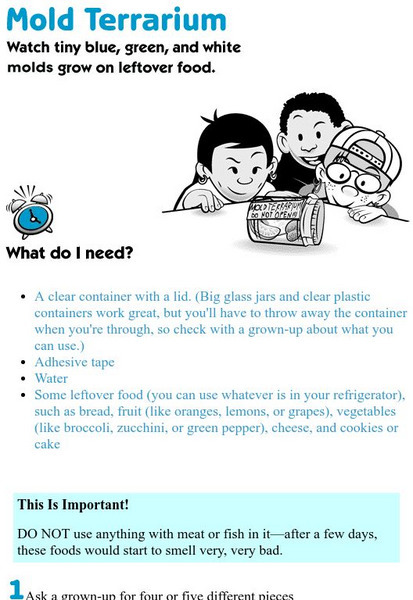
Exploratorium: Mold Terrarium
Exploratorium helps you to grow your own mold terrarium. Includes directions and an explanation for what you see growing on your food!
American Museum of Natural History
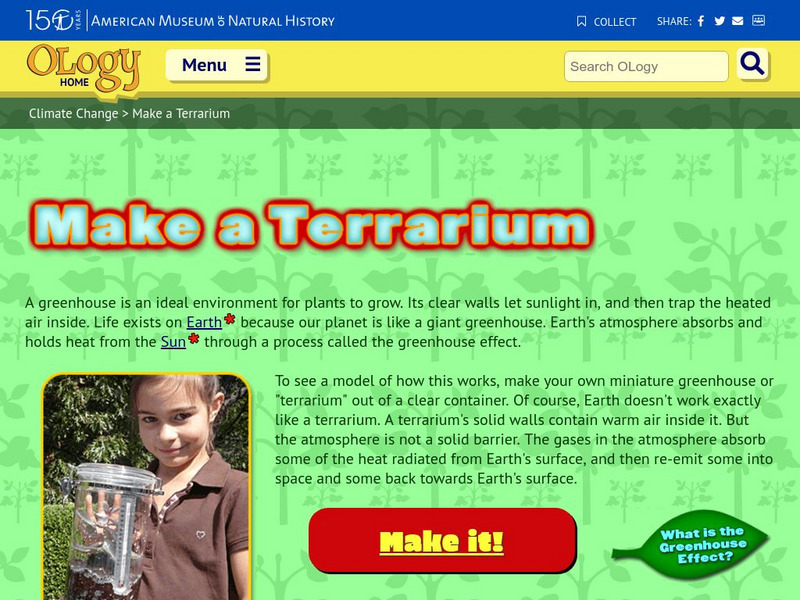
American Museum of Natural History: Greenhouse Effect: Make a Terrarium
Capture the essence of life within your own miniature greenhouse, or terrarium.

SRI International
Performance Assessment Links in Science: Do You See What I See? (Lesson)
For this Grade Two performance task, students observe the contents of a terrarium and explain the purpose of the water, rocks and soil inside it.