Hi, what do you want to do?






Professor Dave Explains
Newton's Second Law of Motion: F = ma
One of the best things about Newton was the way that he showed how natural phenomena abide by rigid mathematical principles. So much so that we can use mathematical equations to calculate how objects will actually behave. This equation,...
Curated Video
Newtons
This live-action video program is about the word newton. The program is designed to reinforce and support a student's comprehension and retention of the word newton through use of video footage, photographs, diagrams and colorful,...
Professor Dave Explains
Newton's Law of Universal Gravitation
You thought we were all done with Newton, didn't you? You figured that three laws are enough for any scientist. Well think again! Newton was quite the champ, and his work with gravity was revolutionary. I mean, the guy invented calculus...
Visual Learning Systems
Force and Newton's Laws: Gravity
This video discusses the principle of force and the application of Newton's Three Laws of Motion. Students will witness the effect of friction on force and see how force is calculated. Other terminology includes: inertia, weight, mass,...
Curated Video
Newton's 3rd Law
This live-action video program is about the Newton's 3rd Law. The program is designed to reinforce and support a student's comprehension and retention of Newton's 3rd Law through use of video footage, photographs, diagrams and colorful,...

Curated OER
Video 6 - Gravity
Most people know the famous story of Sir Issac Newton and the apple. Watch that example animated, narrated, and explained. Class members can learn what gravity is, why it pulls things down, how strong it is, and how it's related to...

Curated OER
Newton’s Laws of Motion
Newton's laws of motion are put into action as they are defined and demonstrated. Tennis balls, skateboards, and human bodies are all part of each example. Good definitions plus solid examples equals an informative video.

Curated OER
Isaac Newton's First Law of Motion
Review Newton's first law of motion. This easy-to-follow clip demonstrates and explains how the law of motion is applied in space and on Earth.

Khan Academy
Khan Academy: Calculus: Newton, Leibniz, and Usain Bolt
Video lesson explaining the use of differential equations by exploring the speed at which Usain Bolt runs. Explains the difference between average speed and instantaneous speed. [9:07]
Scholastic
Scholastic: Study Jams! Science: Force and Motion
A video and quiz on how force must overcome inertia in order to produce motion.
Bozeman Science
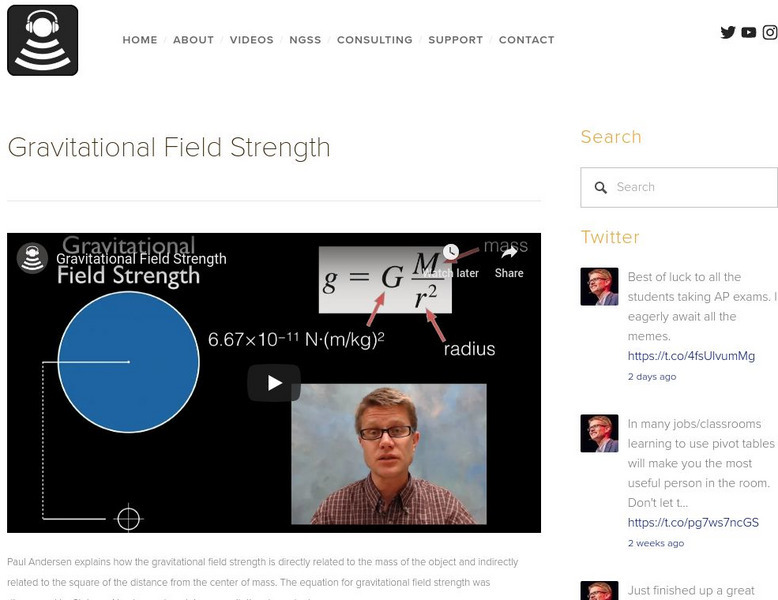
Bozeman Science: Gravitational Field Strength
Find out how the gravitational field strength is directly related to the mass of the object and indirectly related to the square of the distance from the center of mass. [5:38]

Other
Phoenix Film and Video: Gravity, Force, and Work
Zog is introduced to Newton's basic laws of motion. By observing objects on earth and in space, Zog learns that nothing can start moving, speed up, slow down, change direction or stop unless a force is applied to it -- even if the force...

Khan Academy
Khan Academy: Introduction to Differential Calculus: Newton and Usain Bolt
In this video, students learn why we study differential calculus.

Sophia Learning
Sophia: Newton's Second Law of Motion
Watch this introduction to Newton's Second Law of Motion. See example problems solved in an easy to understand format. [9:49]

Crash Course
Crash Course Physics #10: Collisions
COLLISIONS! A big part of physics is understanding collisions and how they're not all the same. Mass, momentum, and many other things dictate how collisions can be unique. In this video episode of Crash Course Physics, Shini sits down to...

Khan Academy
Khan Academy: Early Modern: Emilie Du Chatelet, Part 2
Andrew Janiak (Duke) further introduces Emilie Du Chatelet, a French philosopher, and her contribution to the debate about the principle of sufficient reason. [3:51]

Sophia Learning
Sophia: Defining Impulse Mathematically
This lesson gives a mathematical relationship for impulse.