Hi, what do you want to do?






NASA
Exploring the Solar System: Lucy Goes to Space
Discover the mysteries of the solar system through the eyes of the Lucy mission and its team members. This first episode features Deputy Principal Investigator Cathy Olkin, who discusses Lucy's journey out...
Curated Video
Exploring Apollo 11: The Historic Moon Landing Mission
Apollo 11 was the spacecraft that successfully delivered Neil Armstrong and Buzz Aldrin to the moon in 1969. Learn about the structure of the spaceship and details of the mission.
NASA
Counting Comets
The Solar and Heliospheric Observatory, a joint mission between ESA (the European Space Agency) and NASA, was not designed to find comets — its original goal was to study the Sun from its deep core to the outer layers...
NASA
NASA's Parker Solar Probe Touches The Sun For The First Time
For the first time in history, a spacecraft has touched the Sun. NASA’s Parker Solar Probe has now flown through the Sun’s upper atmosphere – the corona – and sampled particles and magnetic fields there.
<
br/>...
<
br/>...
NASA
Take a Spin With NASA's Nancy Grace Roman Space Telescope
On schedule to launch no later than May 2027, NASA’s Nancy Grace Roman Space Telescope mission will help uncover some of the biggest mysteries in the cosmos. The state-of-the-art telescope on the Roman spacecraft...
NASA
NASA in Silicon Valley: Daniel Andrews Talks About Exploring The Moon With Robots
A conversation with Daniel Andrews, Project Manager for NASA’s Resource Prospector mission.
NASA
An Update on Our Artemis I Mission on This Week @NASA – February 25, 2022
An update on our Artemis I mission, test firing an Artemis rocket engine, and a resupply mission delivers to the space station … a few of the stories to tell you about – This Week at NASA! Producer: Andre Valentine Editor: David Anderson...
NASA
NASA | So, You Want to Build a Satellite?
Part 2: Putting It Together
Building satellites isn't easy. They're complex, expensive, and not to mention hard to make! This is why whenever NASA makes a new satellite--like the MAVEN mission to Mars--its scientists and...
Building satellites isn't easy. They're complex, expensive, and not to mention hard to make! This is why whenever NASA makes a new satellite--like the MAVEN mission to Mars--its scientists and...
Next Animation Studio
$10 billion dollar telescope reaches magical spot in space
The $10 billion James Webb Space Telescope has safely arrived at Lagrange Point 2 — and it’s now getting ready to look back in time to 13.7 billion years ago.
Next Animation Studio
NASA’s Moon to Mars exploration program
NASA’s Moon to Mars exploration program first proposed in 2015 consists of three phases.
<br/>
Visual Learning Systems
The Outer Planets: Jupiter
Students are taken on an exciting animated trip to the outer reaches of our solar system. Images from NASA and the Hubble space Telescope illustrate the Giant Red Spot on Jupiter, Saturns' beautiful rings, the tilted rings of Uranus, and...
Visual Learning Systems
Nearby Planets
This video provides a brief overview of the planets closest to Earth in our solar system, including Mercury, Venus, and Mars. It describes the unique characteristics of each planet and includes images and footage from spacecraft that...

Museum of Science
Ei E: A Long Way Down: Designing Parachutes Lesson 2
Students use information about the temperature, atmosphere, and surface of a planet to imagine how a spacecraft traveling to that planet might be designed. [14:29]

NASA
Nasa New Horizons: Pluto in a Minute: How Did New Horizons Phone Home?
Find out how the NASA space mission New Horizons phoned home, and how exactly a spacecraft communicates to Earth from 3 billion miles away. [1:46]
Science Friday Initiative
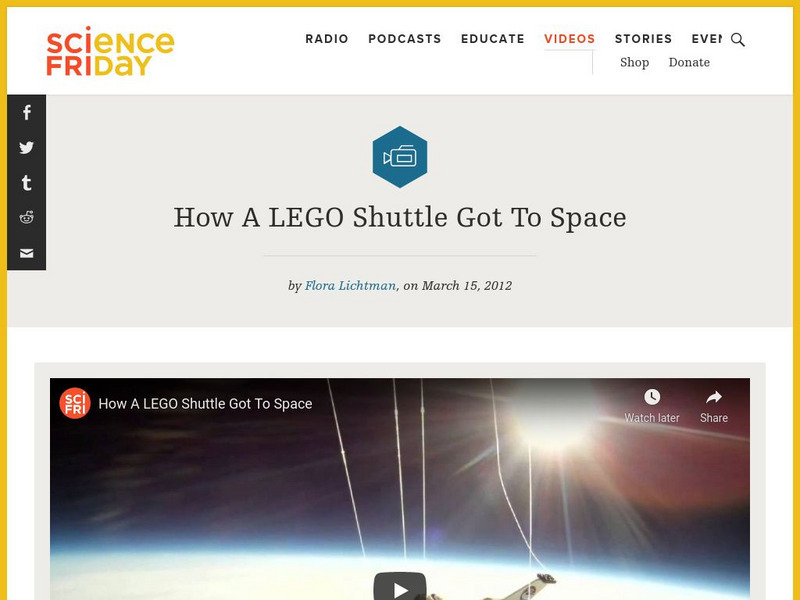
Science Friday: How a Lego Shuttle Got to Space
Raul Oaida, 18-years-old, attached a LEGO shuttle, a video camera and a GPS tracker, to a huge helium balloon and sent them into space. Oaida says flight time was just about three hours and the shuttle reached an altitude of 115,000 feet...
California Academy of Sciences
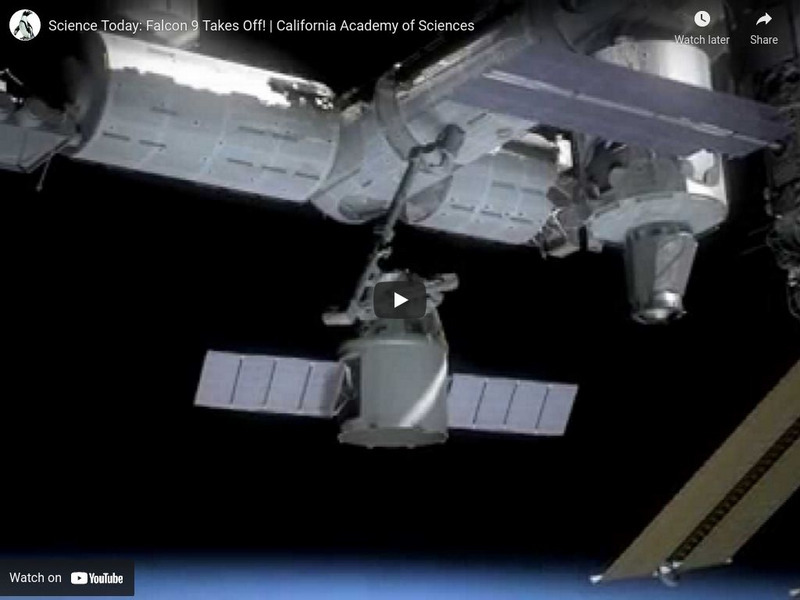
Ca Academy of Sciences: Falcon 9 Takes Off!
With the successful launch of Falcon 9 on June 4, 2010, Space-X began its move into commercial space flights. This article helps us understand what the change from NASA-controlled space flight to commercial flights might mean.