Hi, what do you want to do?






Bozeman Science
Ray Diagrams - Mirrors
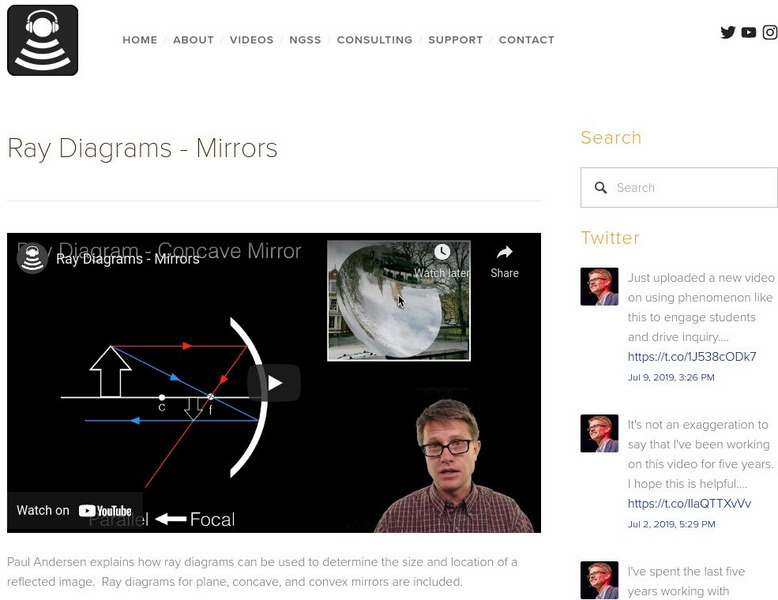
In this video Paul Andersen explains how ray diagrams can be used to determine the size and location of a reflected image. Ray diagrams for plane, concave, and convex mirrors are included.
Visual Learning Systems
Using Light: Mirrors and Light
This video examines the various uses of light and the role of different types of lenses in light refraction. The way in which eyeglasses, contact lenses, and binoculars manipulate light to allow us to see better is illustrated. Other...
Let's Tute
Understanding Reflection of Light in Plane Mirrors
This video explains the technical process behind the formation of images in plane mirrors, and justifies the characteristics of those images. It covers the laws of reflection, the formation of point images, and the fact that the image in...
Curated Video
Images Plane Mirror
This video focuses on where and why plane mirrors are used and image formation. Students will come to understand that plane mirrors form virtual images, and that that image is the same size as the object it reflects and is as far behind...
Let's Tute
Introduction to Reflection in Spherical Mirrors
This video is a lesson on reflection in spherical mirrors, using everyday objects like spoons to explain the concepts. The teacher covers technical terms such as center of curvature, radius of curvature, and focal length, and explains...
Let's Tute
Light Reflection in a Plane Mirror
This video explains the science behind reflection in plane mirrors, including the formation of virtual and real images, lateral inversion, and the properties of upright and erect images. It also includes an activity to identify letters...
Let's Tute
Introduction to Reflection and Reflecting Surfaces
This is a video about the behavior of light and the concept of reflection. It covers the laws of reflection, types of mirrors, and the difference between specular and diffuse reflection.
Bozeman Science
Bozeman Science: Physics: Ray Diagrams Mirrors
In this video, Paul Andersen explains how ray diagrams can be used to determine the size and location of a reflected image. Ray diagrams for plane, concave, and convex mirrors are included. [11:44]