Hi, what do you want to do?






Curated Video
GCSE Chemistry - Moles, Concentration & Volume Calculations #29
This video covers:
- How to use the moles = concentration x volume equ
ation
- A worked example using the above equation and mol
ar ratios
Exam
board specific info:
IGCSE Edexcel -...
- How to use the moles = concentration x volume equ
ation
- A worked example using the above equation and mol
ar ratios
Exam
board specific info:
IGCSE Edexcel -...
Curated Video
GCSE Chemistry - How to Find the Volume of a Gas #28
This video covers:
- How to calculate the volume of a gas using the equal: volume = moles
x 24
- How to find the volume of a product when you're told the volume of
a reactant
Exam
board specific info:
AQA -...
- How to calculate the volume of a gas using the equal: volume = moles
x 24
- How to find the volume of a product when you're told the volume of
a reactant
Exam
board specific info:
AQA -...
FuseSchool
Moles In Equations
Learn the basics about Moles in equations. How do you calculate a mole? How do moles work in equations? Find out more in this video!
Khan Academy
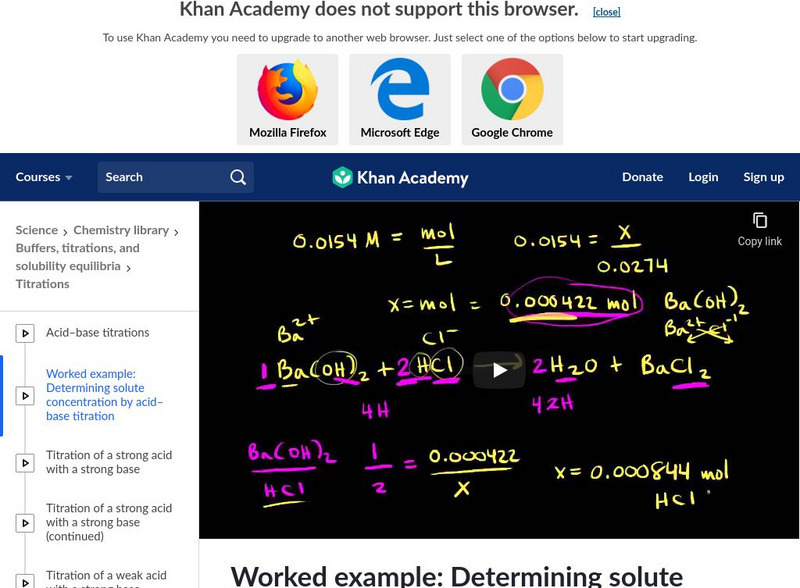
Khan Academy: Titration Calculation Example
An example of titrating a strong acid, hydrochloric acid, with a strong base barium hydroxide. Learn how to calculate the unknown concentration when you don't have a 1:1 molar ratio of H+ to OH-. [7:50]
Sophia Learning
Sophia: Chemical Reactions Stoichiometry: Lesson 1
This lesson will demonstrate how to use a balanced chemical equation to determine the mass of a product given the starting mass of a reactant. It is 1 of 2 in the series titled "Chemical Reactions - Stoichiometry."
Sophia Learning
Sophia: Converting From Mass a to Volume B Using a Balanced Chemical Equation
This lesson will demonstrate how to use a balanced chemical equation to determine the volume of substance B given the starting mass of substance A.

Sophia Learning
Sophia: Converting From Volume a to Particles B Using a Balanced Equation
This lesson will demonstrate how to use a balanced chemical equation to determine the number of particles of substance B given the starting volume of substance A.