Hi, what do you want to do?






Wonderscape
History Kids: The Legislative Branch
This video provides an overview of the legislative branch of the United States government, known as Congress. It explains how Congress was formed, the roles of the House of Representatives and the Senate, and the powers and...

Curated OER
American Presidents: John Quincy Adams
A skinny-dipping president? John Quincy Adams was a bible reader by morning and a skinny-dipper by late morning, apparently. His strong beliefs and lack of persuasive power ultimately ended his time in presidency, but he did go on to...

Curated OER
US Government Review Part 1 - 3 Branches of Government
A fun and interesting teacher describes the three branches of the US government. His lecture style and ability to explain with good examples could be a really big help to older students needing a tutorial or extra support in...
Arizona State University
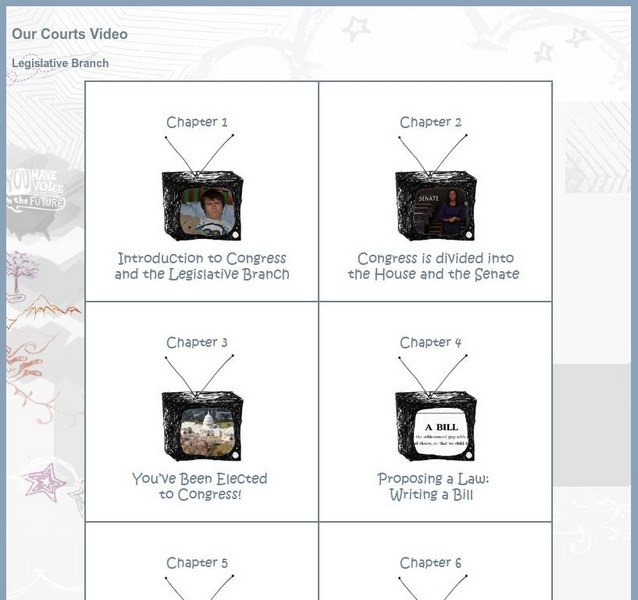
Arizona State University: College of Law: Legislative Branch Videos
Video collection divided into seven chapters designed to teach students about the legislative branch of the U.S. government. With overviews of the House of Representatives and Senate, voting and vetoes, and how a bill becomes law.

National Constitution Center
National Constitution Center: Constitution Hall Pass: The Legislative Branch
Video introduced by John Lewis, a member of the House of Representatives. He discusses the legislative branch of the government, what elected members do, the importance of voting and of lobbying representatives. We are then taken on a...

Khan Academy
Khan Academy: The Constitution and Proportional Representation
This video is a discussion about the Constitutional Convention of 1787 and how the delegates compromised on state representation by dividing the legislative branch between the Senate, in which every state has two representatives...

Khan Academy
Khan Academy: Gerrymandering
This video lesson from Khan Academy discusses Congressional behavior of gerrymandering. This lesson is intended for students taking high school or college level American Government and Civics courses, including the AP Government course.

Khan Academy
Khan Academy: Representatives as Delegates, Trustees, and Politicos
This video lesson from Khan Academy discusses Congressional representatives as delegates, trustees, and politicos. This lesson is intended for students taking high school or college level American Government and Civics courses, including...

Khan Academy
Khan Academy: Senate Filibusters, Unanimous Consent and Cloture
This video lesson from Khan Academy discusses Senate filibusters, unanimous consent and cloture. This lesson is intended for students taking a high school or college level American Government and Civics courses, including the AP...

Khan Academy
Khan Academy: The House of Representatives in Comparison to the Senate
This video lesson from Khan Academy discusses how the House of Representatives is more hierarchical and efficient than the Senate. This lesson is intended for students taking a high school or college level American Government and Civics...

Khan Academy
Khan Academy: How a Bill Becomes a Law
This video lesson from Khan Academy discusses how a bill becomes a law. This lesson is intended for students taking high school or college level American Government and Civics courses, including the AP Government course.

Khan Academy
Khan Academy: Congressional Oversight of the Bureaucracy
This video lesson from Khan Academy discusses Congressional oversight of the bureaucracy. This lesson is intended for students taking high school or college level American Government and Civics courses, including the AP Government course.
PBS
Pbs Learning Media: Crash Course Government and Politics: The Bicameral Congress
In which Craig Benzine teaches you about the United States Congress, why it's bicameral, and what bicameral means. Learn what the senate and house of representatives are for, some of the history of the institutions, and just how you can...
Center For Civic Education
60 Second Civics: Representation in the House and Senate
The House and the Senate were designed in different ways so that all people would be represented. There would be room for change if people wanted it, yet there was also built-in stability.
Center For Civic Education
60 Second Civics: How Congress Functions: Pt. 7: Political Party Control
Compares how political parties are controlled in the House and the Senate.
Center For Civic Education
60 Second Civics: How Congress Functions: Pt. 8: The Speaker of the House
The Speaker of the House of Representatives wields a good deal of power. For example, the Speaker controls committee appointments and sits on the Rules Committee.
Center For Civic Education
60 Second Civics: How Congress Functions: Pt. 10: Political Party Control
The Speaker in the House of Representatives can exert strong control that emphasizes his or her party's agenda. For example, by appointing party members to chair committees, rather than members with seniority.
Center For Civic Education
60 Second Civics: How Congress Functions: Pt. 14: House Whips
Explains the role a whip plays in the House of Representatives, which is to monitor members for their adherence to the party agenda.
Crash Course
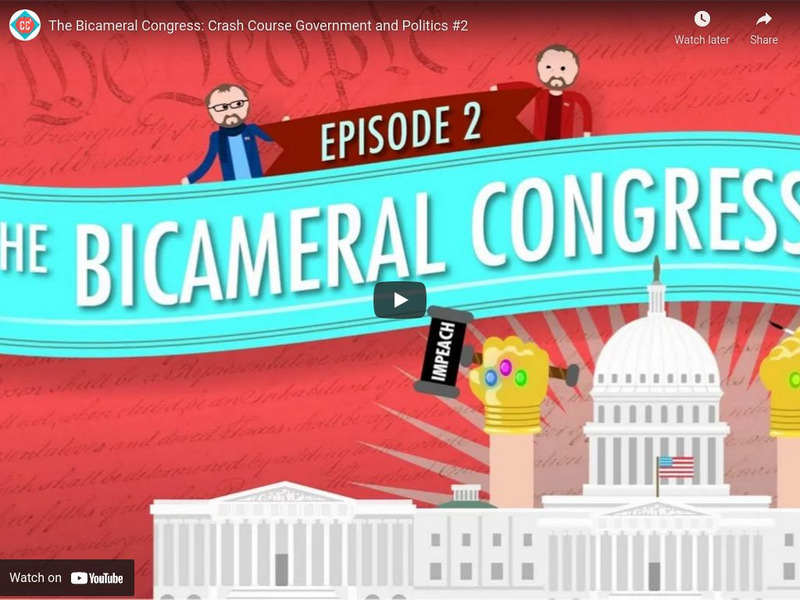
Crash Course Government and Politics #2: The Bicameral Congress
Crash Course video in which Craig explains what it means to have a Bicameral Congress discussing some of the history behind our Legislative Branch. [9:04]
CGP Grey
Cgp Grey: Grey Explains: What if the Electoral College Is Tied?
Explains how the House of Representatives becomes involved if there is a tie vote in the Electoral College, and what rules apply. [3:37]

Khan Academy
Khan Academy: Article I of the Us Constitution
Jeffrey Rosen of the National Constitution Center in conversation with Walter Isaacson of the Aspen Institute about Article I of the Constitution. [10:43]

Khan Academy
Khan Academy: Madison's Role in the Constitutional Convention in 1787
Lynne Cheney, author of "James Madison: A Life Reconsidered" in conversation with Walter Isaacson of the Aspen Institute about the role of James Madison at the Constitutional Convention. [7:05]

Khan Academy
Khan Academy: Us History: 1754 1800: The Constitutional Convention
In 1787, the Framers of the US Constitution came together to create a stronger central government. In this video, Kim discusses how the Framers compromised over the plan for the legislative branch of government, combining the Virginia...

Khan Academy
Khan Academy: Article I of the Constitution
This video lesson from Khan Academy discusses Article I of the Constitution. This lesson is intended for students taking a high school or college level American Government and Civics courses, including the AP Government course.