Hi, what do you want to do?






Curated OER
You Are Where You Live
Students explore where insects live and how they have adapted to their environment.

Curated OER
At Home on the Prairie
Students discover the importance of the bison within the prairie ecosystem and Native American culture, and explain the importance of habitat and place to living organisms.

Curated OER
Coral Reef Choreographic ProjectTo
Pupils enhance their understanding of how animals function in a habitat.Students are scattered individually and in small groups. About half of pupils make coral shapes in small groups. The other half of students move like animals in the...

PBS
Pbs Learning Media: Desert Elephants
In this video from Nature, observe elephants trek across the desert to an isolated waterhole. [4:13]
PBS
Pbs Learning Media: Forest Elephants
Although the rainforest is a demanding environment for a cameraman, photographer Martyn Colbeck manages to capture a glimpse of forest elephants in the Congo in this video segment from Nature.
Tramline
Virtual Field Trip: Temperate Forest Biome
Travel with your students on a Virtual Field Trip to learn about Temperate Forest Biomes. You will also discover many informative and interactive websites.

Science Buddies
Science Buddies: Antlion Pits in Open Sand or Under Leaf Cover
Antlion larvae are known for their predatory ways. In sandy areas, they dig pits to trap ants or other crawling insects that happen to stumble in. This project shows you how to create a mini-environment for antlion larvae to test their...
Science Buddies
Science Buddies: Bug Vacuums: Sucking Up Biodiversity
In this science fair project you can take on the role of a wildlife biologist by examining the biodiversity of insects in your own backyard. To do this, you will follow the directions to create a homemade bug vacuum.
Science Education Resource Center at Carleton College
Serc: Our Big Backyard
An activity for students to fine tune their observation skills using their senses in their own backyard. During this activity, students will record their observation to compare and contrast living things over a period of different seasons.

Science Education Resource Center at Carleton College
Serc: Our Big Backyard: How Does Our Local Ecosystem Change During the Year?
Get students observing the environment around their school with this activity. In this lab experiment, students keep a journal containing written observations and digital pictures of how local flora and fauna change during the school year.
The Association of the British Pharmaceutical Industry
Abpi: Human and Animal Habitats
An interactive learning game where students answer whether or not certain environments would be suitable for different animals. Printable worksheets are available for review at the end of the activity.

University of California
Ucmp: The World's Biomes
The University of California Museum of Paleontology hosts this site devoted to the study of the earth's biomes, which are the world's major communities, classified according to the predominant vegetation and adaptations of organisms to...

Other
Campeoles
This cute website offers various types of information to viewers: stays, specials, reservations, and a boutique. If you click on "campeole," you will be able to read more about the organization.
![Clemson Cooperative Extension: The Basics of Population Dynamics [Pdf] Handout](http://lessonplanet.com/content/resources/thumbnails/410022/large/bwluav9tywdpy2symdiwmduymc0yntu1ms1wzw1pdgeuanbn.jpg?1589984835 "Clemson Cooperative Extension: The Basics of Population Dynamics [Pdf] Handout")
Other
Clemson Cooperative Extension: The Basics of Population Dynamics [Pdf]
Students learn the many ecological factors that affect the carrying capacity for populations of wild species.
Smithsonian Institution
Smithsonian Gardens: What Trees Provide [Pdf]
This lesson from the Smithsonian Gardens introduces students to concepts of habitat as well as to help them understand the importance of trees and what they provide.
PBS
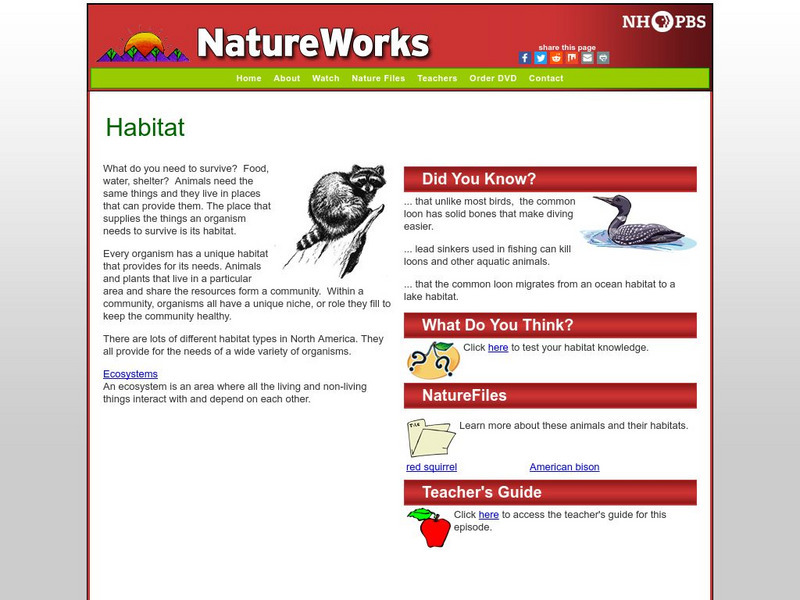
Nh Pbs: Nature Works: Habitat
What do you need to survive? Food, water, shelter? Animals need the same things and they live in places that can provide them. This informative site looks at the characteristics, range, habitat, food, reproduction and behavior of the red...
PBS
Pbs Learning Media: Grassland Elephants
This video segment from Nature features a greeting ceremony by grassland elephants in Kenya.
Buck Institute
Buck Institute for Education: Pblu: Schoolyard Habitat Project
An example of a project-based learning opportunity that engages students in learning what a healthy habitat is by working within the school's campus to increase opportunity for animals to find food and shelter, maintaining plants, and...
University of Illinois
University of Illinois Extension: Natural Resources, Environment, and Ecosystems
A collection of lesson plans for specific age levels to help students gain a better understanding of animals, plants, and people, and how they affect each other in ecosystems. Many of the activities provide discussion questions and...
CK-12 Foundation
Ck 12: Episd: Ecosystems
[Free Registration/Login may be required to access all resource tools.] Explore ecosystems and ecology on an introductory level uncovering fact about types of ecosystems and the competitive exclusion principle.
CK-12 Foundation
Ck 12: Episd: Habitat and Niche
[Free Registration/Login may be required to access all resource tools.] Students will identify and present the differences between a habitat and a niche.
American Museum of Natural History
American Museum of Natural History: Welcome to Dzanga Sangha
Connect the dots to investigate three different habitats either the forest, bai or river of the rain forest. By connecting the dots students make a food chain to see how organisms in each habitat depend on each other.
TeachEngineering
Teach Engineering: Marine Mapping
The marine environment is unique and requires technologies that can use sound to gather information since there is little light underwater. The seafloor is characterized using underwater sound and acoustical systems. Current...
American Museum of Natural History
American Museum of Natural History: Dive Into Worlds Within the Sea
Think and Link to investigate three different ecosystem either the deep sea, coral reef or continental shelf. By connecting the dots students make a food chain to see how organisms in each habitat depend on each other.