Hi, what do you want to do?






PBS
The Dinosaurs That Evolution Forgot
Where are all the east coast dinosaurs? Why don’t we find famous species like Triceratops in Central Park? Turns out, evolution and geology came together to make the east coast into an ancient lost world of weird dinosaurs.
PBS
Darwin's Unexpected Final Obsession
After having solved the small matter of evolution by natural selection - becoming one of the most famous scientists in the world in the process - Charles Darwin turned his focus to a different personal obsession…
PBS
When Mammals Only Went Out At Night
For decades, scientists believed dinosaurs were diurnal and tiny mammals were nocturnal. But as researchers have uncovered more mammalian fossils and studied the biology of different dinosaur species, they’ve found some surprising results.
PBS
How the Egg Came First
The story of the egg spans millions of years, from the first vertebrates that dared to venture onto land to today’s mammals, including the platypus, and of course birds. Like chickens? We’re here to tell you: The egg came first.
Bozeman Science
LS4A - Evidence of Common Ancestry and Diversity
In this video Paul Andersen describes several types of evidence for common ancestry. This evidence is contained in the fossils, embryos and molecules of living organisms. Even though life on our planet is incredibly diverse there are...
SciShow
Did Dinos Dance? And Other Behavior Questions
Dinosaurs were social animals, moving in herds, hunting in packs, but could they dance?
SciShow
Hyenas Once Lived in the Frigid Arctic
Prehistoric teeth prove that hyenas once roamed the Arctic and the relationship between ancient crocodiles and climate is more complicated than we thought.
Bozeman Science
Genetic Drift
Paul Andersen describes genetic drift as a mechanism for evolutionary change. A population genetics simulator is used to show the importance of large population size in neutralizing random change. The near extinction of the northern...
Bozeman Science
Evidence of Evolution:
Paul Andersen describes pieces of evidence that Charles Darwin used to support the idea of evolution and his process of natural selection. He begins with the following evidence use in the Origin of Species; artificial selection,...
Bozeman Science
ESS1C - The History of the Earth
In this video Paul Andersen explains in more detail the history of the Earth. He shows how the history of the Earth is written in the rocks that are built up over time. Fossils allow us to compare different rock layers relative to one...
PBS
The Enduring Legend of the Loch Ness Monster
The infamous "Surgeon's Photograph" of the Loch Ness Monster, taken in 1934, greatly boosted the legend's popularity. The photo made Nessie a cultural icon and international tourist attraction. Despite later information that proved the...
Curated Video
Homo Habilis and Boisei
2 million years ago, two species of apeman had evolved different strategies to survive the African environment. When the landscape changed, which would continue on the path to becoming human, and why? Biology - Adaptation And Evolution -...
Curated Video
Homo Ergaster
Homo ergaster had a huge brain and lived in complex social groups, but his evolution was stunted for a million years, until he discovered fire. Biology - Adaptation And Evolution - Learning Points. Homo ergaster evolved from homo habilis...
Visual Learning Systems
The Classification of Organisms: Taxonomy
For thousands of years scientists have named and categorized the vast array of life on Earth. This series of videos highlights the major advances concerning the classification of life, more specifically focusing on current trends in...

PBS
Pbs Learning Media: Finding Lucy
This Evolution video segment depicts the landmark hominid fossil finds by Don Johanson and his team in Ethiopia. [4:32]
PBS
Pbs Learning Media: Evolving Ideas: How Do We Know Evolution Happens?
This video from Evolution focuses on one of the several lines of evidence for evolution -- fossils, highlighting the evolution of whales from land-dwelling mammals to the aquatic creatures we know today. [6:58]
PBS
Pbs Learning Media: Permian Triassic Extinction
In this video segment from Evolution: "Extinction!", geologist Peter Ward discusses evidence for a Permian-Triassic mass extinction. [2 min, 20 sec]
BBC
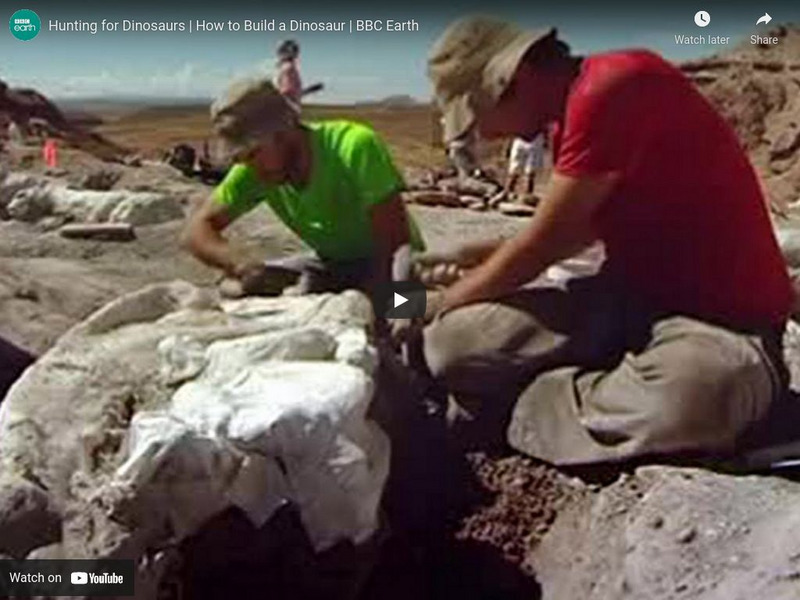
Bbc Earth: Hunting for Dinosaurs How to Build a Dinosaur
Luis Chiappe and his team of paleontologists excavate a dinosaur. Working out what species the dinosaur is won't be possible until the bones are back in the lab in Los Angeles. [3:03]

BBC
Bbc Earth: How to Build a Dinosaur: The Color of Dinosaurs
Professor Mike Benton has the fossilized remains of a dinosaur that are so well preserved that it is possible to discern the color of the feathers on the dinosaur. [3:04]
Sophia Learning
Sophia: Fossils
This lesson provides a timeline of fossils while also discussing the different types, locations, and geology of various fossils. [4:13]
Annenberg Foundation
Annenberg Learner: The Habitable Planet: Many Planets, One Earth (Video)
With this resource, users learn how rocks from millions of years ago give evidence of the emergence of oxygen in Earth's atmosphere. Make the connection between this evidence and the presence of complex animal life on our planet. [28:27]