Hi, what do you want to do?






Mediacorp
Deforestation and Rising Sea Levels in Bangladesh
This video discusses the importance of the Sunderbans mangrove forests in Bangladesh, which act as a barrier between freshwater sources and the sea. However, deforestation for timber and rising sea levels are threatening the survival of...
Weatherthings
Weather Things: Hurricane Forecasting
For their size and impact, hurricanes are often called the greatest storms on Earth. They expend a tremendous amount of energy through the water cycle, and through wind, to maintain the balance of the atmosphere. Known by different names...
Weatherthings
Weather Things: Floods
The cycle of water from the air to the ground to the oceans and back to the air never ends. Water is found in the air, in the ground, in rivers and oceans, and it's found as gas, liquid, and solid. As it moves though phases and locations...
Let's Tute
Understanding Floods: Causes, Consequences, and Prevention
This video explains the causes of floods and their devastating consequences on a nation's economy, environment, and people. It also discusses the factors that contribute to floods and how they can be prevented through water conservation...
Curated Video
Understanding and Preparing for Hurricanes
This video provides an informative overview of hurricanes, explaining their characteristics, formation, and the potential damage they can cause. It also highlights the importance of forecasting and preparedness measures in mitigating the...
Tumble Science Podcast for Kids
The Hurricanes of the Future
Hurricanes are huge storms that can cause major damage and destruction. Scientists predict that hurricanes will gain in strength due to climate change. Since nothing can be done to stop hurricanes, scientists are working on methods to...
Barcroft Media
Storm Chaser Braves 2017’s Most Dangerous Weather
The year 2017 has been an intense year for storms, especially across the USA, as this veteran storm chaser’s archive shows. Jason Weingart has been an avid storm chaser since 2009, but 2017 has been a particularly challenging year,...
Mediacorp
The Shift to Renewables in Developing Economies
This video highlights the challenges faced by developing economies, particularly Bangladesh, in transitioning from fossil fuels to renewable energy. It showcases the environmental pollution caused by reliance on fossil fuels and the...
Weatherthings
Hurricane Sandy: The Meteorology
What led to the unique path of Hurricane Sandy in 2016 and why it had such a large impact, as the second most-costly hurricane to hit the United States in modern times. It was nicknamed a superstorm for the wide impact it had in the...
Ancient Lights Media
Bangladesh
Video Atlas of Asia: This clip looks at the physical features, climate and culture of Bangladesh.
Ancient Lights Media
Atlas of the United States: Louisiana
This clip explores the geography, history, and some important cultural features of Louisiana.
Kids Learning Videos
Hurricanes - Learning about Hurricanes for kids and children
A hurricane is a huge storm with powerful winds and lots of rain. They can be up to 600 miles across, and make a spiraling shape.
Hurricanes are formed over water in tropical areas, and use warm water as energy. They can move...
Hurricanes are formed over water in tropical areas, and use warm water as energy. They can move...
AllTime 10s
10 Civilizations Wiped Out By Nature
Sometimes, Mother Nature just decides to ruin an entire culture for the hell of it. From an Egyptian city sinking into the ground to ancient Antarcticans being hit with an asteroid, these are 10 Civilizations Wiped Out By Nature.
Weatherthings
Weather Things: Hurricane Safety
For their size and impact, hurricanes are often called the greatest storms on Earth. They expend a tremendous amount of energy through the water cycle, and through wind, to maintain the balance of the atmosphere. Known by different names...

Curated OER
Flooding in Canutillo
In 2006 there was a terrible storm that led to the flooding of the small town of Canutillo. Listen and watch as a young boy describes the causes and effects of this flood. This is a very interesting video because the boy interviews and...

Curated OER
4 Degrees Warmer: Great Cities Wash Away
Our planet, if four-degrees warmer, will be "unrecognizable" according to one scientist. Flooding will be rampant and rivers like the Ganges will self-destruct. See what else could happen in "5 Degrees Warmer..." following this clip.

Curated OER
5 Degrees Warmer: Civilization Collapses
Imagine the world five degrees warmer: large, uninhabitable deserts span across the globe, forcing refugees to flee to cooler areas with water. Human civilization may very well diminish as social systems break down and people turn...

Curated OER
Could Just One Degree Change the World?
A one-degree change in the earth's climate does not seem like a problem, but the rate at which our climate is changing is frightening. Of all the recorded temperature changes, our planet is currently warmer than it has ever been. If the...

Curated OER
6 Degrees Warmer: Mass Extinction?
In this final clip of climate change by National Geographic, a "doomsday scenario" is shown. Truly, six degrees difference will change the world as we know it, having devastating effects on all life forms. Let's prevent this by making...

National Science Foundation
National Science Foundation: When Nature Strikes: Flash Floods
Flash floods can happen anywhere, but factors such as heavy precipitation, geography and soil conditions can put some areas at greater risk. Russ Schumacher at Colorado State University is studying these factors to make more accurate...

Science Friday Initiative
Science Friday: A Tale of Two Coastlines, Skirted by Swelling Seas
Reports from the National Research Council and the U.S. Geological Survey say that sea levels on both coasts of the United States are rising at an accelerating rate. Oceanographer Peter Howd talks about what's pushing up the oceans, and...
Bozeman Science
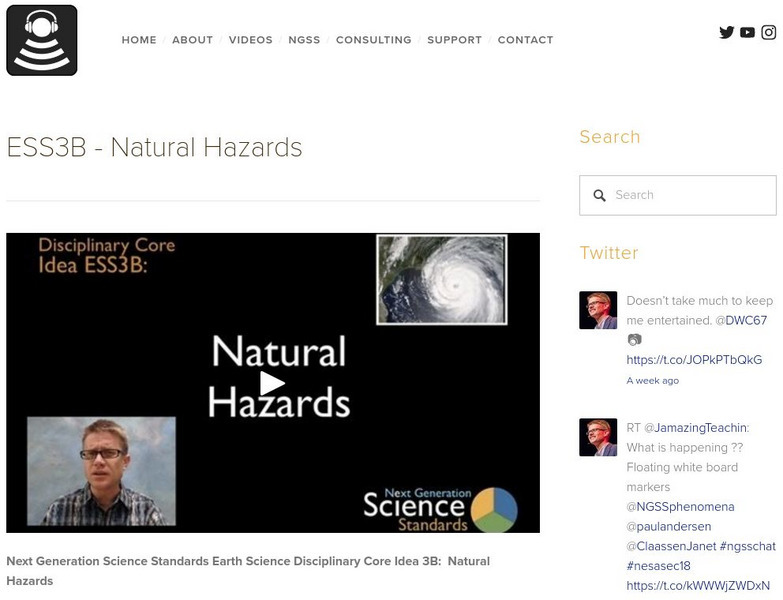
Bozeman Science: Natural Hazards
In this video, Paul Andersen explains how natural disasters (like earthquakes, tsunamis, volcanoes and flooding) have affected and will continue to affect humans on the planet. Many of the natural hazards (like volcanoes and storms) can...