Hi, what do you want to do?






Curated Video
Varying sentences and using anecdotes to express a viewpoint
Pupil outcome: I can effectively express a viewpoint in an engaging and persuasive way. Key learning points: - When expressing a viewpoint in a persuasive piece of writing, it’s important to create a rapport with the audience. -...
Curated Video
Analysing a persuasive speech
Pupil outcome: I can analyse the writer's choices of rhetorical and persuasive devices. Key learning points: - Looking for patterns within the language makes analysis more perceptive. - Having an awareness of the text as a whole enables...
Curated Video
Considering and emulating the use of direct address in the opening of a speech
Pupil outcome: I can use direct address to structure the opening to a speech in a way that engages the audience. Key learning points: - A speech is different to other types of writing since it is designed to be delivered aloud. - Speech...
Curated Video
Revising and editing non-fiction writing
Pupil outcome: I can use effective editing strategies to revise and rewrite a response. Key learning points: - Revising and editing written work is a great way to improve our writing skills overall. - Improving vocabulary choices and...
Curated Video
Education for poor Victorian children
Pupil outcome: I can explain how emotive language is used to discuss poverty in Victorian Britain. Key learning points: - There was no compulsory schooling in Victorian Britain. - Education was a luxury only the rich could afford. -...
Curated Video
Analysing and emulating the use of sound in slam poetry
Pupil outcome: I can understand how a slam poet creates sound, and use this understanding to create my own refrain and stanza. Key learning points: - Sound is an important feature of slam poetry, it adds to the dynamic and energetic...
Curated Video
Improving your opinion article on Gothic literature
Pupil outcome: I can use new knowledge to improve my own writing. Key learning points: - Rhetorical questions need to be ‘targeted’ - personalised to the situation or moment, and used with an aim in mind. - Using emotive language in...
Curated Video
Using Commas: Direct Address
Using Commas: Direct Address teaches how to use of commas to set off words from the rest of the sentence by writing five complete sentences, each of which contains a direct address followed by a comma.
Schooling Online
Virginia Woolf's A Room of One's Own - Theme of Sexism and Female Oppression
It’s easy to forget that the rights and privileges women enjoy today had to be won. It’s been a tough, centuries-long fight against staunch opposition, especially for female writers. Woolf would know! Join us for a detailed analysis of...
Cerebellum
English Punctuation: Dependent Clauses and Commas continued
Learn how to use commas for fun and profit, and how to make colons work for you. We continue looking at pauses in a sentence, with a focus on dependent clauses and how to support them. This is part 1 in the series: 'English Punctuation...
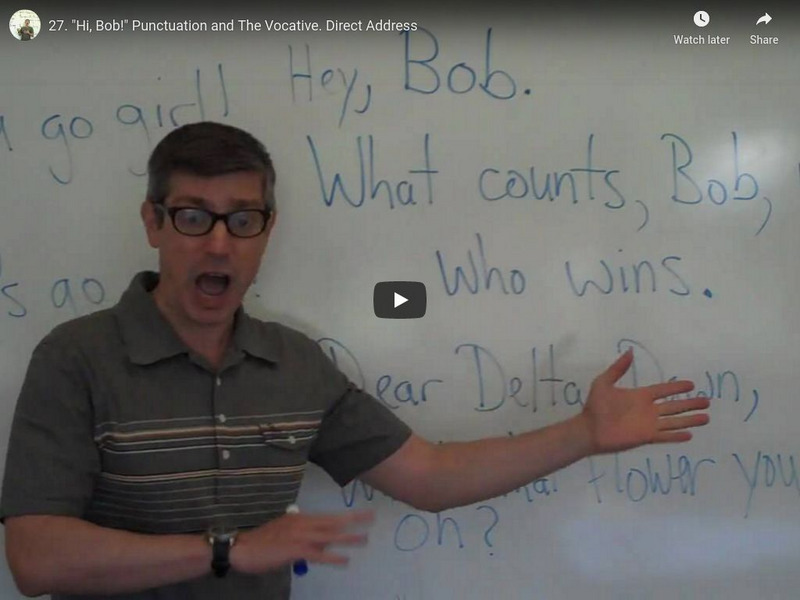
Yossarian the Grammarian
Yossarian the Grammarian: "Hi, Bob!" Punctuation and the Vocative
This video lesson from Yossarian the Grammarian demonstrates how to punctuate a direct address.

Khan Academy
Khan Academy: More Uses for Commas
David and Paige, KA's resident grammarians, discuss tag questions, yes and no statements, and direct address -- all situations where the comma is super useful.