Hi, what do you want to do?






SciShow
What Would Happen if Mosquitoes Went Extinct?
Do mosquitoes serve a purpose in the ecosystem? As one of the most hated creatures on the planet, some people have wondered why we don't just kill them ALL? Let's unpack this issue, with SciShow!
SciShow
Killing Mosquitoes With a Flip of a Gene
Eliminating certain species of mosquitoes could make summertime more enjoyable and cut down on the transmission of certain diseases. And scientists are looking into doing this by manipulating a single gene!
Crash Course
How Does Disease Move? Crash Course Geography
From outbreaks of measles in the United States and cholera in Haiti to patterns of lead poisoning near gold mines in Nigeria, medical geographers play an important role in tracking disease in the landscape. Today, we're going to look at...
SciShow
Good News, & Drinking Pigs
The SciShow Science News Bureau brings us some GOOD news this week - Hank tells us about a newly developed vaccine for dengue fever, a newly discovered monkey species in the Democratic Republic of the Congo, and some happy pigs drinking...
SciShow
Another Zika Update & Quantum Physics Gamers
Today on SciShow News: We've learned more about the Zika virus, and we'll tell you how gamers are helping to develop quantum computers.
SciShow
What If We Killed All the Mosquitoes?
With the Zika virus in the news, some people have wondered why we don't just kill them ALL.
SciShow
Arctic Bison Mummy!
SciShow News explains how Wikipedia has been used to track, and even predict, outbreaks of disease all over the world, and then introduces you to the most complete naturally mummified bison ever found.
SciShow
Killing Mosquitoes With a Flip of a Gene
Eliminating certain species of mosquitoes could make summertime more enjoyable and cut down on the transmission of certain diseases. And scientists are looking into doing this by manipulating a single gene!
TED Talks
Hadyn Parry: Re-engineering mosquitos to fight disease
In a single year, there are 200-300 million cases of malaria and 50-100 million cases of dengue fever worldwide. So: Why haven't we found a way to effectively kill mosquitos yet? Hadyn Parry presents a fascinating solution: genetically...
Curated Video
These Diseases Love a Warmer World But Which Should We Worry
As our world gets warmer and our climate gets more extreme, the weather isn’t the only thing that’s changing and becoming more dangerous. Disease vectors are also spreading and becoming riskier to humans. In this episode of Weathered, we...
The Guardian
Life as a Migrant in Southern Italy
After a harrowing journey from Northern Africa to Southern Italy, Fata and Yankuba are stuck in rural Italy, unable to work and waiting for papers. From racism to boredom to inconsistent electricity, learn about some of the difficulties...
Curated Video
Visual Memory Techniques: A Step by Step guide for fast memorization.
Visual Memory techniques or Visual Mnemonics are one of the secret study tips successful Visual Learners use. Learn why Visual memory is the fastest to recall.
<
br/>
Visual mnemonics have the lowest memory capacity. Learn How...
<
br/>
Visual mnemonics have the lowest memory capacity. Learn How...
Science360
Marine Mammals' Need for Speed!
In this episode of NSF Science Now, we also learn about a new tool for combating mosquito-borne disease, we explore how kirigami is inspiring new materials, and finally, we discover new hydrothermal vents. Check it out!
Science360
NSF SCIENCE NOW: EPISODE 51
In this week's episode, we learn about marine mammals' need for speed, magnify a new tool combating mosquito-borne disease, break down new materials inspired by kirigami, and finally, discover new hydrothermal vents. Check it out!
Next Animation Studio
Philippines declares national dengue epidemic
Dengue is now a national epidemic in the Philippines.
JJ Medicine
Dengue Fever | Pathophysiology, Symptoms, Diagnosis & Treatment
Dengue Fever & What You Need to Know, including Pathophysiology, Symptoms, Diagnosis & Treatment. Dengue fever is a viral infection with potentially fatal consequences. In this lesson, we discuss how people are infected with Dengue...
Mediacorp
Genetically Altering Mosquitoes to Reduce the Spread of Dengue Fever
Editing the genes of humans is not yet legal in many countries, but editing the genes of other creatures is. Learn how one scientist is editing the genes of mosquitoes to reduce the spread of dengue fever - and some of the risks this...
msvgo
Common Viral Diseases in Humans
This nugget describes common viral diseases in detail with respect to their causative agents, symptoms, diagnosis, treatment and methods of prevention.
Next Animation Studio
Florida releasing millions of genetically modified mosquitoes
Health experts are releasing 750 million genetically modified mosquitoes in the Florida Keys to reduce local populations of disease-carrying mosquitoes, according to local news reports.
SWPictures
KILL OR CURE - A Vaccine for Dengue
Dengue fever affects up to 100 million people every year, mainly children. It kills about 20,000 – and they die from what is known as dengue shock syndrome. The hunt is now on for a vaccine. Sanofi pasteur and GSK, two of the biggest...
SWPictures
Dengue Fever Outbreak in Jakarta: The Fight Against Mosquitoes
This video highlights the growing concern over dengue fever in Jakarta, a disease that is blamed on climate change. The Indonesian government has set up an emergency system to halt its spread, and the community is responding by...

Science Friday Initiative
Science Friday: Mosquitoes Engineered to Kill Their Own Kind
Researchers hope to crash populations of dengue-transmitting mosquitoes, using genetic engineering. [12:19]
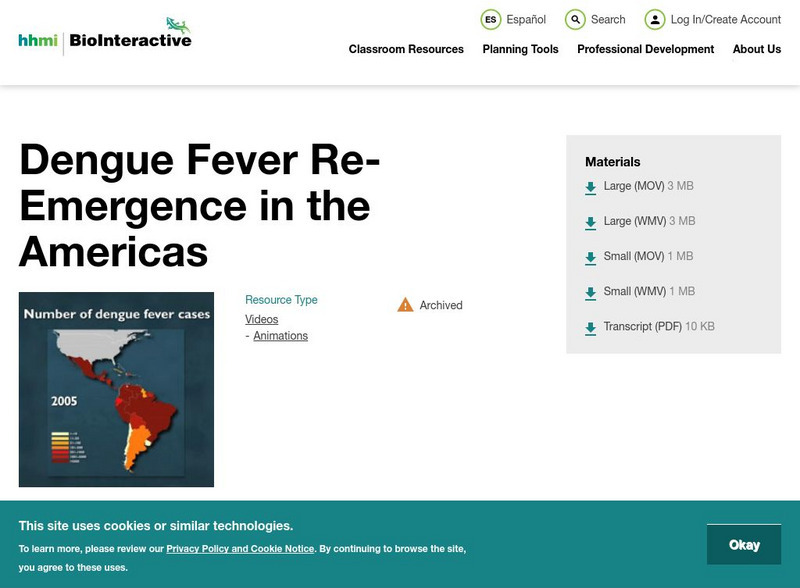
Howard Hughes Medical Institute
Hhmi: Biointeractive: Viral Outbreak: Dengue Fever Re Emergence in the Americas
See how far the dengue fever virus has spread throughout the Americas since the 1960s. [0:24]
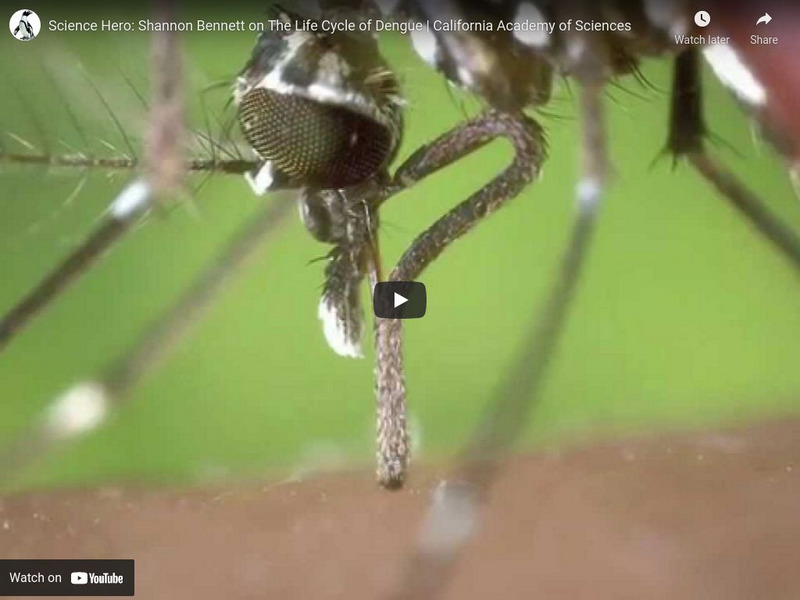
California Academy of Sciences
Ca Academy of Sciences: Science Heroes: Shannon Bennett, Life Cycle of Dengue
Shannon Bennett studies the mosquito species most responsible for the spread of dengue, which is particularly good at transmitting human pathogens because it has adapted to feed efficiently on humans. [0:55]