Hi, what do you want to do?






TMW Media
Present Simple Tense - Summary and examples
This lesson teaches Present Simple Tense Sentence Forms (Positive, Negative, Question), Contractions (Does Not/Doesn't, Is Not/Isn't), Pronunciation (Voiced and Voiceless Sounds, Words Endings (S, CH, IZ).
Professor Dave Explains
Types of Tissue Part 3: Muscle Tissue
With epithelial tissue and connective tissue down, it's time to learn about the third type of tissue, and that's muscle tissue. This makes up all the muscles in our bodies, and it comes in three types. Those are skeletal muscle, cardiac...
Curated Video
Muscle Types
In this live-action program viewers will learn that the there are three muscle types; cardiac, smooth and skeletal. Students will come to understand that all muscles consist of long muscle cells bundled together into muscle fibers. The...
Professor Dave Explains
The Circulatory System Part 1: The Heart
The heart! What a symbol of love and affection. But does emotional processing really take place in the heart? Sorry romantics, but no. That's the brain's business. But the heart is still miraculous. It is a completely natural pump whose...
Professor Dave Explains
The Mechanism of Muscle Contraction: Sarcomeres, Action Potential, and the Neuromuscular Junction
We've learned about the types of muscle, including skeletal muscle, and we know then when these muscles contract, we are able to move our bodies around. But how exactly does this happen on the molecular level? There is an astonishing...
Rachel's English
How to Introduce Yourself -- American English Pronunciation
Get more comfortable introducing yourself in English with the video that goes over some common phrases we use when introducing ourselves!
Curated Video
Mastering Homophones: Its vs. It's
In this video, the teacher guides students through a lesson on the correct usage of the homophones "its" and "it's." The lesson includes explanations of contractions, possessive pronouns, and examples of sentences using the homophones....

Curated OER
How To Get an Egg in a Milk Bottle
Have you ever seen an egg squeeze through a milk bottle? Show your class this experiment to illustrate expansion and contraction. Where else do we see these at work?

Curated OER
How To Make a Simple Bulb Thermometer
Nearly 400 years have passed since the thermometer was first created! But guess what? The principles are still the same. It works based off of expansion and contraction. Have small groups create thermometers and test them out in...

Sophia Learning
Sophia: Muscle Contractions: Micro Level: Lesson 1
This lesson will go into more detail describing how a muscle contracts. It is 1 of 4 in the series titled "Muscle Contractions: Micro Level."

Crash Course
Crash Course A&p #22: Muscles, Part 2 Organismal Level
Hank calls in a friend to do his push ups for him today to explain how skeletal muscles work together to create and reverse movements. Hank and Claire also demonstrate the role size plays in motor units, the three phase cycle of muscle...
Sophia Learning
Sophia: Apostrophes
A brief audiovisual presentation that explains what an apostrophe is and its three main uses [3:22]
Sophia Learning
Sophia: Apostrophes and Contractions
A screencast lesson introducing contractions and explaining how to use apostrophes when forming contractions. [2:56]
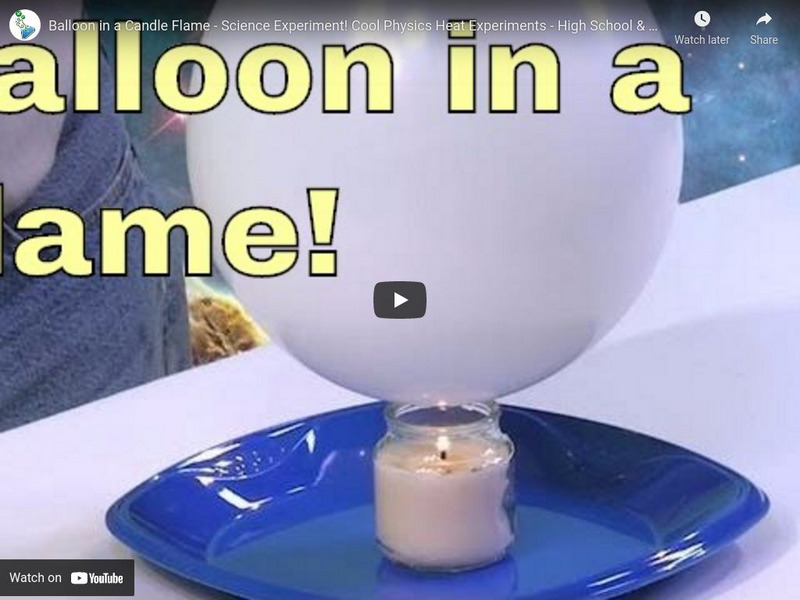
Curated Video
Math Tutor Dvd: Balloon in a Candle Flame Science Experiment
In this cool science experiment, you will see how you can put a balloon directly into a candle flame and the balloon will not burst. The power of heat conduction makes this possible. Have fun while learning about heat transfer and energy...

Khan Academy
Khan Academy: Introduction to the Apostrophe
David and Paige, KA's resident grammarians, introduce a new piece of punctuation: the apostrophe!

Khan Academy
Khan Academy: Introduction to Contractions
Apostrophes are great at standing in for missing letters, allowing us to shorten words. Paige and David discuss contractions and the Principle of Least Effort.
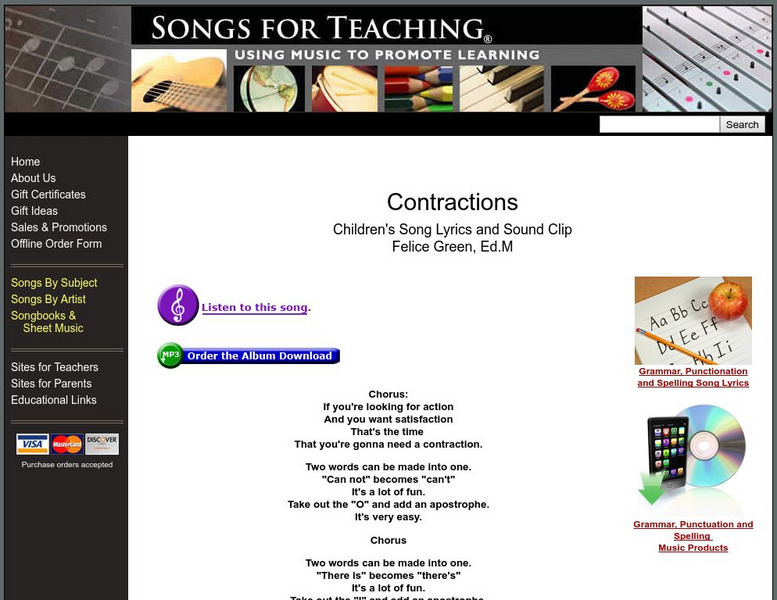
Songs for Teaching
Contractions Song for Learning
Contractions are easy when you use this song to help you remember how to form them.
Songs for Teaching
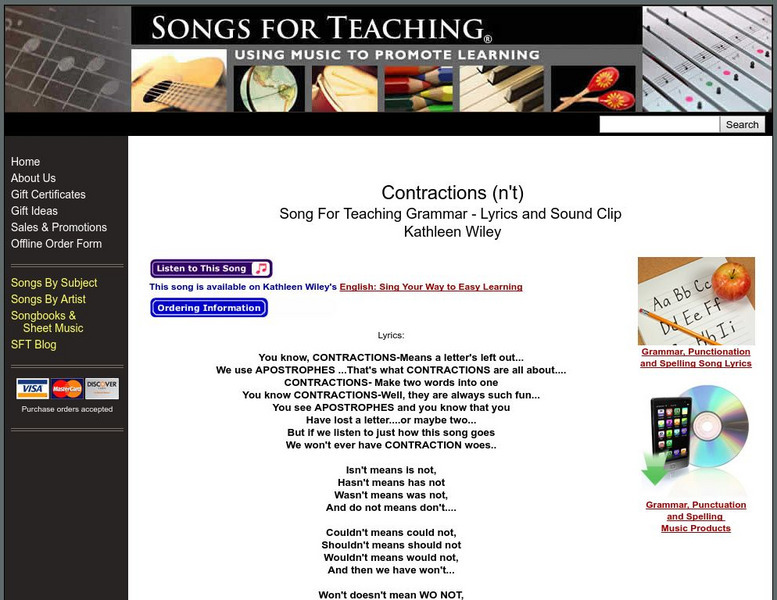
Songs for Teaching: N Apostrophe T
Learn this simple contraction with this clever song.