Hi, what do you want to do?






MinuteEarth
Why Is There So Much Land In The North?
Most of Earth’s land is currently in the northern hemisphere because we happen to exist in a time where uneven heating in the mantle has pushed many continental plates northward.<br/>
SciShow
Did Earth's Continents Come from Space?
Earth didn't always have the land beneath your feet, but what might have caused it to form is a bit of a mystery.
PBS
The World Before Plate Tectonics
There was a time in Earth’s history that was so stable, geologists once called it the Boring Billion. But the fact is, this period was anything but boring. In fact, it set the stage for our modern version of plate tectonics - and...
SciShow
Without Volcanoes, Earth Might be Dead
You might think of plate tectonics as destructive since it's the ultimate force behind earthquakes, tsunamis, and volcanic eruptions. But the slow movement of our planet's surface does a lot more than shake things up now and then. Some...
SciShow
How Earth Recycled a Mountain Range
Mountains take can take billions of years to form, but the Adirondack Mountains got ahead by recycling itself.
SciShow
The Complicated Lives of Mountains | Compilation
It’s easy to discount the history and evolution of mountains on our jagged world, but they really hold an immense amount of information about history within them. From mountain ranges in space, to why Earth isn’t a waterworld, here are...
TED-Ed
TED-Ed: Why is Mount Everest so tall? - Michele Koppes
At 8,850 meters above sea level, Qomolangma, also known as Mount Everest, has the highest altitude on the planet. But how did this towering formation get so tall? Michele Koppes peers deep into our planet's crust, where continental...
Curated Video
Fold Mountains: Formation
Where are fold mountain ranges found on our planet? And how do the movements of tectonic plates affect their growth? Earth Science - Geology - Learning Points. A Fold mountain forms over millions of years by a process called orogeny....
Curated Video
Basalt
A dark, fine-grained igneous rock that forms most of the Earth's crust. A Twig Science Glossary Film. Key scientific terms defined in just 60 seconds using stunning images and concise textual definitions. Twig Science Glossary Films...
Incorporated Research Institutions for Seismology
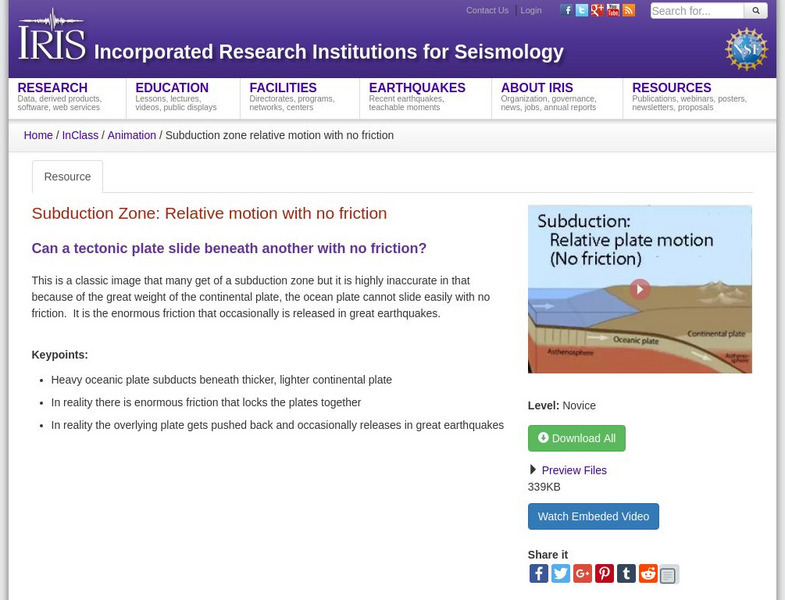
Iris: Subduction Zone: Relative Motion With No Friction
See how converging oceanic and continental tectonic plates react to one another.