Hi, what do you want to do?






SciShow
Tsunamis... From the Sky?
Scientists have developed reliable early warning systems for tsunamis caused by earthquakes. The problem is, earthquakes aren't the only things that cause tsunamis.
SciShow
Cymatics: Turning Sound into Art
Sound waves vibrate more than just our eardrums, they can also make visual art!
Bozeman Science
Wave Superposition
In this video Paul Andersen explains how waves interact when moving through one another. Unlike particles waves can interfere both constructively and destructively. The amount of interference is determined through the superposition...
SciShow
Good Vibrations
Can you feel them in your fingers? How about in your lungs? Vibrations are all around us, so let’s explore some everyday vibrations!
Bozeman Science
Beats
In this video Paul Andersen explains how beats are created through interference of waves with similar frequencies. The changes in amplitude are caused by destructive and constructive interference. The frequency of beats is equal to the...
Bozeman Science
Wave Interference
In this video Paul Andersen explains how waves interact with objects and with other waves. When a wave hits a fixed object it will be reflected and inverted. When a wave hits a free object it will be reflected without being inverted. ...
Bozeman Science
Interference Patterns
In this video Paul Andersen explains how constructive and destructive interference can create interference patterns. Interference patterns can be created by all types of waves, including water, sound, and light. A classic experiment...
Crash Course
Spectra Interference: Crash Course Physics
Light is everywhere … but it’s not as predictable as you might think. It’s a wave that travels in straight lines, yet it also reflects off of surfaces, refracts through various materials, and generally changes direction all the time!...
Higgsino Physics
Does Quantum Mechanics Apply to Large Objects?
Why Quantum mechanics applies to more than just the smallest particles. And how quantum mehcnaics converges to the classical limit depending on the de brogile wavelength.
We explore the double slit experiment and discover bucky...
We explore the double slit experiment and discover bucky...
Flipping Physics
AP Physics 1: Review of Mechanical Waves
Review of the Mechanical Waves topics covered in the AP Physics 1 curriculum.
Professor Dave Explains
Examples of s-p Mixing in Molecular Orbital Theory
Admittedly, my prior tutorial on MO theory was a little confusing, and had some errors. I wanted to make things right, so here's another one! This will clarify some of the basic concepts, and will also extend them to discuss a new...
Visual Learning Systems
Sound: Interactions of Sound Waves
When you hear the roar of traffic, the bark of a dog, or your teacher's voice, you are experiencing sound. This program uses colorful animations to explore important characteristics of sound, including intensity, loudness, pitch, and...
Flipping Physics
Standing Waves Introduction
Reflection with and without inversion caused by fixed and free ends are demonstrated. Standing wave patterns at 5 different frequencies are demonstrated. A standing wave animation is shown to understand to how standing wave patterns are...
Flipping Physics
Demonstrating Beat Frequency - A Video Project by Bo
Bo teaches us about beat frequency. You get to hear what beats sound like, see the constructive and destructive interference wave forms, and learn a practical application of beats while tuning a guitar.
Curated Video
The Science of Iridescence
This video explores the concept of iridescence, where seemingly colorless or differently colored surfaces change their color when viewed from different angles. It explains how iridescence occurs through mechanisms like thin film and...
Professor Dave Explains
Interference, Reflection, and Diffraction
Light and sound waves do all kinds of cool stuff, because they can be in the same place at the same time, unlike matter. This creates patterns that are important to understand! Let's take a look.
Flipping Physics
Wave Superposition Introduction
The difference between wave and object interaction is demonstrated. Constructive interference, destructive interference, and total destructive interference via superposition are all demonstrated.

Curated OER
Physics Lab Demo : Ripple Tank
After explaining the basics of a ripple tank, the instructor introduces two sources of waves in order to show constructive and destructive interference. If you do not have a ripple tank, this would be a valuable visual to add to your...

Khan Academy
Khan Academy: Light and Electromagnetic Radiation: Wave Interference
A video lecture investigating when two waves superpose to create a resultant wave. This phenomenon called interference is discussed in detail in this video including what happens in constructive and destructive interference. Also learn...
Other
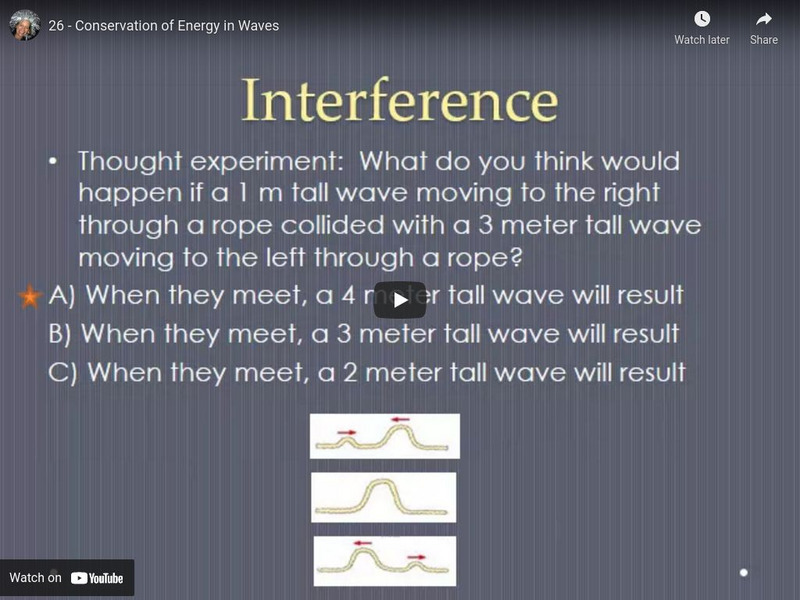
Conservation of Energy in Waves
High school teacher Kate Nichols explains that wave energy is equal to the amplitude of a wave. Looks at different scenarios where we may notice that wave energy is being conserved or not. The conversion of wave energy into another type...
Bozeman Science
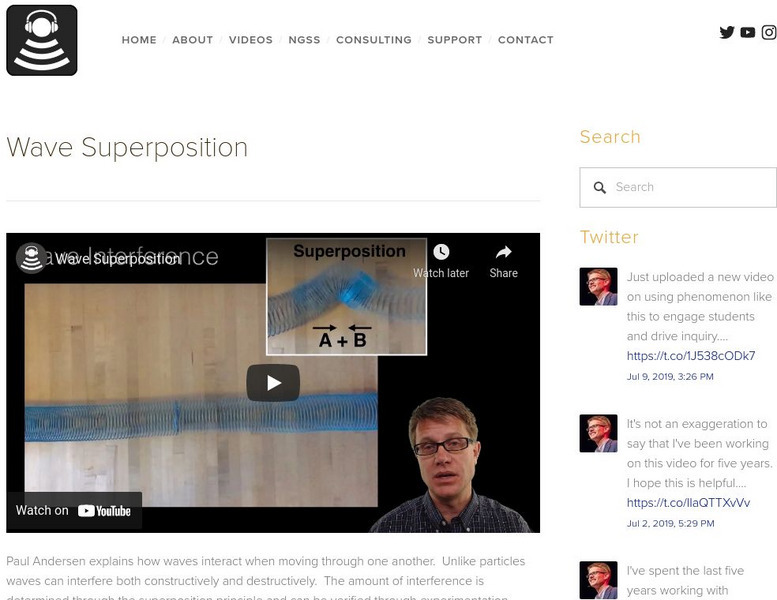
Bozeman Science: Wave Superposition
Paul Andersen explains how waves interact when moving through one another. Unlike particles waves can interfere both constructively and destructively. The amount of interference is determined through the superposition principle and can...
Bozeman Science
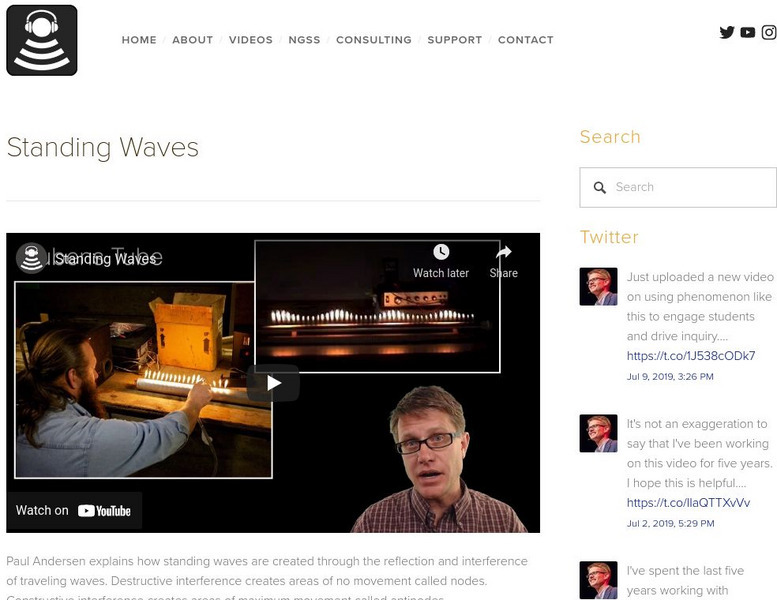
Bozeman Science: Standing Waves
Paul Andersen explains how standing waves are created through the reflection and interference of traveling waves. Destructive interference creates areas of no movement called nodes. Constructive interference creates areas of maximum...
Bozeman Science
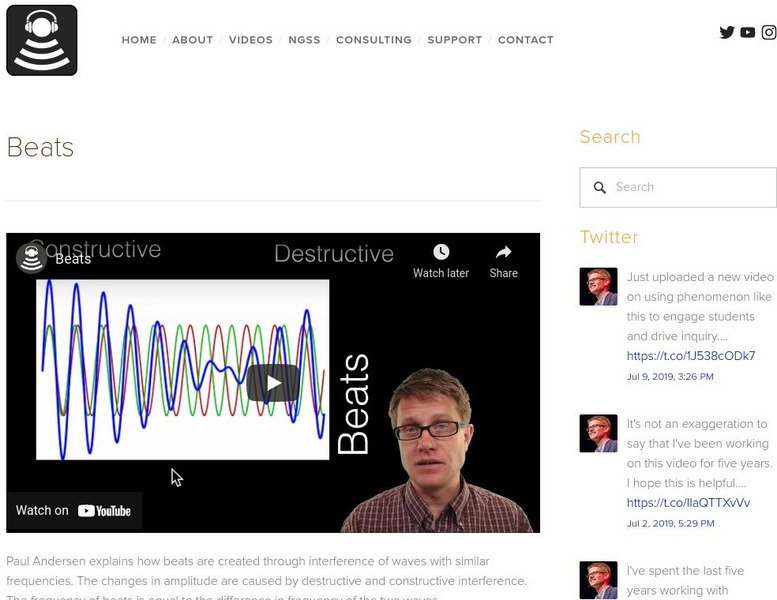
Bozeman Science: Beats
In the following video Paul Andersen explains how beats are created through interference of waves with similar frequencies. The changes in amplitude are caused by destructive and constructive interference. The frequency of beats is equal...