Hi, what do you want to do?






T. Trimpe
Atomic Basics
Get down to basics with these worksheets on the structure of atoms. Challenging young chemists to identify information from the periodic table and create Bohr diagrams and Lewis dot structures for different elements, this...

Mr. E. Science
Acids, Bases and Solutions
If you are not part of the solution, then you are part of the precipitate. The presentation covers solutions, suspensions, solubility, dissociation, and acid/base reactions. This is the 19th lesson in a series of 26.
Vision Learning
Visionlearning: Chemistry: The Nature of the Chemical Bond
This site talks about ionic, polar covalent, and non-polar covalent bonding.
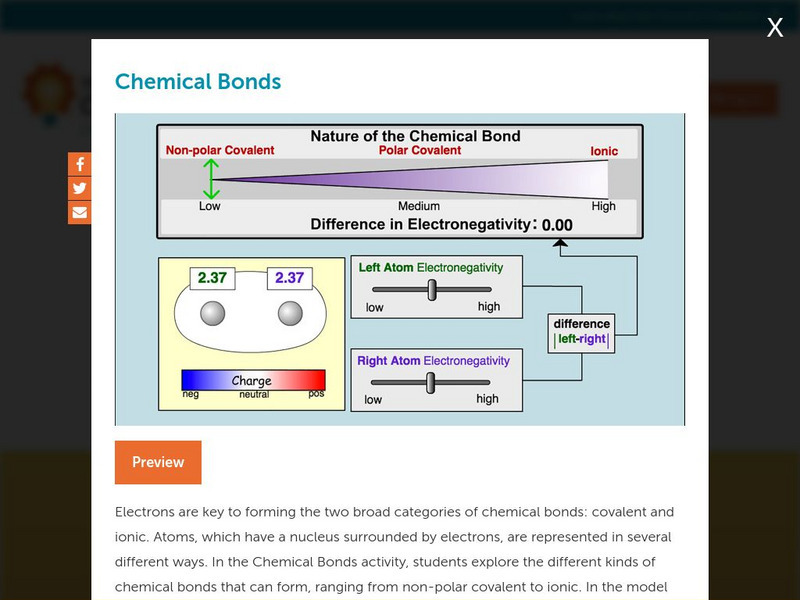
Concord Consortium
Concord Consortium: Stem Resources: Chemical Bonds
By working through this web-based activity, students differentiate between ionic, non-polar covalent, and polar covalent bonds. Specifically, distinctions are made between bonding types based on orbital shapes and electronegativity...
BBC
Bbc: Gcse Bitesize: Bonding: Covalent Bonds
This section of the lesson module focuses on covalent bonds, which are formed between non-metal atoms that share a pair of electrons. It includes links to a video and a test. Other types of chemical bonds are covered elsewhere in the...
Texas Education Agency
Texas Gateway: Ionic and Covalent Bonding
In this tutorial, students learn about ionic and covalent bonds and predict which elements will form which type of bond. Includes interactive exercises as well as videos.
CK-12 Foundation
Ck 12: Chemistry: Metallic Bond
[Free Registration/Login may be required to access all resource tools.] Describes the metallic bond and properties of metals. Includes review questions.
CPALMS
Florida State University Cpalms: Florida Students: Physical and Chemical Changes
Explore the differences between chemical and physical changes, including some examples at the atomic level.

American Chemical Society
Middle School Chemistry: Lesson Plans: Why Does Water Dissolve Sugar?
Lesson plan in which students design an experiment to determine if different types of liquids affect the amount of dissolution of an M&M candy shell.