Hi, what do you want to do?






Howard Hughes Medical Institute
EarthViewer
Can you imagine Washington DC and London as close neighbors occupying the same continent? Learners will be fascinated as they step back in time and discover the evolution of the earth's continents and oceans from 4.5 billion...

NOAA
History's Thermometers
How is sea coral like a thermometer? Part three of a six-part series from NOAA describes how oceanographers can use coral growth to estimate water temperature over time. Life science pupils manipulate data to determine the age of corals...

NOAA
Plate Tectonics I
Young geologists get a glimpse beneath the earth's surface in this plate tectonics investigation. After first learning about the different layers of the earth and the constant movement of its plates, young...
University of California
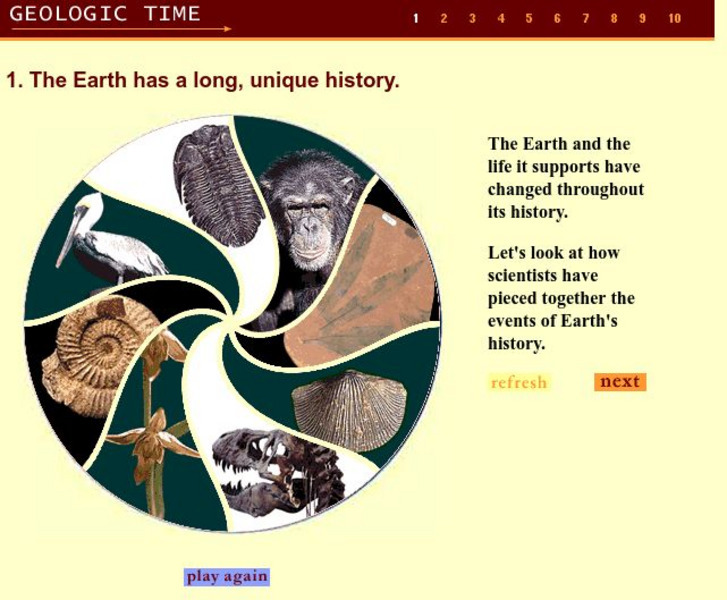
University of California Museum of Paleontology: Geologic Time
Learn about geologic time, including the age of the Earth by putting it in terms of pages in a book.
Georgia Department of Education
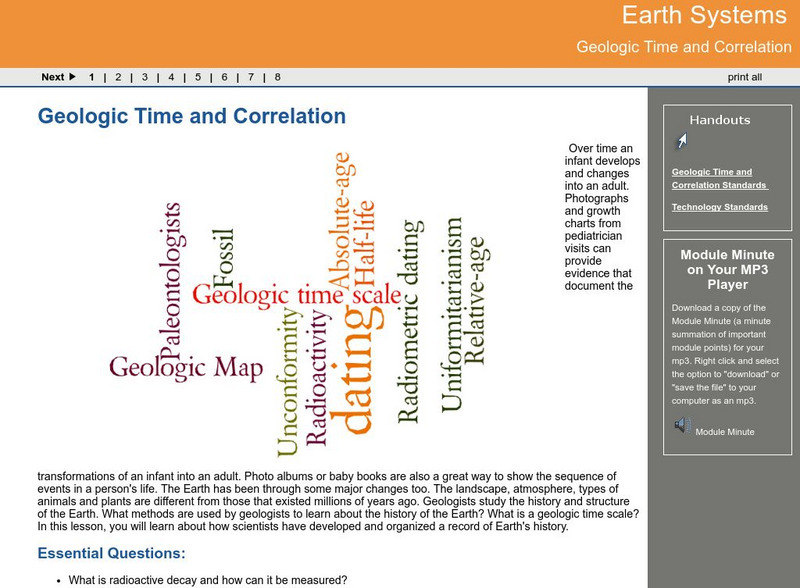
Ga Virtual Learning: Geologic Time and Correlation
In this amazing interactive tutorial you will learn about what methods are used by geologists to learn about the history of the Earth. Investigate a geologic time scale and learn about how scientists have developed and organized a record...

CK-12 Foundation
Ck 12: Fourth Grade Science: Earth Science: Relative Ages of Rocks
[Free Registration/Login may be required to access all resource tools.] Looks at how stratigraphy can be used to determine the relative ages of rocks, how unconformities occur, ways to match rock layers in different areas, and how...

TED Talks
Ted: Ted Ed: Four Ways to Understand the Earth's Age
The Earth is 4.6 billion years old- but how can humans relate to a number so colossal, and where do we fit on the geologic timeline? Joshua Sneideman reminds us of our time and place in the universe. [3:45]