Hi, what do you want to do?






Calisphere
The 6 C's of Primary Source Analysis
Arm your class members with the six C's of primary source analysis—content, citation, context, connections, communication, and conclusions—and help them to establish a solid system for analyzing historical sources of...

National Park Service
The Power of Remembrance
On every July 4th, we watch fireworks and celebrate our independence, but how is the history of the American Revolution preserved? Four social studies instructional activity guide learners through different memorials, commemorative...

Urban Education Exchange
Lessons and Units: The Watsons go to Birmingham—1963 5TH GRADE UNIT
Get ready to read The Watsons Go to Birmingham - 1963 with a lesson plan about historical fiction. Spanning several centuries, the resource prompts learners to guess the historical era of a story based on a word or...

Angel Island Immigration Station Foundation
How Do Pictures Tell the Story of Angel Island?
Young historians learn more about the history of Angel Island Immigration Station through their analysis of primary source images. Guided by a list of inferential questions, scholars learn how to make and record observations on a...

Center for History and New Media
The Daily Experience of the Laurel Grove School, 1925
What was daily life like for those attending segregated schools in 1925? Modern learners fill out a KWHL chart as they explore historical background and primary source documents about the Laurel Grove School in Fairfax County, Virginia....

Reading Through History
The Slaughterhouse Cases
Do modern citizens interpret the Fourteenth Amendment the way it was intended? Scholars study the Slaughterhouse Cases to see how judges interpreted the amendment in the 1800s. Following the reading on the subject, they answer...

Center for History and New Media
Slavery and Free Negroes, 1800 to 1860
What was life like for enslaved and free black people before the American Civil War? Explore the building tension between states and the freedom of individuals with a thorough social studies lesson. Learners of all ages explore...

Eastconn
Learning to Analyze Political Cartoons with Lincoln as a Case Study
Discover the five main elements political cartoonists use—symbolism, captioning and labels, analogy, irony, and exaggeration—to convey their point of view.

Mississippi Department of Archives and History
Protesting Violence without Violence
The ultimate legacy of Emmett Till's violent death is its role in the non-violent roots of the Civil Rights Movement. A lesson compares contemporaneous articles with the lyrics of Bob Dylan's "The Death of Emmett Till" and prompts...

Smithsonian Institution
Changing Gender Roles on the Home Front
Many historians discuss how gender roles changed because of World War II, but how did this come to be? An informative resource challenges scholars to do some digging and research the information for themselves. They research how...

Center for History and New Media
A Look at Virginians During Reconstruction, 1865-1877
The transition between rebellion to reunification was not smooth after the Civil War. Young historians compare primary and secondary source documents in a study of the Reconstruction era in Virginia, noting the rights that were not...

Center for History and New Media
The Impact of the Jim Crow Era on Education, 1877–1930s
Even though American slaves were officially emancipated in 1865, the effects of slavery perpetuated throughout the 19th and 20th centuries. Middle and high schoolers learn about the ways that discrimination and the Jim Crow laws...

ABCya
Ab Cya: Journey to the Past Tense
Follow Rivette on her journey to the past and help her collect historical artifacts! In this game, kids will use their knowledge of past tense verbs to help fuel Rivette's time machine. Time-traveling users will have to recognize the...
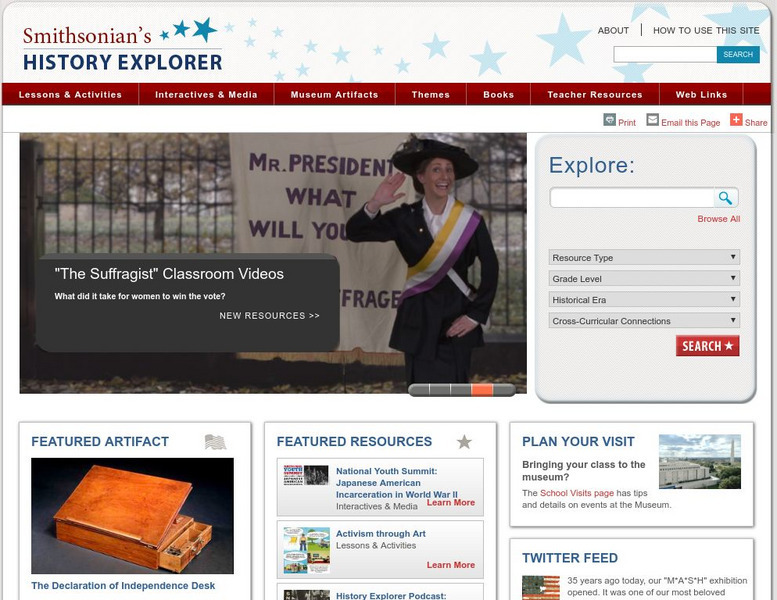
Smithsonian Institution
National Museum of American History: History Explorer
This website, developed by the National Museum of American History, provides standards-based online resources for teaching and learning American history. An array of teacher lessons, activities, interactive media, and artifacts tag this...

Library of Congress
Loc: History Firsthand: Primary Source Research
History Firsthand has been designed to provide elementary children with experiences which enable them to begin understanding primary sources. Students move from personal artifacts to the vast American Memory collections and learn how...
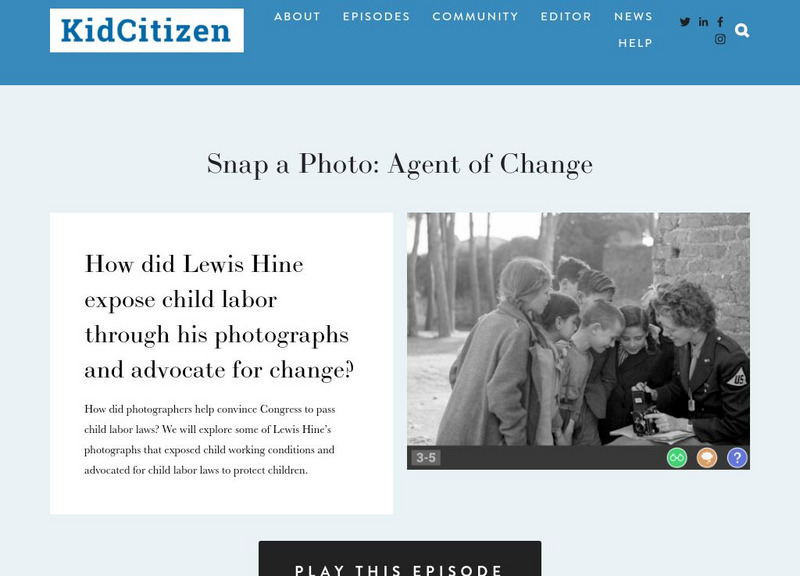
Other
Kid Citizen: Snap a Photo: Agent of Change
How did photographers help convince Congress to pass child labor laws? This module explores some of Lewis Hine's photographs that exposed children's working conditions and advocated for child labor laws to protect them. In this tutorial,...