Hi, what do you want to do?






Lewiston High School
Weight and Mass & Forces in Equilibrium
I would weigh less on the moon? Send me there, then! On the top of the first page, a cartoon image demonstrates the difference between Earth and the moon. It then goes on to describe weight and mass and provides five practice problems...

K12 Reader
Why Does the Moon Orbit Earth?
Have you ever looked up at the moon and wondered why it looks different every night? Learn about the moon's orbit and the lunar cycle with a reading comprehension exercise. Using context clues, kids find the definitions of unfamiliar...

Curated OER
Universal Gravity and Kelper's Laws Worksheet
High school physicists apply their knowledge of planetary motion. Using Kepler's three laws, Newton's law of universal gravitation, and the provided properties of the moon, sun, and Earth, they proceed to solve 23 problems. An...

McGraw Hill
Metric Units of Weight and Volume
Getting the right measurements can save a lot of time and money in the real world. Learners are introduced to unit conversion and how to accurately go from one unit to another. The first pages are notes and then the packet finishes with...

New York State Education Department
Regents High School Examination, Physical Setting, Earth Science
In this earth science worksheet, learners complete a series of multiple-choice and short-answer questions on the different moon phases, gravitational pull, and the Earth's layers.

American Museum of Natural History
What Do You Know About Astronomy
Develop an understanding of the universe. Learners answer 10 multiple choice questions about several topics in astronomy. Questions contain information about the age of the universe, gravitational attraction, galaxies, planets and comets...

New York State Education Department
Grade 8: Intermediate-Level Test, Science Written Test, 2007
In this eighth-grade science standardized test practice worksheet, learners answer 79 multiple-choice and short-answer questions to review their science knowledge.

New York State Education Department
Grade 8: Intermediate-Level Test, Science Written Test, 2004
For this eighth-grade science standardized test practice activity, pupils answer 78 multiple-choice and short-answer questions to review their knowledge.

New York State Education Department
Grade 4: Elementary-Level Test, Science Written Test, 2007
For this fourth-grade science standardized test practice worksheet, fourth graders answer 42 multiple-choice and short-answer questions to review their science knowledge.
University of Colorado
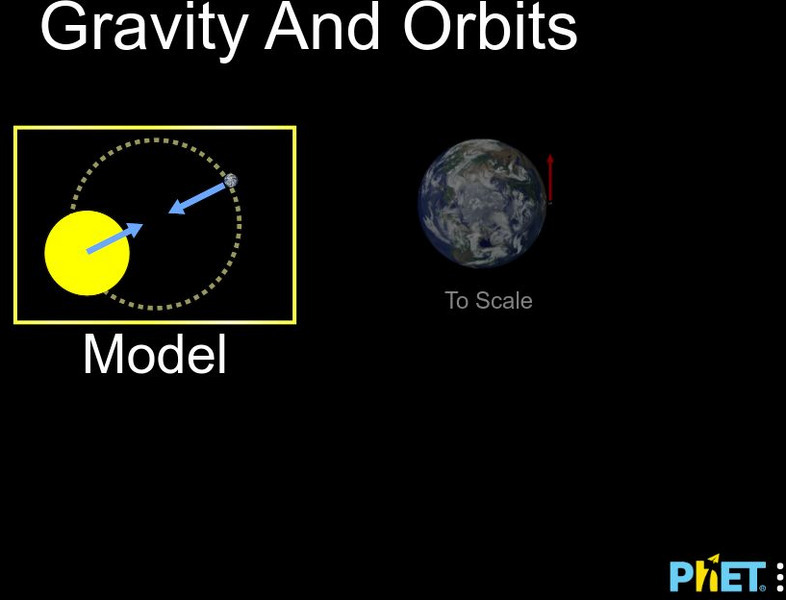
University of Colorado: Ph Et Interactive Simulations: Gravity and Orbits
Move the sun, earth, moon, and space station to see how it affects their gravitational forces and orbital paths. Visualize the sizes and distances between different heavenly bodies, and turn off gravity to see what would happen without it.

E-learning for Kids
E Learning for Kids: Antarctica Penguins: How Does the Moon Influence the Tide?
This lesson explains how the moon affects tides on Earth and about the different types of tides.

Physics Classroom
The Physics Classroom: Cavendish and the Value of G
A short description of how Cavendish measured the value of G - the universal gravitation constant and supported Newton's theory. Illustrated.
Ambleside Church of England Primary School
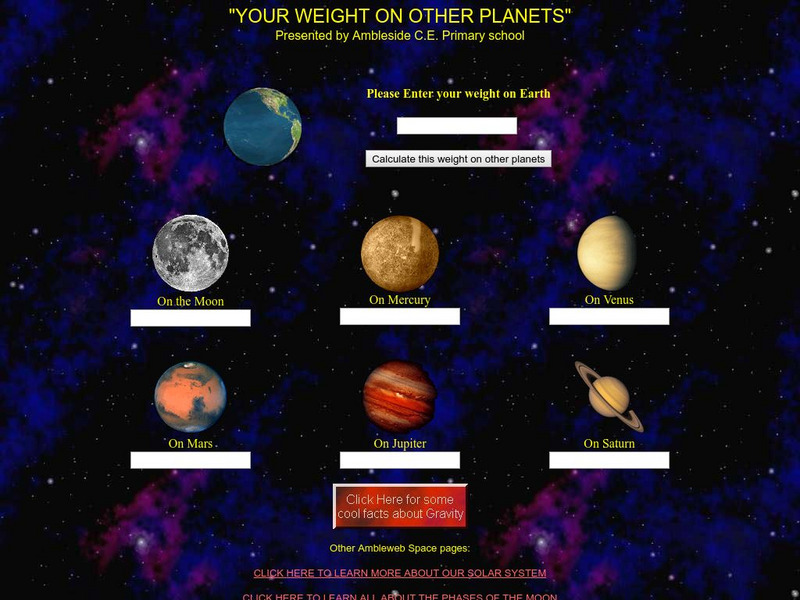
Ambleside c.e. Primary School: Your Weight on Other Planets
Students enter their weight here on Earth, and find out how much they would weigh on the moon and other planets.
Texas Education Agency
Texas Gateway: Newton's Universal Law of Gravitation
By the end of this section, you will be able to explain Earth's gravitational force, describe the gravitational effect of the Moon on Earth, discuss weightlessness in space, and understand the Cavendish experiment.