Hi, what do you want to do?






US Department of Agriculture
Sink or Float?
Will it sink or will it float? Learners predict the outcome as they drop random objects into a container of water. Then, they keep track of the results and record the data in a t-chart to draw a final conclusion.

Center for Learning in Action
Density
Explore the concept of density within states of matter—gases, liquids, and solids—through a group experiment in which young scientists test objects' texture, color, weight, size, and ability to sink or float.

CK-12 Foundation
Going Fishing
Why do some things float and others sink? A creative simulation allows learners to adjust mass and volume of an object to affect its buoyancy in water. A graph records the effect of each manipulation.

University of Southern Indiana
Manifest Density
There's a lot content packed into the four lessons of this physical science unit on density. From salad dressing to the water cycle and hot air balloons, these lessons engage students in hands-on activities that explore real-world...

Illinois Valley Community College
STEM Activities for Middle School Students
Use STEM activities within the class to provide connections to concepts. The resource includes activities that range from working with buoyancy to building rockets and launching them. Other activities involve the engineering design...

US Environmental Protection Agency
Thirstin's Wacky Water Adventure
Make a splash with young scientists as you teach them all about water using this activity packet. Thirstin, a cartoon glass of water, walks children through the water treatment process, teaches them about different sources of water, and...

TLS Books
Vocabulary Practice
Using context clues is a valuable skill in reading comprehension. Help kids to learn about homonyms with a multiple-choice worksheet, in which they read two sentences and fill in the blanks with the word that would work in both.

Center for Learning in Action
Properties of Balls
Enhance your states of matter lessons with a hands-on science investigation that compares six different balls' color, texture, size, weight, ability to bounce, and buoyancy.

American Chemical Society
Middle School Chemistry: Density: Sink and Float for Liquids
Students determine whether a liquid will sink or float in water by comparing its density to the density of water.
Science Education Resource Center at Carleton College
Serc: Investigating Density in Solutions: How Can You Make an Egg Float?
In this activity, students will learn about density by determining how to make an egg float in water. By the end of the lesson, students will understand that density and weight are different and that density matters in floatation. They...
PBS
Pbs Learning Media: Floating and Sinking: Hot Air Balloons
Why do hot air balloons float? This resource from the NOVA Web site offers a series of interactive activities that illustrates the physics of hot air balloons.
American Chemical Society
Middle School Chemistry: Density: Sink and Float for Solids
Young scholars determine whether an object will sink or float by comparing its density to the density of water.
PBS
Pbs Learning Media: Sesame Street: Sink or Float Educator Guide
This is an educator's guide for a unit on things that sink or float. It includes lesson plans, experiments, and activities. Students apply the scientific method as they investigate whether objects sink or float.
PBS
Pbs Learning Media: Buoyancy Brainteasers: Buoyancy Question
This interactive brainteaser from the NOVA: "Voyage of Doom" Web site challenges you to figure out what causes an object to sink.
Texas Education Agency
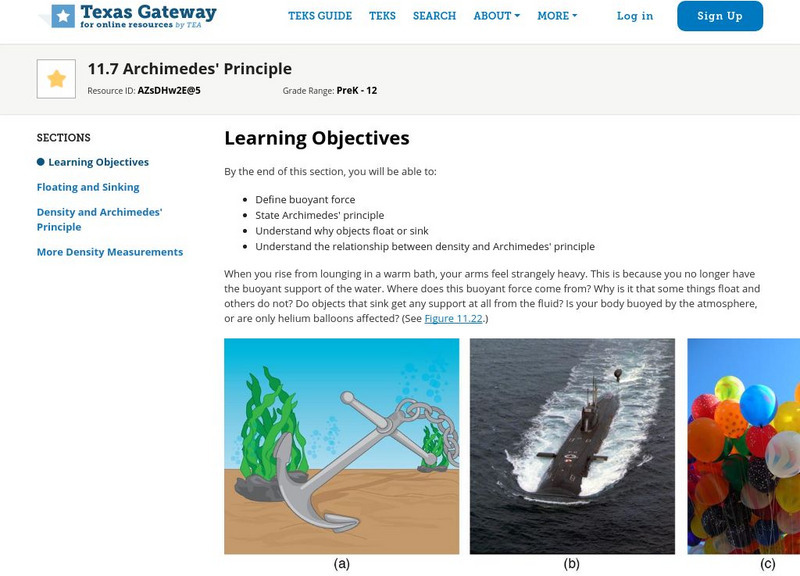
Texas Gateway: Ap Physics: Fluid Statics: Archimedes' Principle
By the end of this section, you will be able to define buoyant force, state Archimedes' principle, understand why objects float or sink, and understand the relationship between density and Archimedes' principle.
CK-12 Foundation
Ck 12: Chemistry Simulation: Going Fishing
[Free Registration/Login Required] Students will be able to change the mass and volume of an item and observe if it floats, sinks, or remains at a certain depth in the water. Students will also be able to change the liquid in level 2.
American Chemical Society
Inquiry in Action: Changing the Density of an Object: Adding Material
In this activity, students see that a can of regular cola sinks while a can of diet cola floats. As a demonstration, bubble wrap is taped to the can of regular cola to make it float. This high-volume but light-weight material increases...
American Chemical Society
Inquiry in Action: Changing the Density of an Object: Changing Shape
Throughout the activities in this investigation, students may have wondered how a boat made out of steel, which is more dense than water, can float. This activity addresses that question. Students will see that changing the shape of an...

American Chemical Society
Inquiry in Action: Defining Density
Do heavy things always sink and light things always float? In this introductory demonstration and activity, students are introduced to the concept of density as they explore a rock and a wooden block in water.
American Chemical Society
Inquiry in Action: Compare the Density of an Object to the Density of Water
In this activity, students use tea light candle holders and a student-made balance to compare the weight of equal volumes of wax, water, and clay. Students will discover that since the wax weighs less than an equal volume of water, it is...
American Chemical Society
Inquiry in Action: Changing the Density of a Liquid: Adding Salt
In this activity, students will see that a carrot slice sinks in fresh water and floats in saltwater. Considering the placement of the carrot slice in water and salt water, students will infer that the density of salt water must be...
American Chemical Society
Inquiry in Action: Changing the Density of a Liquid: Heating and Cooling
In this activity, students will investigate whether the temperature of water affects its density. Students will place colored hot and cold water in a cup of room-temperature water to see that cold water sinks while hot water floats. Then...
University of Colorado
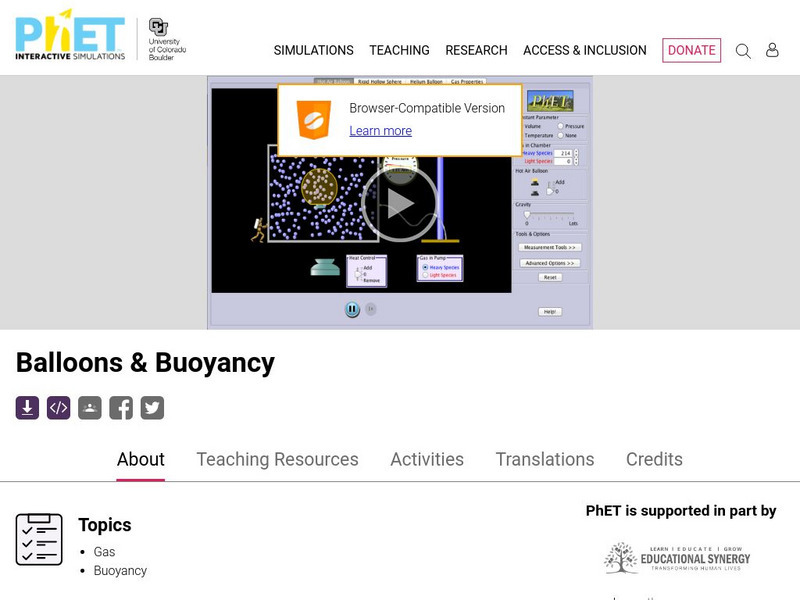
University of Colorado: Ph Et Interactive Simulations: Balloons & Buoyancy
Experiment with a helium balloon, a hot air balloon, or a rigid sphere filled with different gases. Discover what makes some balloons float and others sink.
American Chemical Society
Middle School Chemistry: Chapter 3: Density
Six interactive chemistry lessons about density complete with handouts and animations.
Other popular searches
- Sinking and Floating
- Floating and Sinking Objects
- Sinking or Floating
- Science Floating and Sinking
- Free Floating and Sinking
- Floating and Sinking Water
- Floating and Sinking Inquiry
- Water Floating Sinking
- Sinking/floating Items
- Science Floating Sinking