Hi, what do you want to do?






Center for Learning in Action
Investigating Physical and Chemical Changes
Super scientists visit ten stations to predict, observe, and draw conclusions about the physical and chemical changes that occur when different states of matter—liquid, solid, and gas—are placed under a variety of conditions. To...

Center for Learning in Action
Introducing Physical and Chemical Changes
Young scientists investigate chemical and physical changes to the states of matter—gas, liquid, and solid—as well as solutions and suspensions with a variety of demonstrations, grand conversation, and an interactive quiz to check for...

Mr. E. Science
An Introduction to Matter
What's the matter? Gas, solid, liquid, or plasma. The presentation covers how to describe and identify matter, changes in matter, types of matter, measuring matter, particles of matter, Democritus, and John Dalton's Atomic Theory.

LABScI
Freezing Point Depression: Why Don’t Oceans Freeze?
Can you go ice fishing in the ocean? Learners examine the freezing point of different saltwater solutions. Each solution has a different concentration of salt. By comparing the freezing points graphically, they make conclusions...

Earth Day Network
Staying Green While Being Clean
Clean up the environment with a lesson that focuses on replacing hazardous cleaning supplies with green, environmentally-friendly products. Using a dirty patch of surface as a control area, kids clean other parts of various surfaces...

Cornell University
Glued into Science—Classifying Polymers
Explore the unique characteristics of polymers. A complete instructional activity begins with a presentation introducing polymers. Following the presentation, young scientists develop a laboratory plan for creating substances using...
Texas Education Agency
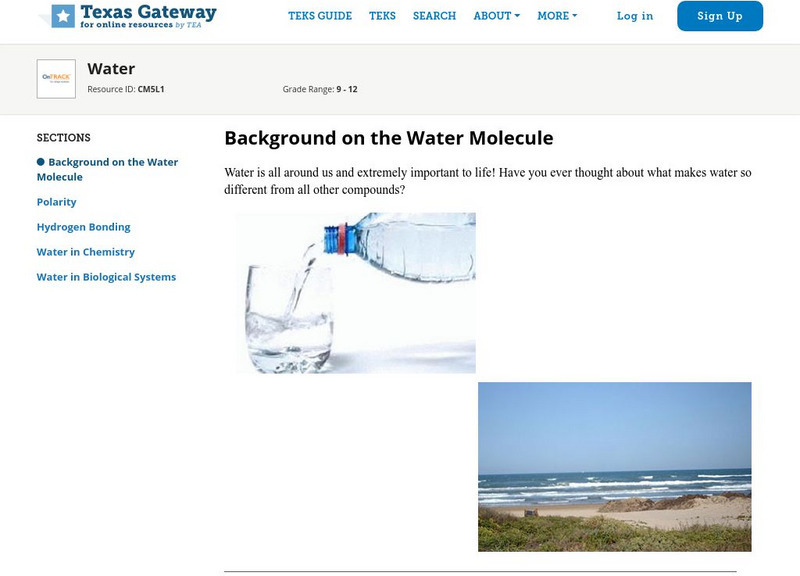
Texas Gateway: Water
Given scenarios, descriptions, or illustrations, the student will determine the properties of water that affect chemical and biological systems.
![American Chemical Society: Best of Wonder Science: Air: It's Really There [Pdf] Activity](https://static.lp.lexp.cloud/images/attachment_defaults/resource/large/FPO-knovation.png "American Chemical Society: Best of Wonder Science: Air: It's Really There [Pdf] Activity")
American Chemical Society
American Chemical Society: Best of Wonder Science: Air: It's Really There [Pdf]
An experiment to explore the properties of air, using a cup placed upsidedown in water.
BBC
Bbc: Gcse Bitesize: Predicting Chemical Reactions
This lesson focuses on predicting chemical reactions using The Group 1 elements in the Periodic Table are known as the alkali metals. They include lithium, sodium and potassium, which all react vigorously with air and water. It provides...