
Curated OER
Lines, Segments, and Rays
Fifth graders use their arm, toothpicks, and marshmallows to create lines, segments, and rays. In this lines, segments, and rays lesson plan, 5th graders learn how these appear on a plane.

Curated OER
Would You Like to Become a Millionaire?
Learners answer questions written by other teams about literature in an attempt to become "millionaires." In small groups they write a motivational introduction to their teams selected books, publish their questions as a HyperCard...

Curated OER
The Family Tree
In this patterns practice worksheet, students read a 3-paragraph excerpt regarding a family tree and respond to 1 graphic organizer question and 1 short answer question.

Curated OER
A Monster's World
Study African American inventor Jan Ernst Matzeliger and create imaginary monsters using texture.

Curated OER
Measuring Marvels
Students investigate measurement. In this library lesson plan, students discuss measurement, read Millions to Measure by David Schwartz, and complete a worksheet. Extra related activities are included in the lesson plan that appeals to...

Curated OER
Me Oh Maya
Students compare basketball to Mayan ring-ball. They write a newspaper article that may have been published during Mayan times.

Curated OER
What's the Cost?
Learners consider what things cost 150 years ago and what those costs would be in today's money. They compare costs and services between the 1850s and today to find out if things are cheaper or more expensive today, in inflation-adjusted...

Curated OER
Connecting Math to Our Lives
Students participate in an online interactive forum to explore how math is used in their families and communities. They design games to submit to other students online, and identify and organize data to solve the problems from other...

Curated OER
Electricity Lesson Plan
Students conduct experiments on static electricity using the Internet. They compose a 30 second electricity safety jingle to be aired on a local radio station.

Curated OER
Crayograph Quilts
Students create a quilt-like fabric swatches using Crayograph crayons, emery paper and rubbing plates.

Other
Houghton Mifflin: Mayan Mathematics
This site explains the mathematical system of the Mayans. It gives the represenation they used for numbers and how they did addition and subtraction.
Stephen Byrne
History for Kids: Ancient Greek Science
Overview of the history of science in Greece during the Hellenistic age when Greek culture mingled with Persia and many advancements were made. Teacher resources include worksheets, activities and quizzes.

Discovering Egypt
Discovering Egypt: Egyptian Mathematics
A brief explanation of the numbering system of the ancient Egyptians, with great drawings and sample problems. Use this resource to introduce yourself to the symbols ancient Egyptians used in mathematics. There are some activities to...
University of Manchester
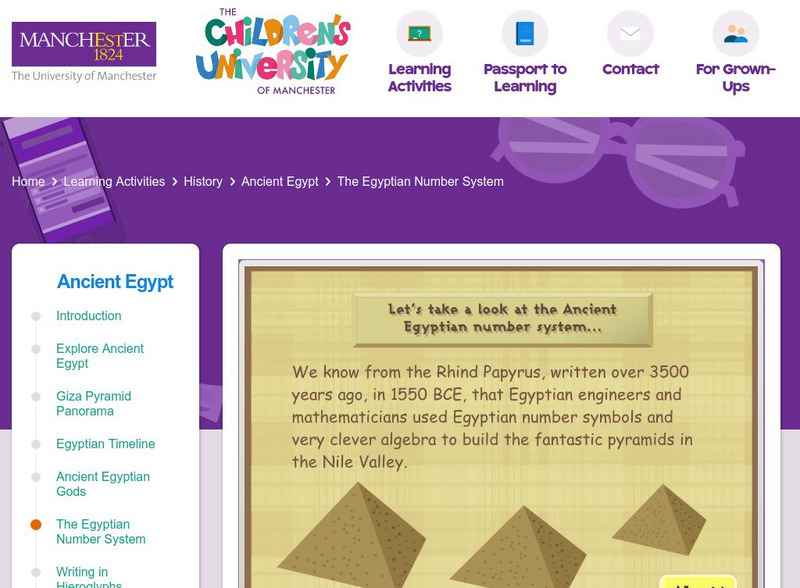
Children's University of Manchester: Ancient Egypt: The Egyptian Number System
Animated and interactive website from Children's University of Manchester on the Ancient Egyptian Number System. Students can explore the characteristics of ancient Egyptian numbers and use their math facts along the way.
NASA
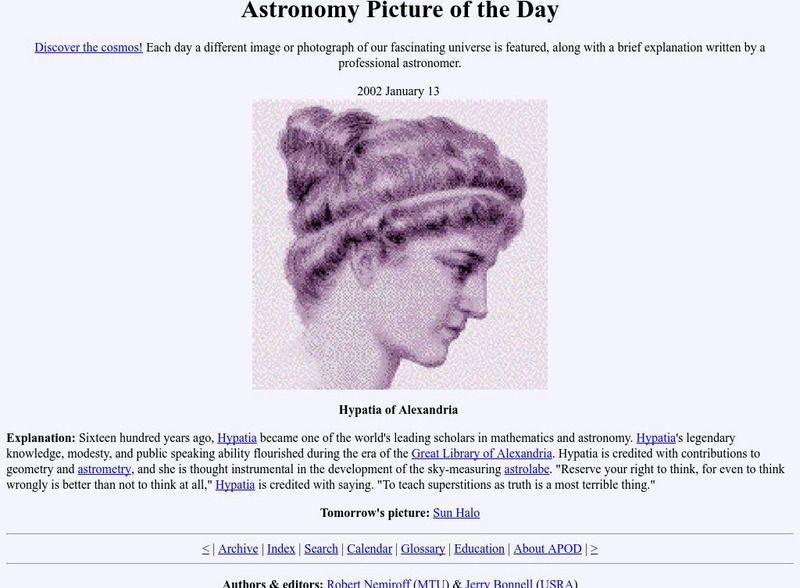
Nasa: Astronomy Picture of the Day: Hypatia
Learn more about Hypatia when you check out this resource. This site features a picture and a brief synopsis of this famous scientist.
PBS
Pbs: Base 60: Babylonian Decimals
Explore a brief history of mathematics in Mesopotamia through the Babylonian Base 60 number system. This video focuses on how a base 60 system does not use fractions or repeating decimals, some of the advantages of a base 60 system, and...
NumberNut
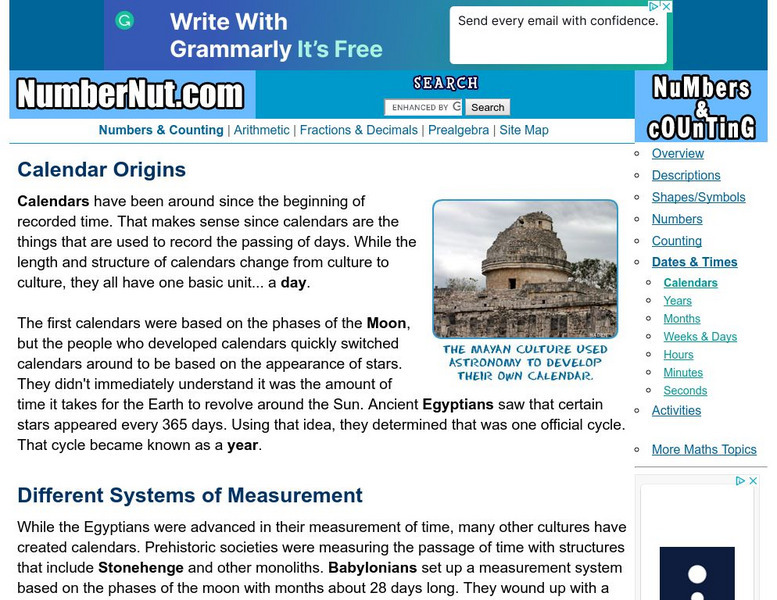
Number Nut: Calendar Origins
History and mathematics merge in this lesson that explores the origin of the calendar. Learn how it all got started in this detailed lesson that includes a simple months of the year game and a more challenging time conversion game. Both...
University of Cambridge
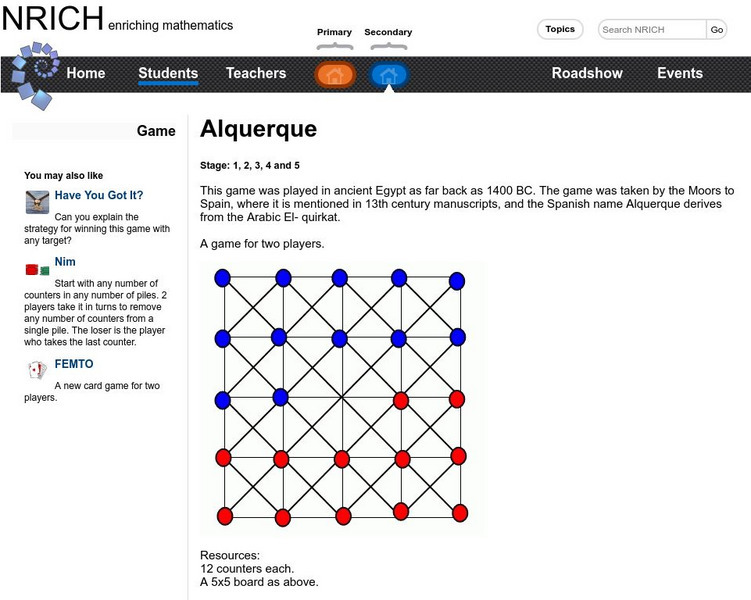
University of Cambridge: Nrich: Alquerque an Egyptian Math Game
This is a board game played in Egypt in 1400 BCE. It requires strategy and to think several moves ahead.

NumberNut
Number Nut: Week and Weekends
Learn about the origins of a week in this integrated lesson. This lesson explores scientific theories and mathematical facts that are the basis for the time period that we call a week. Included in this lesson are two related, interactive...
Other
Great Scott!: Hieroglyphs Numbers
Use this site to learn about the ancient Egyptian numbering system. Use the "converter" to the right to translate modern-day numbers to Egyptian hieroglyphs, or scroll to the bottom of the page to continue the journey and learn about...
Discovering Egypt
Mark Millmore's Ancient Egypt
This site provides a captivating tour through Egypt's past. Visit the ancient temples, the kings and queens of the past. Learn about the hieroglyphic form of communication. Additional links for extended information temples and hieroglyphs.

Alabama Learning Exchange
Alex: Operation to Exploration
Students will use solve mathematical expressions using the order of operations to find artifacts of American History. Students will complete order of operation problems, which will help them explore and solve the route to their final...
Other
Living Math!
A homeschooling website with a focus on Mathematics. Provides articles, wide-ranging lists of recommended books, Math activity ideas, book reviews, and some sample lessons. (Note: Some links may no longer work.)
My Hero Project
My Hero: Galileo
"First to use a telescope to overserve the starts and planets," Galileo Galilei secretly published his work, which contradicted the Catholic Church's teachings. Use this site to learn about how Galileo's independence and courage made him...