Hi, what do you want to do?






Science Struck
Science Struck: Decomposers in the Ocean: Role and Examples
Describes five different types of decomposers that feed on decaying organic matter in the oceans and that are at the bottom of the ocean food chain.
American Museum of Natural History
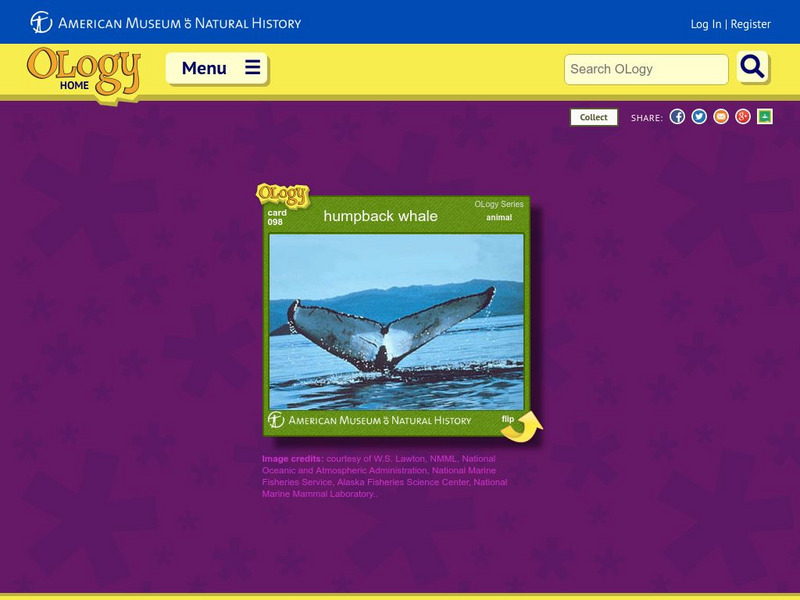
American Museum of Natural History: Humpback Whale O Logy Card
OLogy cards are like virtual baseball cards about all kinds of science topics. This one is about the Humpback Whale and it contains information about the habitat, diet, and other ecological information. See if you can answer a few...

Kidport
Kidport: Who Eats What?
At this site students are encouraged to try and answer questions that relate to what animals eat. At the bottom of the web page are beautiful pictures of land and sea animals and when selected, students will be able to read short facts...
The Franklin Institute
The Franklin Institute: Treasures at Sea
Learn about ocean systems and habitats. Lots of reading, writing, games, and interactive activities. Colorful and fun.
CK-12 Foundation
Ck 12: Plate Tectonics and Seas of the Paleozoic and Mesozoic Era Study Guide
[Free Registration/Login may be required to access all resource tools.] Provides a brief overview of plate tectonic activity during the Paleozoic and Mesozoic eras and the changes in sea level that occurred. Includes some questions to...
Other
An Aquatic Adventure
In this WebQuest, you must pick a type of water habitat to create a new aquarium, choose three animals that can coexist in this habitat and design your own aquarium.
The Franklin Institute
In Quiry Almanack: Undersea and Oversee
Dive into a greater understanding of the oceans by tagging along on this exploration of the oceans.
Read Works
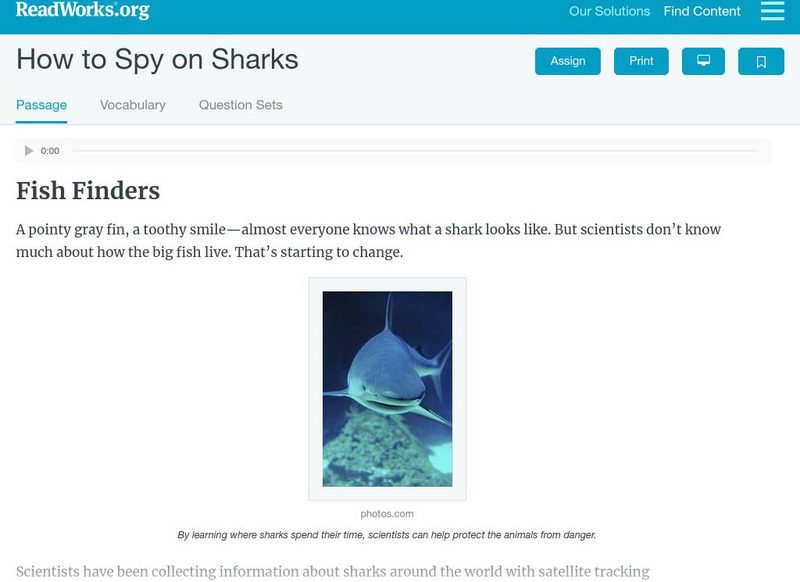
Read Works: How to Spy on Sharks
[Free Registration/Login Required] An informational text about scientists who use satellite tags to help them study different shark species. A question sheet is available to help students build skills in reading comprehension.
Read Works
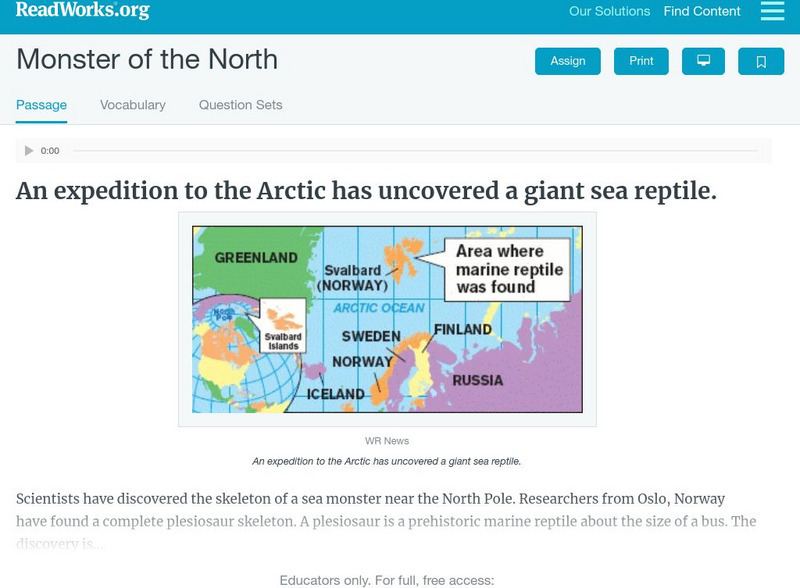
Read Works: Monster of the North
[Free Registration/Login Required] An informational text about the skeleton of a plesiosaur, a giant sea monster, found by scientists near the North Pole. A question sheet is available to help students build skills in reading comprehension.
Read Works
Read Works: Dead Zone
[Free Registration/Login Required] Students read about the "dead zone," an area in the Guld of Mexico where no fish can live due to pollution from fertilizer. A question sheet is available to help students build skills in cause and effect.
Better Lesson
Better Lesson: Counting Clams a Tidal Flat Adventure
Mathematics has an important role in the real world outside of school. In this lesson, students will learn how scientists use multiplication to estimate animal populations. Included in the lesson are a detailed plan, background knowledge...
Kidport
Some Animals Live in Rock Caves
This site has brief illustrations and sample locations as to where the tiger, the bear, the moray eel and bat live.