Hi, what do you want to do?






Khan Academy
Khan Academy: Titration of a Strong Acid With a Strong Base
An example of calculating the pH before the equivalence point for titration of strong acid, hydrochloric acid, with strong base, NaOH. [10:12]

Khan Academy
Khan Academy: Titration of a Weak Acid With a Strong Base
An example calculating the pH for titration of acetic acid with strong base NaOH before adding any base and at half-equivalence point. [14:27]

Khan Academy
Khan Academy: Titration of a Weak Acid With a Strong Base Part 2
An example of calculating the pH for titration of acetic acid with strong base NaOH at equivalence point and past the equivalence point. [15:13]
Khan Academy
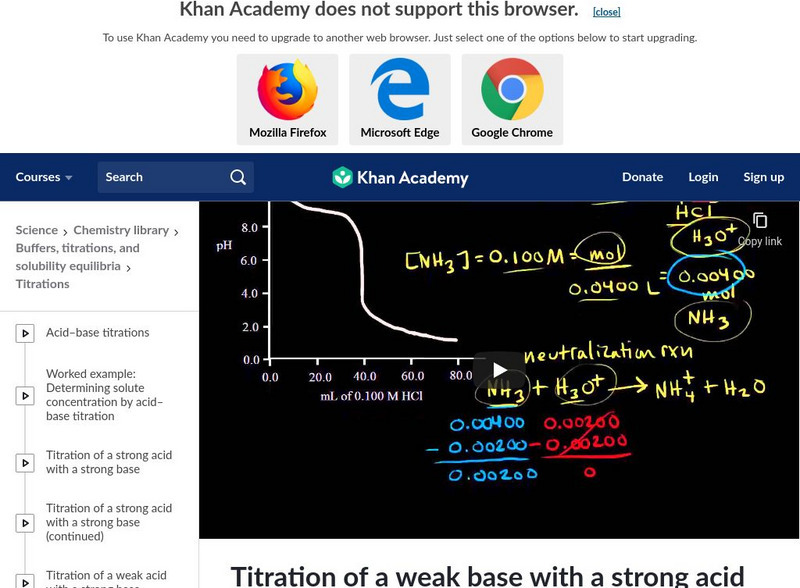
Khan Academy: Titration of a Weak Base With a Strong Acid
An example calculating the pH for titration of weak base, ammonia, with strong acid, HCl, before any HCl is added and at half-equivalence point. [14:57]
Khan Academy
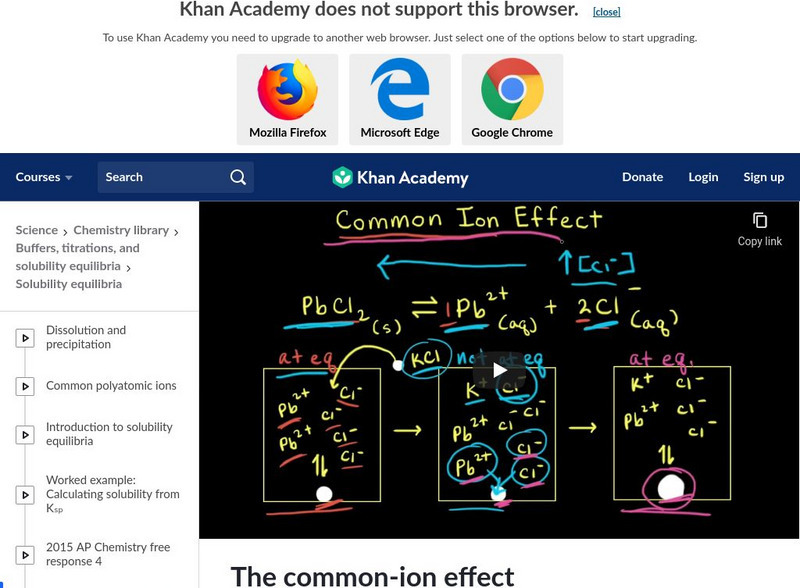
Khan Academy: Solubility and the Common Ion Effect
Using an ICE table to calculate molar solubility. [8:15]

Khan Academy
Khan Academy: Chemistry: P Ka and P Kb Relationship
Using examples this videos explores the equilibrium constants of Ka and Kb. Learn what these constants can tell you about the concentrations of acids and bases in a chemical reaction. [14:33]
Khan Academy
Khan Academy: Bronsted Lowry Definition of Acids and Bases
See the Bronsted-Lowry definition of acids and bases explained, and learn how to conjugate acids and bases. [8:57]
Sophia Learning
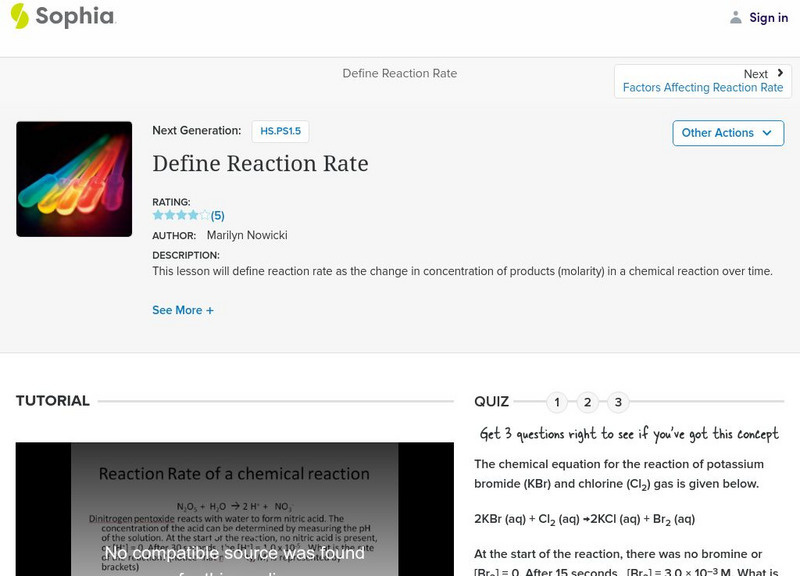
Sophia: Define Reaction Rate
This lesson will define reaction rate as the change in concentration of products (molarity) in a chemical reaction over time.
Sophia Learning
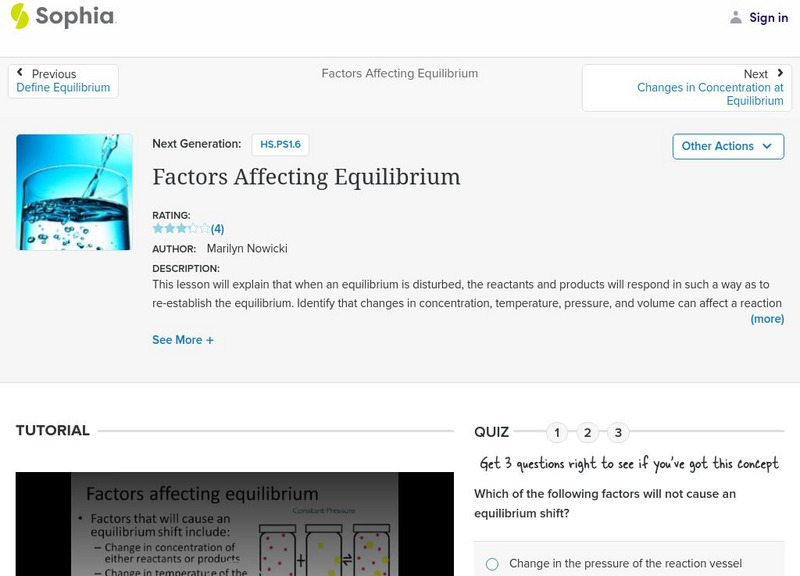
Sophia: Factors Affecting Equilibrium
This lesson will explain that when an equilibrium is disturbed, the reactants and products will respond in such a way as to re-establish the equilibrium. Identify that changes in concentration, temperature, pressure, and volume can...
Sophia Learning
Sophia: Parts Per Million Calculations: Lesson 1
This lesson demonstrates how to calculate parts per million (ppm). It is 1 of 2 in the series titled "Parts per Million Calculations."
Bozeman Science
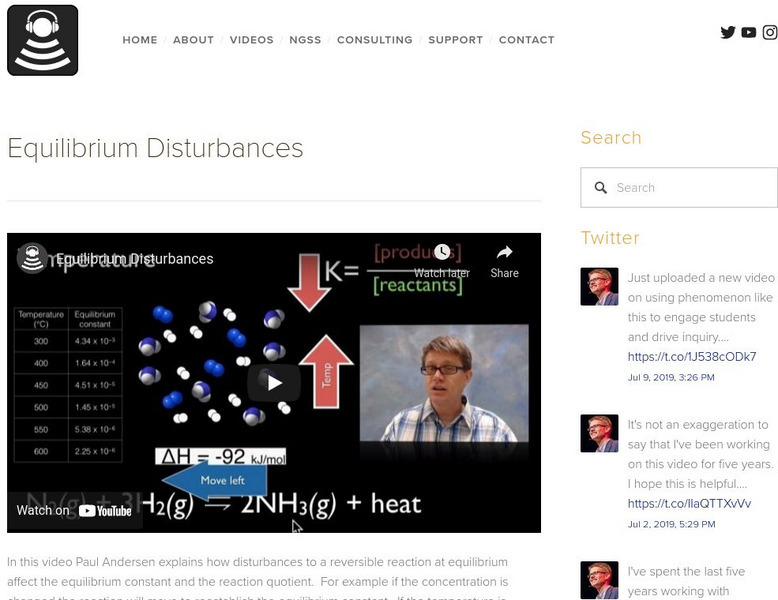
Bozeman Science: Equilibrium Disturbances
In the following video Paul Andersen explains how disturbances to a reversible reaction at equilibrium affect the equilibrium constant and the reaction quotient. For example if the concentration is changed the reaction will move to...
Khan Academy
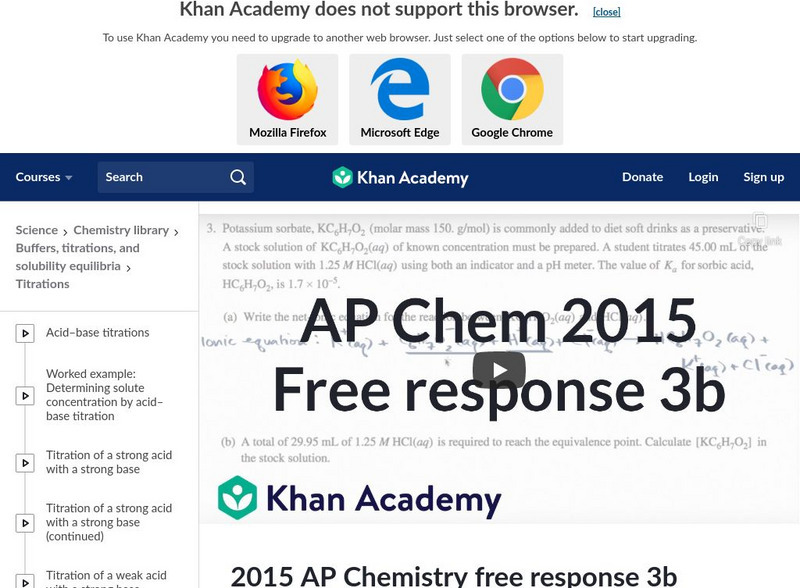
Khan Academy: 2015 Ap Chemistry Free Response 3b
Calculate the concentration of weak base using information about equivalence point in a titration. This example is from the 2015 AP Chemistry free response question 3b. [6:16]

Khan Academy
Khan Academy: Divided Attn, Selective Attn, Inattentional and Change Blindness
Learn about divided attention, selective attention, inattentional blindness, & change blindness in this Khan Academy video. [6:41]

Khan Academy
Khan Academy: Energy and Transport: Concentration Gradients
A concentration gradient occurs when the concentration of particles is higher in one area than another. In passive transport, particles will diffuse down a concentration gradient, from areas of higher concentration to areas of lower...

Khan Academy
Khan Academy: Energy and Transport: Introduction to Kinetics
Kinetics is the study of reaction rates and how they are affected. Many factors, such as concentration, pressure, temperature, and enzyme activity, can impact the rate of a reaction. [15:27]

Khan Academy
Khan Academy: Titration Calculation Example
Learn how to calculate the unknown concentration with titration. See an example of titrating strong acid, hydrochloric acid, with strong base barium hydroxide. [7:49]

Khan Academy
Khan Academy: Titration Introduction
This video is an introduction to acid-base titrations using example of titrating 20.0 mL of HCl of unknown concentration with 0.100 M NaOH. Covers indicators, endpoint, equivalence point, and calculating the unknown concentration.