Hi, what do you want to do?






Makematic
Plessy v. Ferguson
In 1892, Homer Plessy's arrest for sitting in a train car reserved for White passengers led to a Supreme Court decision that endorsed racial segregation under the "separate but equal" doctrine.
Wonderscape
The Struggle for Equality During Reconstruction
Explore the contrasting philosophies of Booker T. Washington and W.E.B. Du Bois during the Reconstruction Era and their approaches to challenging Jim Crow laws. Learn about the landmark Plessy v. Ferguson case and how the NAACP emerged...
Mr. Beat
"Separate But Equal" | Plessy v. Ferguson
In episode 50 of Supreme Court Briefs, a man with lighter skin is arrested after refusing to leave the whites-only railway car of a segregated train in the Jim Crow South.
Mr. Beat
Ending School Segregation | Brown v. Board of Education
In episode 8 of Supreme Court Briefs, the Court unanimously has major issues with Plessy v. Ferguson, and ends up dramatically changing the future of the Civil Rights Movement by ruling segregation "inherently unequal.”
Curated Video
Plessy v. Ferguson: Separate but Equal
Plessy v. Ferguson was a landmark U.S. Supreme Court decision that established the legal doctrine of “separate but equal”. It was a ruling that enabled many states to enact racial segregation laws for decades to come.

Bill of Rights Institute
Brown vs. Board of Education
How did education play into the civil rights movement? The second lesson of a 10-part series explains the Brown vs. Board of Education court case. It helps viewers examine and analyze, via rationale from the video clip, how segregation...

Center For Civic Education
60 Second Civics: Plessy v. Ferguson
The Supreme Court decision in the case of Plessy v. Ferguson (1896) permitted racial segregation so long as facilities were separate but equal. This type of segregation endured for nearly sixty years.
Center For Civic Education
60 Second Civics: Episode 1702: We the People Lesson 26 Part 2:plessy v Ferguson
On today's podcast, we learn about the case of Plessy v. Ferguson.
Khan Academy
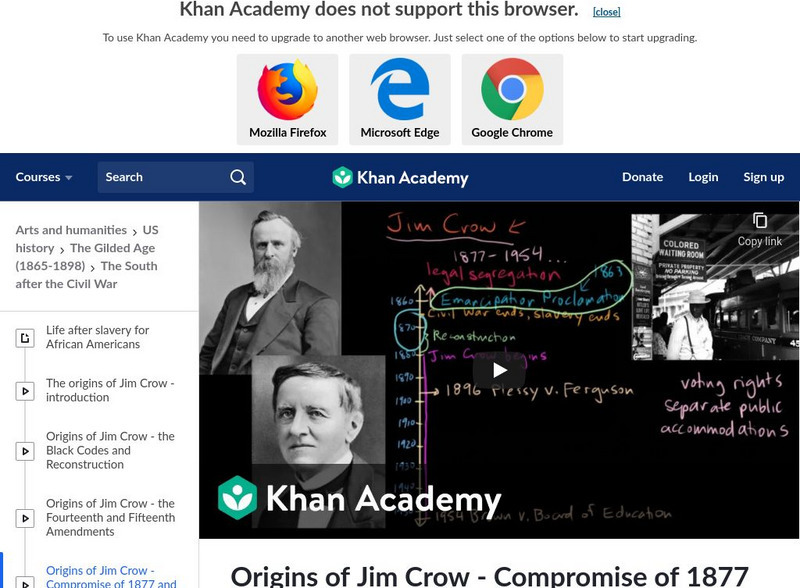
Khan Academy: Ap Us History: 1865 1898: Origins of Jim Crow Part 4
Reconstruction ended in the South and federal troops left once the Compromise Act was passed in 1877. This freed up the South to pass Jim Crow laws to enforce segregation. Then the Plessy v. Ferguson case (1896) in the Supreme Court...