Hi, what do you want to do?






Curated OER
A Tale of Two Reactors
Tenth graders role-play as members of the food chain. Sticky tables acting as polluting factors are introduced and members of different trophic levels suffer varying degrees of damage due to those pollutants.

Curated OER
Leaving Home
Learners explain the importance of larval dispersal and retention to populations. They collect data on organisms and examine it.

Curated OER
And Now for Something Completely Different...
Students identify organisms that are typical a part of a hydrothermal vent. They examine why hydrothermal vents are short-lived.

Curated OER
Three Cold Realms
Students identify organisms within the realms of pelagic, benthic and sea ice. They explain how these three interact with each other.

Curated OER
Motte Rimrock Reserve: Lesson Plan for Flora
Students study the flora of Motte Rimrock Reserve while observing organisms in their natural environment. They use a dichotomous key to identify plants.

Curated OER
Plants
First graders learn the basic needs of plants, label the major parts of a plant and name their uses. They also use a KWL chart.

Curated OER
The Art of Trees
Young scholars identify parts of a tree and use observation and art techniques to depict the growth of a tree from seedling to crown.

Curated OER
Organism Detectives
First graders take a nature walk and search for organisms. They use magnifying glasses to see things that live on or near the surface of the Earth in land, air, and water.

Curated OER
Ecology
Fourth graders research an ecosystem and its endangered species. They create a PowerPoint Presentation, oral report, poster or a booklet based on their research. They research on the internet and in biology texts in teams of 4.
Georgia Department of Education
Ga Virtual Learning: Biology: The Study of Life
A learning module where students analyze the relationships between the structures and functions of cells, tissues, organs to carry out all of the requisite characteristics of life. They also describe the scope of biological study and...

Tree of Life Project
The Tree of Life Web Project
The Tree of Life is a multi-authored, Internet distributed project containing information about phylogeny and biodiversity. The Tree of Life can be used to locate information about a particular group of organisms through their taxonomy.
Texas Education Agency
Texas Gateway: Transportation Classification: Moving on Up
In this learning module, students will begin to undestand the how kingdoms are classified.

Mind My Education
Mind My Education: The Life of Environments
This extensive lesson plan covers various topics about how animals interact with their environment. Topics include how animals sense their environment, how environments and organisms change together, and how animals use their senses to...
PBS
Pbs Teachers:odyssey of Life Ii the Unknown World
Observe organisms in various environments, determine what enables the organisms to live in that environment and discuss the varied biological functions of the organisms.
My Science Site
Life Systems: Cells, Tissues, Organs
Extensive site for teachers provides some helpful resources that pertain to plant and animal cells. Includes a microscope diagram as well as plant, animal and pond labs. Also contains links to structures and mechanisms, matter and...
Sea World Parks & Entertainment
Sea World: Biodiversity
Depicts biodiversity with a brief narrative. Includes vocabulary, bibliography, and one activity. Subject matter at an upper intermediate grade level or higher.
Alabama Learning Exchange
Alex: Organism Power Points/ Booklets
This lesson plan requires students to use technology to research information on any organism from one of the six kingdoms. Students use the information to produce a PowerPoint presentation or booklet to present to their classmates. This...
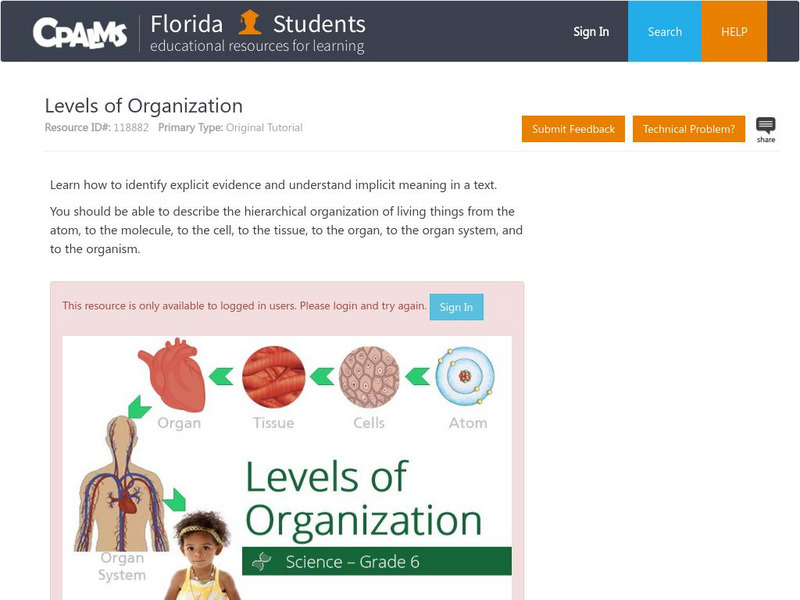
CPALMS
Florida State University Cpalms: Florida Students: Levels of Organization
FSERL: Explanation of the hierarchical levels of living things.
CPALMS
Florida State University Cpalms: Florida Students: The Cell Theory
Learn how the Cell Theory defines living organisms.
Utah Education Network
Uen: 2nd Grade Act. 01: Exploration Tubs
During this language development instructional activity, 2nd graders will explore tubs with different themes. Students will use these tubs to explore fossils, rocks, reptiles, orgnisms
OpenStax
Open Stax: Structural Organization of the Human Body
Try considering the structures of the body in terms of fundamental levels of organization that increase in complexity: subatomic particles, atoms, molecules, organelles, cells, tissues, organs, organ systems, organisms and biosphere....
The Field Museum
Field Museum: Exhibits: Underground Adventure
The Chicago Field Museum provides a comprehensive soil education project covering topics such as soil structure and organisms living underground. Students can use the site for research or do the full-blown project, where they establish a...

Alabama Learning Exchange
Alex: The Tree of Life
This is a lesson to help middle schoolers understand the phylogeny of organisms and how all organisms are linked in a certain way. By navigating an Internet site, students will learn how organisms are classified.
University of California
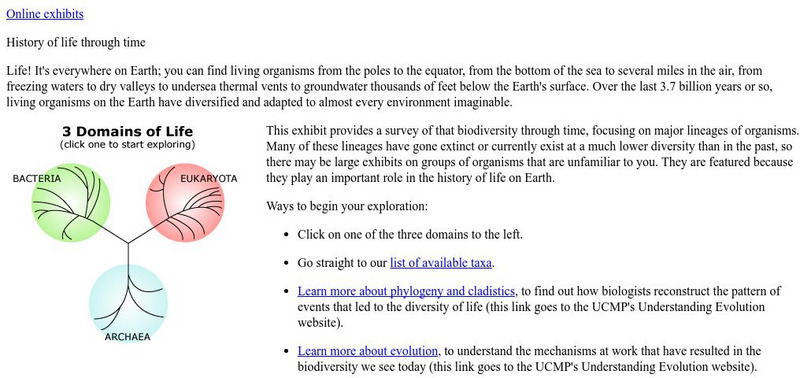
Ucmp: The Biosphere: Life on Earth
Learn about different forms of life that coexist with us on Earth. This Berkeley article provides links to brief write-ups on the three domains of living organisms: Eukaryota, Bacteria, and Archaea.