Hi, what do you want to do?






Cuemath
Cuemath: Mass
A comprehensive guide for learning all about mass with definitions, how to calculate mass, the difference between mass and weight, solved examples, and practice questions.
Other
Bscs: Forces and Motion Content Background Document
In this document, we will try to answer a fundamental question of physical science, "Why do things start to move, slow down, speed up, stop moving or change direction?" In answering these core questions we can develop concepts that can...
Open Ed
Open Ed Sci: 8.1 Contact Forces
In this unit, students explore a variety of phenomena to figure out, "Why do things sometimes get damaged when they hit each other?" Student questions about the factors that result in a shattered cell phone screen lead them to...

E-learning for Kids
E Learning for Kids: Math: Fisher Boat: Time & Mass: Months, Seasons and Mass
Lars in Antarctica needs help. Can you help him with all the months of the year and with mass?

E-learning for Kids
E Learning for Kids: Math: Fashion Store: Mass & Capacity
Penny the Penguin owns a fashion store. Let's find out what people wear at Antarctica. Uses popups.
Massachusetts Institute of Technology
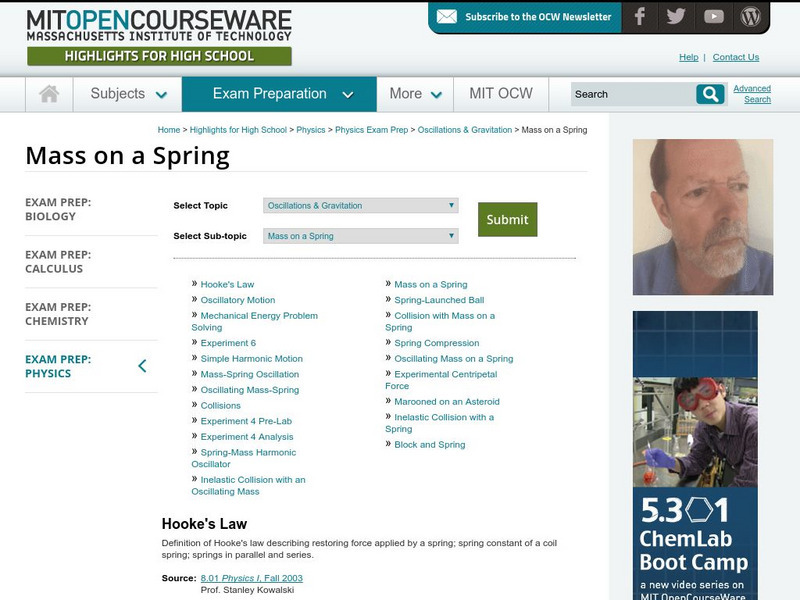
Mit: Open Course Ware: Mass on a Spring
Students explore mass on a spring. Some topics examined in the activities are Hook's law, sinusoidal motion, and oscillatory motion. The resource consists of video clips, lecture notes, practice problems, and exam questions. Practice...
Massachusetts Institute of Technology
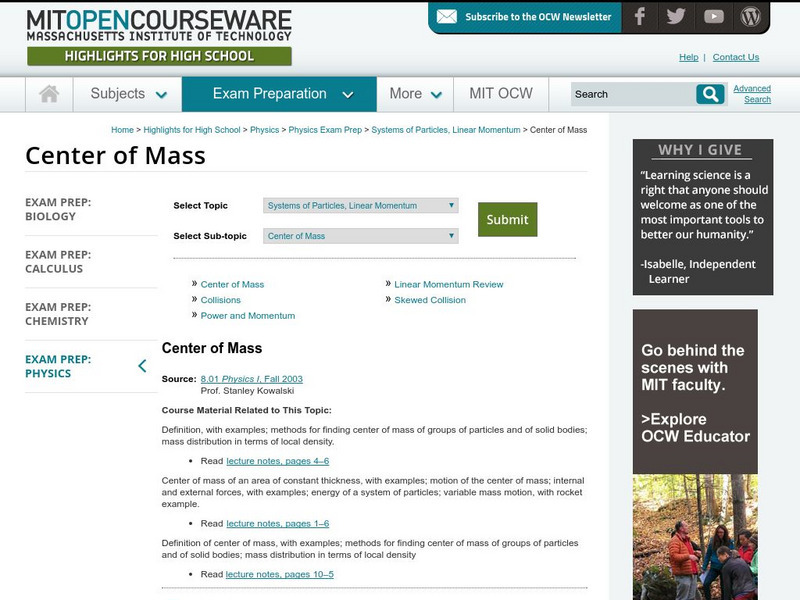
Mit: Open Course Ware: Center of Mass
Students explore center of mass. Some topics examined in the activities are collisions, center of mass motion, and power. The resource consists of video clips, lecture notes, practice problems, and exam questions. Practice problems and...
AAA Math
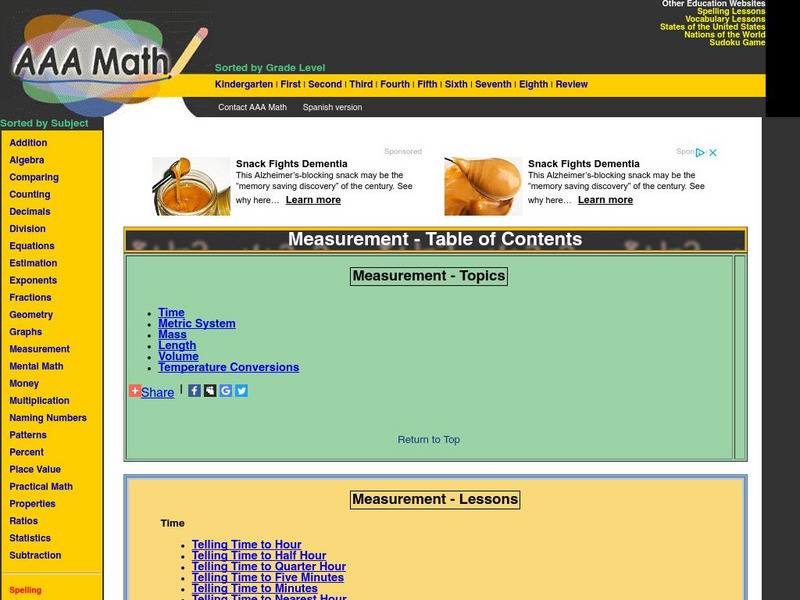
Aaa Math: All About Measurements
A complete tutorial that explains time, metric system, mass, length, volume, and temperature. Interactive practices and challenge games are included.
Curated OER
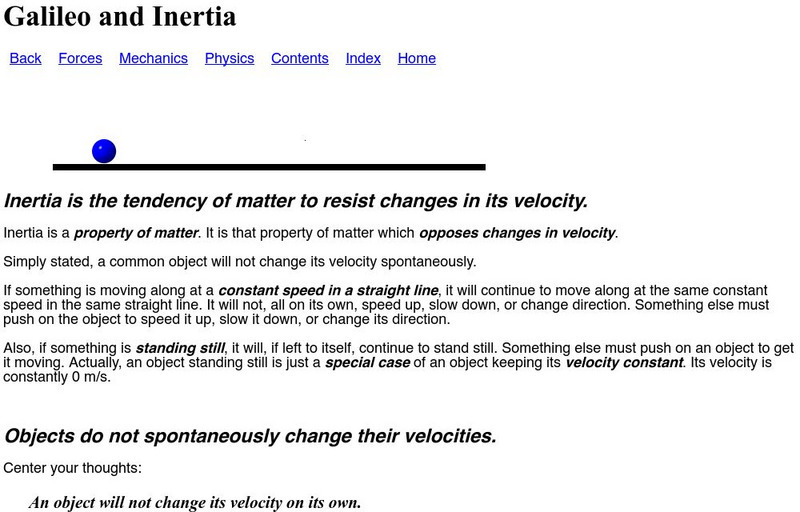
Zona Land: Galileo and Inertia
A tutorial with accompanying animations on classical mechanics. Well-illustrated. Good navigation.
Georgia State University
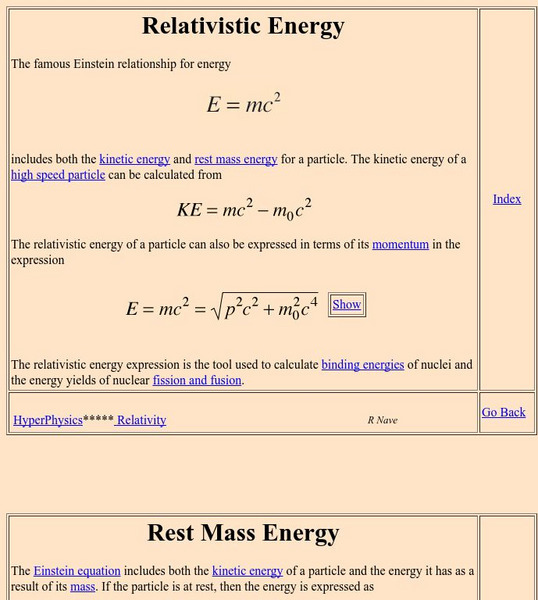
Georgia State University: Hyper Physics: Relativistic Energy
A mathematically understandable presentation of relativistic energy. Parts include Relativistic Energy, Rest Mass Energy, Conservation of Energy, Pair Production, Relativistic Kinetic Energy, and even Kinetic Energy. A couple of...
Center of Science and Industry
Cosi Columbus: Buoyant Bubble [Pdf]
Learn about density in this hands-on science experiment. Includes full list of materials, procedures, and scientific explanation of what makes an object float or sink. [PDF]
University of California
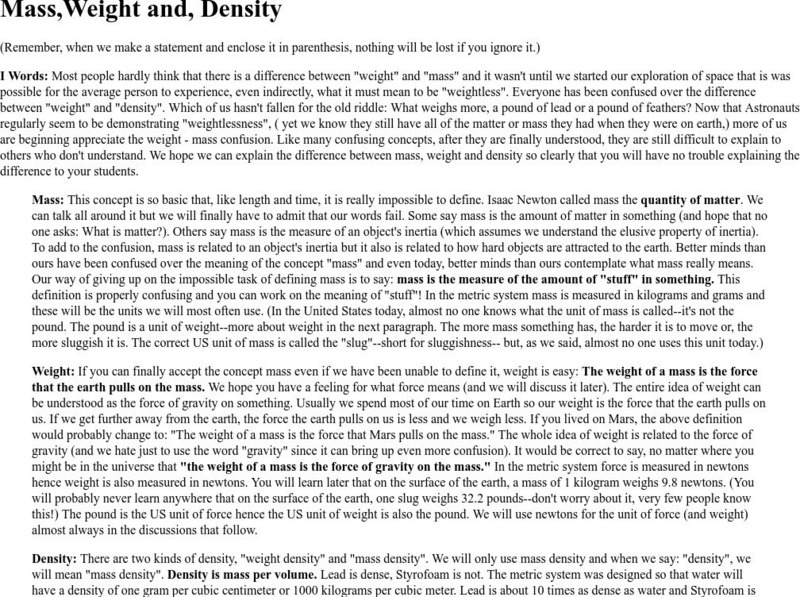
Ucla K 6 Physics/astronomy: Mass, Weight, and Density
This website provides explanations of mass, weight, and density with directions for building simple scales and balances. Provided as encouragement to teach these concepts to young children, it offers a good review for older students.
University of North Carolina
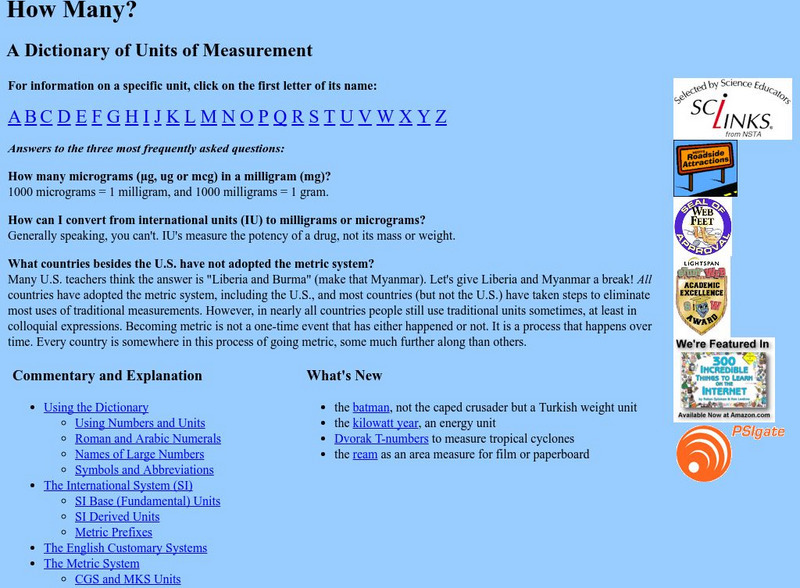
A Dictionary of Units of Measurement
This site contains an extensive list of various units of measurement known internationally and across several disciplines. Unit symbols are also included.
Texas Instruments
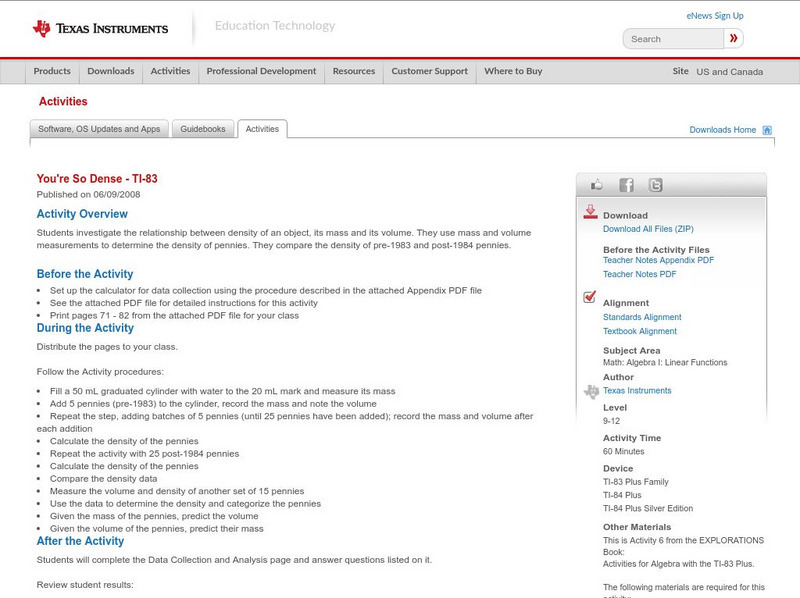
Texas Instruments: You're So Dense Ti 83
Students investigate the relationship between density of an object, its mass and its volume. They use mass and volume measurements to determine the density of pennies. They compare the density of pre-1983 and post-1984 pennies.
Texas Instruments
Texas Instruments: Good Vibrations
In this activity, students will investigate the motion of a mass moving up and down on a spring. They collect data for the position, velocity, and acceleration of the mass's motion and examine the relationship between them.
Science Education Resource Center at Carleton College
Serc: At the Speed of Bowling
In this lab students will measure the energy of a bowling ball with vernier motion detectors. The students will calculate the energy of the ball at the beginning, mid point, and end of a bowling alley. Students will inquire about the...
Science Education Resource Center at Carleton College
Serc: Newton's Second Law: Constant Force Applied to a Skateboarder
In this lab activity, young scholars will become familiar with Newton's 2nd Law of Motion. By investigating the motion of different skateboarders pulled with a variety of constant force values, they will discover that bodies acted on by...

Science Education Resource Center at Carleton College
Serc: Mineral Density: Teaching Accuracy, Slope, and Percent Error
Students explore the meaning of density and use their math skills to graph mass/volume data, write an equation for a line, and interpret the slope of the line. Students also find the density of two unknown mineral samples and use those...
Science Education Resource Center at Carleton College
Serc: Investigating Isotopes: Using M&m's as a Model for Calculating Atomic Mass
This activity allows students to gain an understanding of the relationship between the mass and relative abundance of an isotope and its effect on the average atomic mass of the element. Students will be given a random sample of the...
Science Education Resource Center at Carleton College
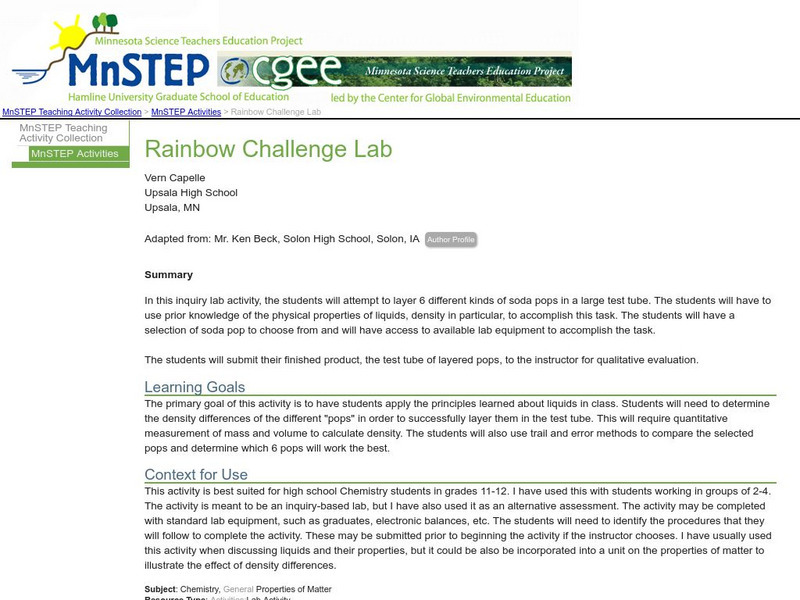
Serc: Rainbow Challenge Lab
In this inquiry lab activity, learners will attempt to layer 6 different kinds of soda pops in a large test tube using their knowledge of density and other physical properties of liquids.

Science Education Resource Center at Carleton College
Serc: Investigating Floating and Sinking: Density
This investigation introduces the concepts of volume, mass, and density and how they interact. Students will make predictions of whether an object will float or sink after finding mass and volume of an object.
Science Education Resource Center at Carleton College
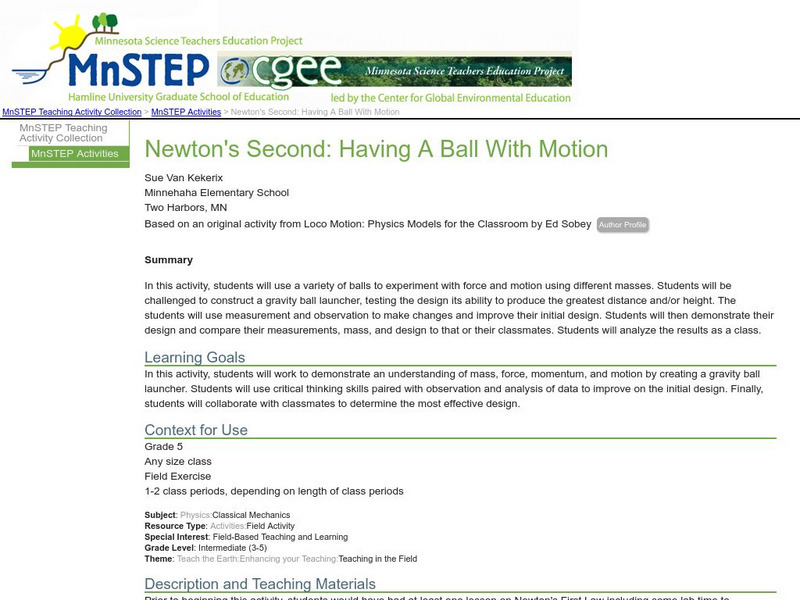
Serc: Newton's Second: Having a Ball With Motion
Students will create a gravity ball launcher to demonstrate their understanding of mass, force, momentum, and motion. The students will use critical thinking, measurement, and observation and analysis of data to make changes and improve...
Science Education Resource Center at Carleton College
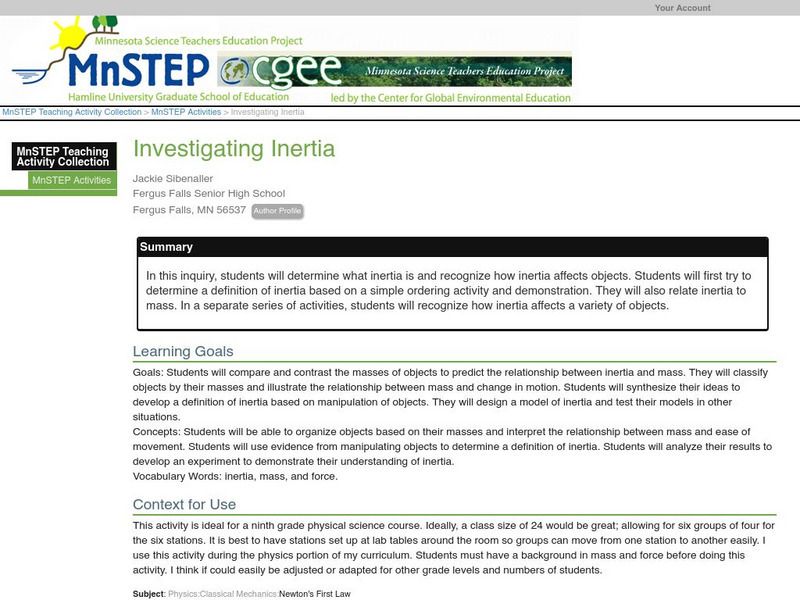
Serc: Investigating Inertia
In this investigation, students will perform a simple ordering activity and demonstration to determine what inertia is and recognize how inertia affects objects. They will compare and contrast the masses of objects to predict the...
Science Education Resource Center at Carleton College
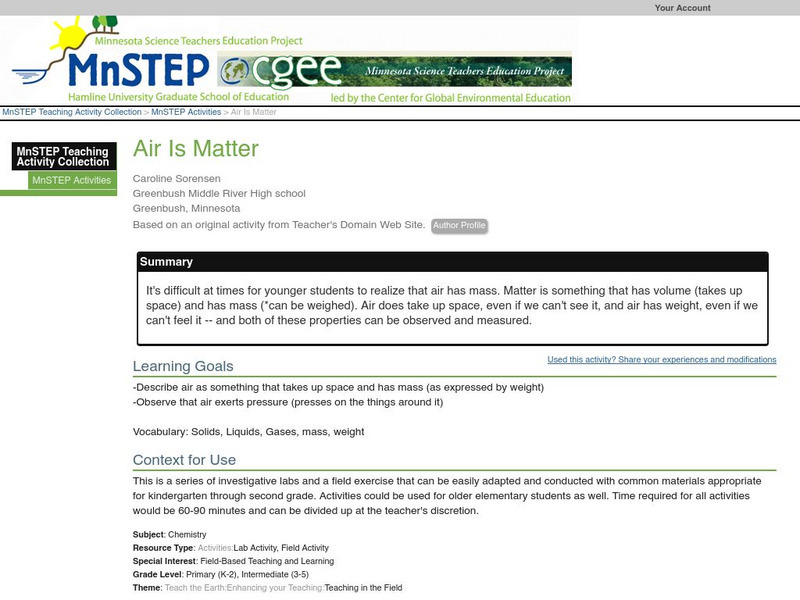
Serc: Air Is Matter
It's difficult at times for younger students to realize that air has mass. Matter is something that has volume (takes up space) and has mass (*can be weighed). Air does take up space, even if we can't see it, and air has weight, even if...