Other
The Official Leonard Bernstein Site
As the Official site, there are recordings, lectures, letters, photos, publications, scripts, etc. that are unavailable elsewhere. Links to the Library of Congress' Leonard Bernstein Collection, another excellent source.
Vision Learning
Visionlearning: General Science: Density
Instructional module focusing on density as a physical property of matter. Discussion incorporates historical references as well as formulas. Site also includes an interactive practice quiz and links relating to the topic.
Sophia Learning
Sophia: Physical Science: Conservation of Mass
Created to teach students of the 21st century, Sophia is bringing the laws of mass straight to your fingertips. Become the commander of your own learning experiences as you take part in this brief tutorial. [0:56]
Discovery Education
Discovery Education: Web Math: Math for Everyone
Provides online programs and explanations on everyday math: calculating a tip at a restaurant, determining the sale price of an item, finding the odds of winning a lottery, computing simple and compound interest, and more.
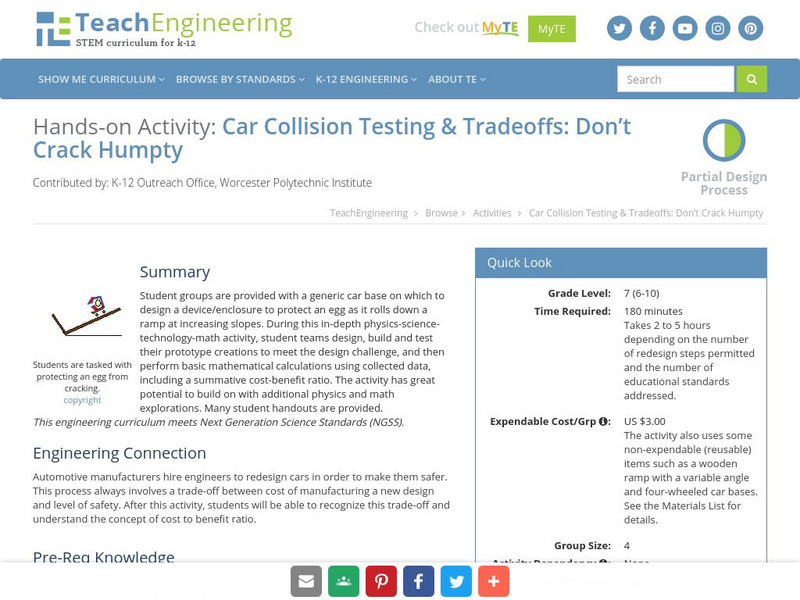
TeachEngineering
Teach Engineering: Car Collision Testing & Tradeoffs: Don't Crack Humpty
Student groups are provided with a generic car base on which to design a device/enclosure to protect an egg as it rolls down a ramp at increasing slopes. During this activity, student teams design, build and test their prototype...
Exploratorium
Exploratorium: Your Weight on Other Worlds
From the Exploratorium Museum. Includes an interactive feature in which a visitor enters their weight on earth and has their weight on other planets computed and displayed. Discusses the distinction between mass and weight and describes...
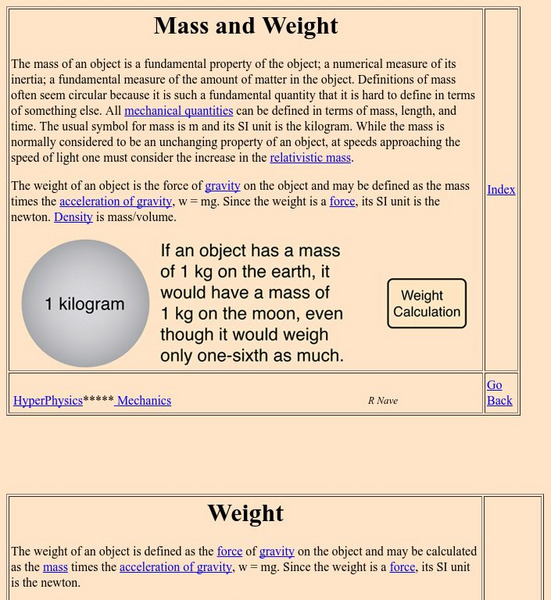
Georgia State University
Georgia State University: Hyper Physics: Mass, Weight, and Weightlessness
Site from HyperPhysics dealing with the topic of mass and weight. In addition the site deals with weightlessness. The numerous links to other pages help the student see how ideas are interrelated.
Utah State Office of Education
Utah State Office of Education: Force, Energy, & Motion
A unit on energy, force, and motion presented with interactive and classroom activities. Students gain an understanding of weight, mass, potential and kinetic energy, sound, and heat with this engaging resource.
eSchool Today
E School Today: All About Forces
Forces are everywhere. Learn what they are, the characteristics of forces, different kinds of forces, and factors that affect them.

Discovery Education
Discovery Education: Rules of Forces and Motion
With this hands-on lesson, help students understand force, gravity, friction, and speed. Students will also learn how each of these concepts affects the another.

NASA
Nasa: Mass vs. Weight
Several learning modules that explain the difference between mass and weight. Each module includes a video introduction and detailed lesson plan.
Utah Education Network
Uen: May the Force Be With You
Third graders will understand that the greater the mass of an object, the greater the force needed to change its motion.
Utah Education Network
Uen: It's a Weighty Matter
Third graders will understand weight, mass, and gravity.
Utah Education Network
Uen: Super Paper Planes
Activity helps students understand force, mass, and measurement.
TeachEngineering
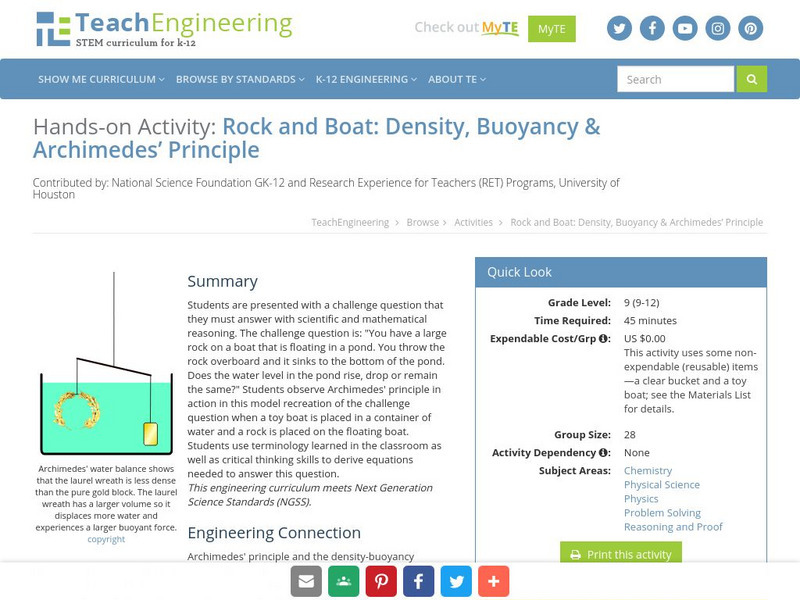
Teach Engineering: Rock and Boat
Students observe Archimedes' principle in action in this challenge where a toy boat is placed in a container of water and a rock is placed on the floating boat. Students must explain why the water level rises/falls/stays the same based...
American Chemical Society
Middle School Chemistry: What Is Density?
Calculate the density of cubes made of different materials to determine what type of material it contains. Using this information explain that the size, mass, and arrangement of the atoms or molecules of a substance determines its density.
American Chemical Society
Middle School Chemistry: Density of Water
Students discover the concept that density is a characteristic property of water by measuring the volume and mass of water and calculating its density.
PBS
Pbs Learning Media: Floating and Sinking: Hot Air Balloons
Why do hot air balloons float? This resource from the NOVA Web site offers a series of interactive activities that illustrates the physics of hot air balloons.
PBS
Pbs Learning Media: Matter's Physical Properties: Interactive Lesson
In this interactive lesson, learn what the "physical properties" of matter are and how can they be measured and observed.
Math Drills
Math Drills: Unit Converter
Download these free worksheets to sharpen your skills in converting units. Sheets focus on converting between a wide variety of measurement units including mass, length, volume, temperature, time, and many more.
PBS
Pbs Learning Media: Fitness Dice: Lesson Plan
Read the die to find out what exercise to do and how many repetitions are needed, keep a running tally of rolls to see who gets the highest score.
Cuemath
Cuemath: Mass
A comprehensive guide for learning all about mass with definitions, how to calculate mass, the difference between mass and weight, solved examples, and practice questions.
Other
Bscs: Forces and Motion Content Background Document
In this document, we will try to answer a fundamental question of physical science, "Why do things start to move, slow down, speed up, stop moving or change direction?" In answering these core questions we can develop concepts that can...
Open Ed
Open Ed Sci: 8.1 Contact Forces
In this unit, students explore a variety of phenomena to figure out, "Why do things sometimes get damaged when they hit each other?" Student questions about the factors that result in a shattered cell phone screen lead them to...