
McGraw Hill
Glencoe: Self Check Quizzes 1 Mass and Capacity Metric System
Use Glencoe's randomly generated self-checking quiz to test your knowledge of mass and capacity in the Metric System. Each question has a "Hint" link to help. Choose the correct answer for each problem. At the bottom of the page click...
Sophia Learning
Sophia: Newton's Second Law: Lesson 3
This lesson introduces Newton's Second Law and explains that force is equal to mass times acceleration. It is 3 of 3 in the series titled "Newton's Second Law."
CK-12 Foundation
Ck 12: The International System of Units
[Free Registration/Login may be required to access all resource tools.] In this online tutorial students will begin to identify the seven base units of the International System of Units. They will understand the commonly used metric...
CK-12 Foundation
Ck 12: Chemical Formulas
[Free Registration/Login may be required to access all resource tools.] Students will use a chemical formula or mass data to calculate the percent composition of a compound, and then calculate the empirical or molecular formula for a...
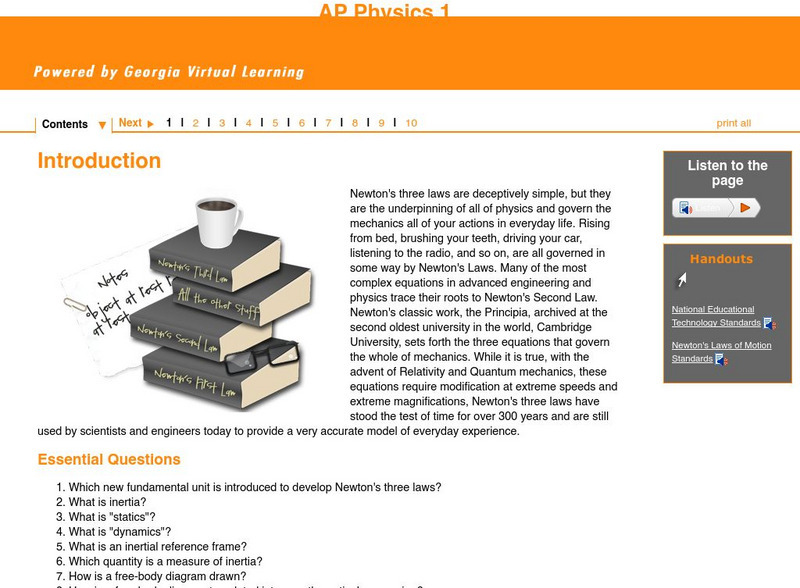
Georgia Department of Education
Ga Virtual Learning: Ap Physics 1: Newton's Laws of Motion
Newton's three laws are deceptively simple, but they are the underpinning of all of physics and govern the mechanics all of your actions in everyday life. Take an in-depth look at these laws in this learning module.

Khan Academy
Khan Academy: Dalton's Atomic Theory
Article explores the key points of Dalton's atomic theory and the laws of conservation of mass and constant composition. Which points do we still use today?
Texas Education Agency
Texas Gateway: Properties: Extensive and Intensive
Find out about physical and chemical properties of matter, and then compare extensive and intensive property characteristics.
Other
Memorial Sloan Kettering Cancer Center: Cancer
General information on what cancer is, types of cancer, treatment and prevention.
OpenStax
Open Stax: Newton's First Law of Motion: Inertia
In the following interactive students will begin to define mass and inertia and understand Newton's first law of motion.
OpenStax
Open Stax: Physical Quantities and Units
Giving numerical values for physical quantities and equations for physical principles allows us to understand nature much more deeply than does qualitative description alone. To comprehend these vast ranges, we must also have accepted...
American Chemical Society
American Chemical Society: Hompage
ChemCenter, available from the American Chemical Society, provides chemistry news, reference sources and other public services.
TeachEngineering
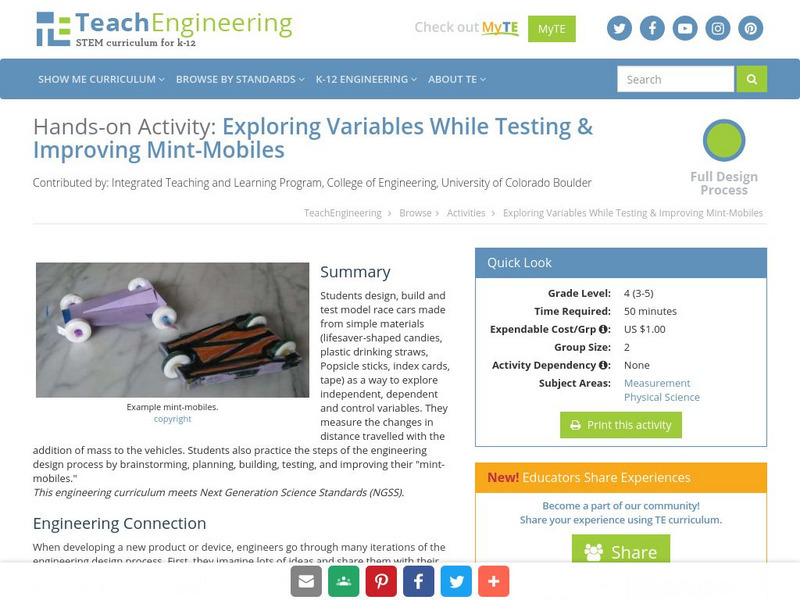
Teach Engineering: Mint Mobiles
Students design, build and test model race cars made from simple materials (lifesaver-shaped candies, plastic drinking straws, Popsicle sticks, index cards, tape) as a way to explore independent, dependent and control variables. They...
TeachEngineering
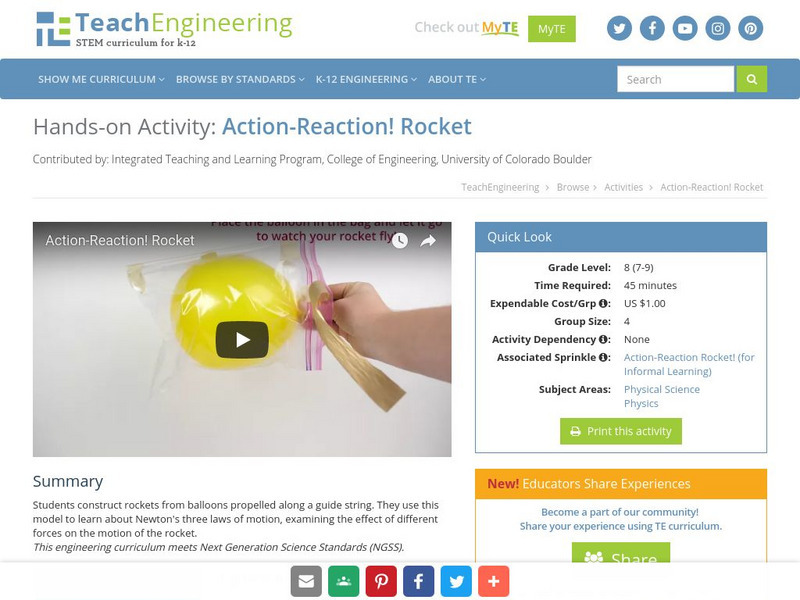
Teach Engineering: Action Reaction! Rocket
Students construct a rocket from a balloon propelled along a guide string. They use this model to learn about Newton's three laws of motion, examining the effect of different forces on the motion of the rocket.
TeachEngineering
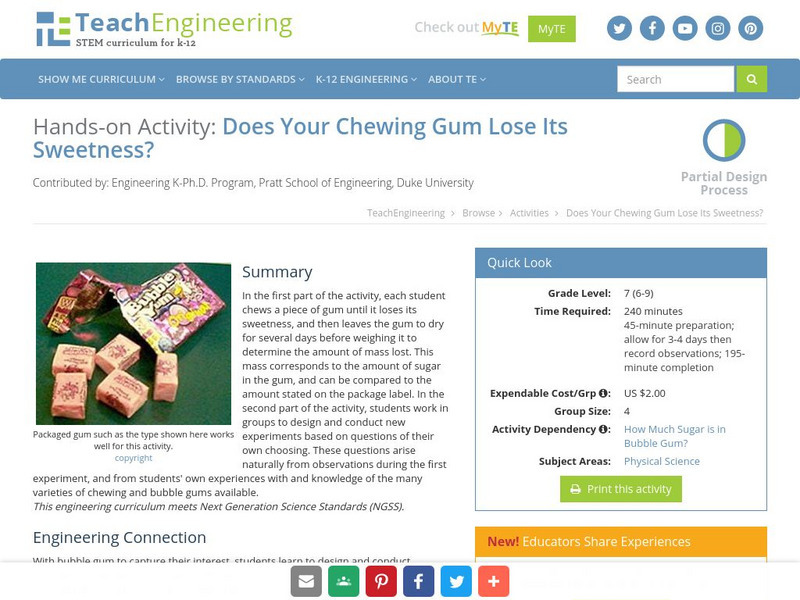
Teach Engineering: Does Your Chewing Gum Lose Its Flavor?
In the first part of the activity, each student chews a piece of gum until it loses its flavor, and then leaves the gum to dry for several days before weighing it to determine the amount of mass lost. This mass corresponds to the amount...
TeachEngineering
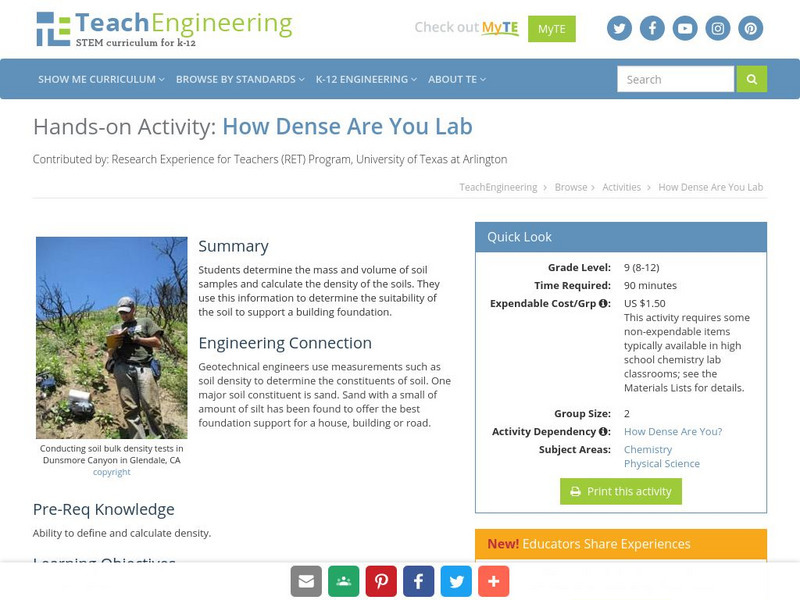
Teach Engineering: How Dense Are You Lab
Students determine the mass and volume of soil samples and calculate the density of the soils. They use this information to determine the suitability of the soil to support a building foundation.
TeachEngineering
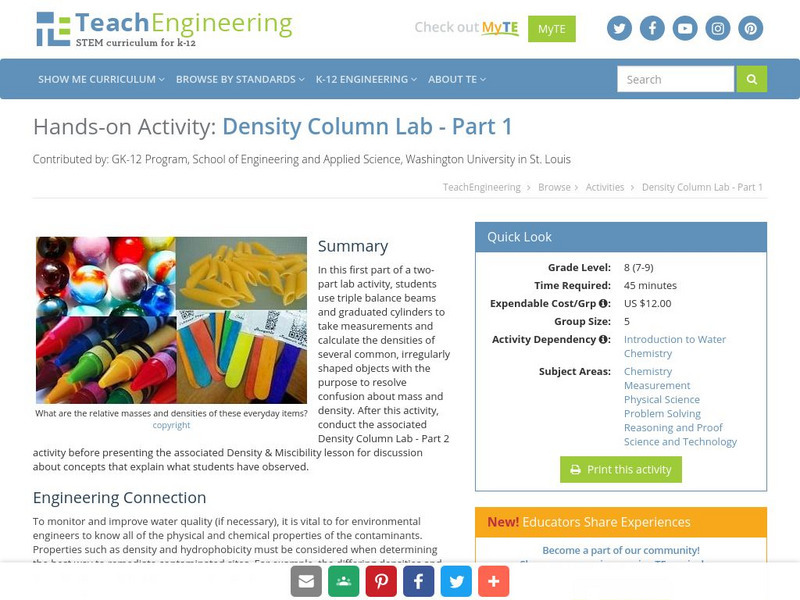
Teach Engineering: Density Column Lab Part 1
In this first part of a two-part lab activity, students use triple balance beams and graduated cylinders to take measurements and calculate the densities of several common, irregularly shaped objects with the purpose to resolve confusion...

TeachEngineering
Teach Engineering: Mechanics Mania
Through ten lessons and numerous activities, students explore the natural universal rules engineers and physicists use to understand how things move and stay still. Together, these rules are called "mechanics." The study of mechanics is...

TeachEngineering
Teach Engineering: The Physics of Fluid Mechanics
Five lessons about the study of fluid mechanics. The unit concludes with students applying what they have learned to determine the stability of individual above-ground storage tanks given specific storm conditions so they can analyze...
TeachEngineering
Teach Engineering: Move It!
Mechanical energy is the most easily understood form of energy for students. When there is mechanical energy involved, something moves. Mechanical energy is a very important concept to understand. Engineers need to know what happens when...

TeachEngineering
Teach Engineering: What Floats Your Boat?
Students use modeling clay, a material that is denser than water and thus ordinarily sinks in water, to discover the principle of buoyancy. They begin by designing and building boats out of clay that will float in water, and then refine...
Texas Education Agency
Texas Gateway: Newton's First Law
Within this resource, you will learn more about Newton's first law and real-world applications of this law.
Texas Education Agency
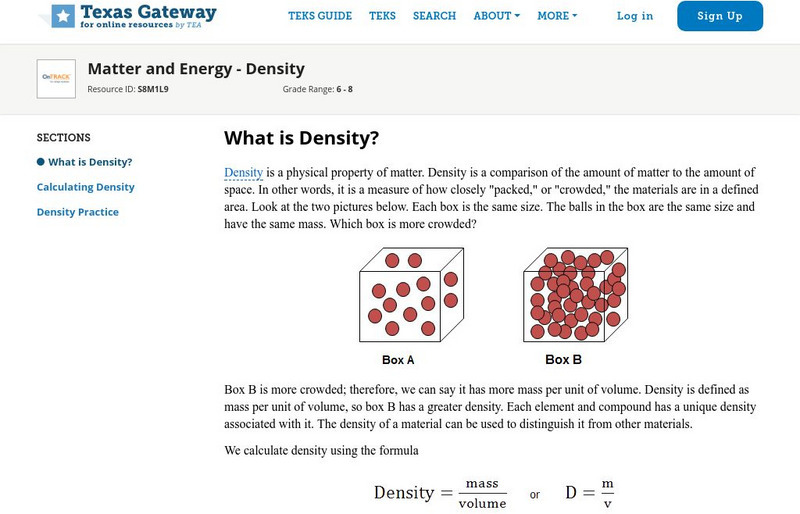
Texas Gateway: What Is Density?
This tutorial is an explanation of the properties of density.
Annenberg Foundation
Annenberg Learner: British and Metric Conversions Interactives
The resource assesses students on British and metric conversions. There are tutorials on metric units, length, mass, volume, English units, symbols, and temperature. There is also an introduction and an interactive activity to test the...

University of St. Andrews (UK)
University of St. Andrews: Albert Einstein
A truly complete biography of the great man. Some adequate discussion of his theoretical and scientific work, but the accent here is on his personal life. Many anecdotes, many quotes from him, many references and hotlinks to other...