Hi, what do you want to do?






Great Big Story
Kathy Streeter, revolutionizing marine mammal training
Explore Kathy Streeter's unique, non-food based training methods with seals at the New England Aquarium.
Curated Video
Insulation – Did you know?
Did you know that marine mammals have a thick layer of fat, or blubber, that acts as an insulator?
<
br/>
Material processes - Changing material
s
- Insulation
Learning Points
Thermal insulators...
<
br/>
Material processes - Changing material
s
- Insulation
Learning Points
Thermal insulators...
Great Big Story
Behind the Scenes at the Whale Warehouse, A Marine Mammal Treasure
Explore the fascinating, research-focused world of the Natural History Museum's Whale Warehouse, housing over 5,000 marine mammal specimens.
Great Big Story
Kathy Streeter, Revolutionizing Marine Mammal Training
Explore Kathy Streeter's unique, non-food based training methods with seals at the New England Aquarium.<br/>
Brainwaves Video Anthology
Allison Kaufman - Animal Creativity and Innovation
Allison B. Kaufman, PhD is a research scientist with the Department of Ecology and Evolutionary Biology at the University of Connecticut, where she also teaches as a adjunct professor in the departments of Marine Biology and Psychology....
EarthEcho International
STEM Career Closeup: Research Coordinator
Liam Antrum is a research coordinator at the Olympic Coast National Marine Sanctuary, where he advocates for scientific research and coordinates collaborations. He finds excitement in getting out into the sanctuary and conducting...
EarthEcho International
STEM Career Closeup: A Day in the Life of a Marine Biologist and Conservationist
Dr. Kate Charlton-Robb is the Founding Director and Head of Research at the Marine Mammal Foundation. With over 16 years experience researching dolphins across southern Australia, Kate achieved a Bachelor of Science with a double major...
EarthEcho International
PlasticSeas: Exploring the Impact of Plastic Pollution on Our Oceans and Wildlife
The video explores the impact of plastic pollution on marine life and the environment, featuring interviews with marine biologists and researchers who study the effects of plastic on seabirds and dolphins. The message is clear: we need...
Tumble Science Podcast for Kids
Whales and Snot from their Blowholes
A whale inhales and exhales air through the blowhole at the top of its head. The plume that rises when the whale exhales is made up of blow, a scientific term for whale snot. Whale snot can reveal important information about whale...
Curated Video
The Fascinating World of Seals and Sea Lions
This video provides an overview of seals and sea lions, highlighting their diverse species, habitats, behaviors, and reproductive strategies. It explores their role as top predators in the ocean and emphasizes the importance of these...
Red Rock Films
Ecosystem Activator: Marine Coasts. Age 10 - 14.
Life on the rocky and sandy shore of the ocean coast. How the marine coast supports life on land and sea. Threats to the ocean and how to help.
NASA
Can Data from Space Save Dolphins?
The age-old mystery of why otherwise healthy dolphins, whales and porpoises get stranded along coasts worldwide deepens: After a collaboration between NASA scientists and marine biologists, new research suggests...
Curated Video
Whales: Size, Behavior, and Life Cycle
This video provides an overview of whales, the largest marine mammals in the world. It explores their size, feeding habits, communication methods, mating behaviors, and the importance of whales in the marine ecosystem. The video also...
Red Rock Films
Ecosystem Activator: Marine Coasts. Age 7 - 10.
Life on the rocky and sandy shore of the ocean coast. How the marine coast supports life on land and sea. Threats to the ocean and how to help.
Curated Video
Dolphins: Behavior, Communication, and Social Structure
This video provides an overview of dolphins, highlighting their diverse species, social behaviors, communication methods, mating rituals, and parenting habits. It also explores their intelligence, tool usage, and ability to mimic other...

TED-Ed
The Lovable (and Lethal) Sea Lion
What lives in the ocean, has ears, walks on all fours, and can reach a top speed of 18 miles an hour? Why, the sea lion, of course! A cute, animated video introduces viewers to the majestic aquatic mammal.

TED-Ed
Why Do Whales Sing?
Although little is know about why whales sing, researchers are developing theories that explain how whales are able to vocalize. Viewers get a short course in whale song and even get to listen to recordings of the haunting melodies...

PBS
Nova Science Now: Smart Marine Mammals: Smart Sea Lions
In this video, meet Rio, a captive California sea lion who has helped research biologists to better understand the cognitive abilities of this species. See how Rio has learned that certain sounds are associated with certain letters or...
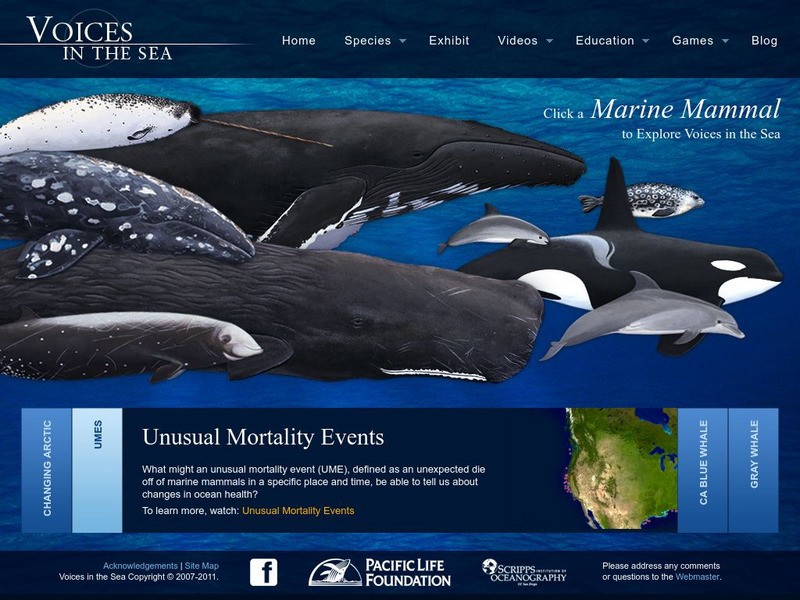
University of California
Voices in the Sea: Marine Mammals
Listen to the calls of some of the animals that live in the ocean. Get basic stats of the animal as you listen to the sounds they make in the wild.
Science Friday Initiative
Science Friday: Dolphins and Comparative Medicine
What happens when a dolphin catches a cold? No, it's not a trick question. In this hour, we'll talk about what marine mammals can teach us about human biology.