Hi, what do you want to do?






Alabama Learning Exchange
Alex: You Don't Taste the Way You Look!
This Evolution lesson uses edible materials to demonstrate how a mimic acquires survival advantage. This particular lesson provides students an easy approach to learn and retain this information.

Alabama Learning Exchange
Alex: Animal Hide and Seek
This instructional activity will help students become aware of how animals use their colors to their advantage. After a discussion and activity about the importance of different animals' colors, students will participate in a virtual...

Utah STEM Foundation
Utah Stem Action Center: Sorting Living Things
Living things live in places that have what they need to survive. Since fish don't breathe air, they need to live in an ocean. That one is pretty obvious, but what about different kinds of trees? Can all animals that breathe air live...
Concord Consortium
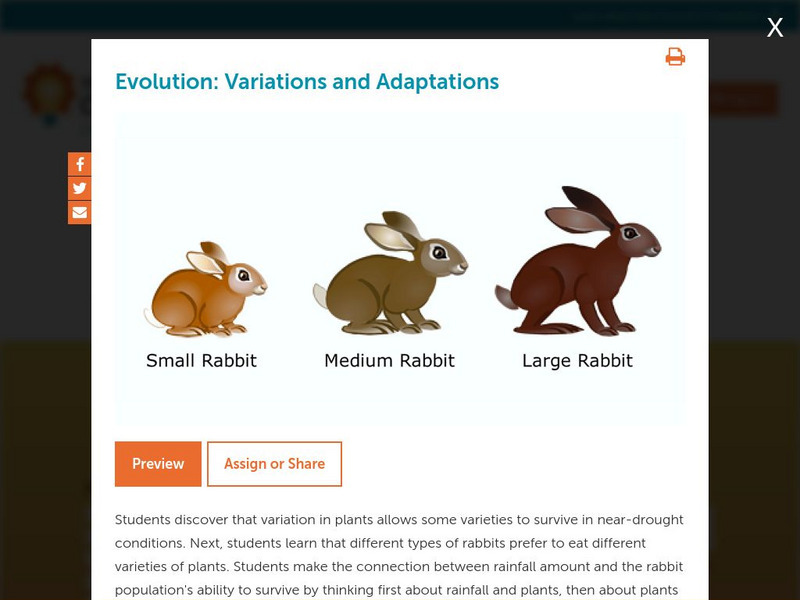
Concord Consortium: Evolution: Variations and Adaptations
Students discover that variation in plants allows some varieties to survive in near-drought conditions. Next, students learn that different types of rabbits prefer to eat different varieties of plants. Students make the connection...
CK-12 Foundation
Ck 12: Life Science: 10.18 Bird Diversity
Learn about some of the bird adaptations that help birds survive.
CK-12 Foundation
Ck 12: Life Science: 7.2 Plant Evolution
Discover the evolution and change of plants over time.
CK-12 Foundation
Ck 12: Life Science: 4.3 Natural Selection
Explore the theory of evolution by means of natural selection.
PBS
Pbs Learning Media: Animal Adaptations: Fishing Cat
Learn how the semi-aquatic fishing cat evolved millions of years ago to live in the wetlands of South and Southeast Asia in this video from NATURE: The Story of Cats (4:18). The accompanying activity prompts students to write an...
Louisiana Department of Education
Louisiana Doe: Curriculum Hub: Ela Guidebooks: Romeo and Juliet: Discussions
Engage in a whole-class discussion to demonstrate your understanding of adaptations of Romeo and Juliet and West Side Story.
Science Education Resource Center at Carleton College
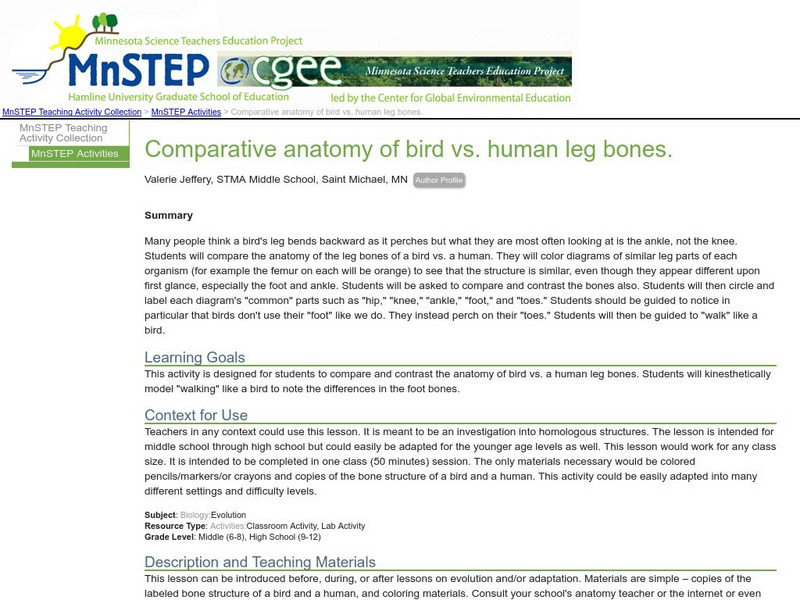
Serc: Comparative Anatomy of Bird vs. Human Leg Bones
This activity is designed for students to compare and contrast the anatomy of bird and human leg bones. Students will kinesthetically model walking like a bird to note the differences in the foot bones.
TED Talks
Ted: Ted Ed: The Game Changing Amniotic Egg
April Tucker peels back each layer of the amniotic egg, revealing how truly extraordinary this evolutionary marvel is. [4:30]
BioMan Biology
Bio Man Biology: Snurfle Islands
Create a Snurfle and see whether it can survive in different environments. As you play the game, you will learn about natural selection and animal adaptations. At the end of the game, try the multiple-choice quiz to check your...
Concord Consortium
Concord Consortium: Stem Resources: Variations and Adaptations
Experiment with variations in grass to see which size grows best with different amounts of water. Understand that grass that can live in different levels and change to its environment has a better chance of surviving. Also, experiment...
PBS
Pbs Teachers:how Can I Hide in Namib?
Identify how certain species survive in the Namib Desert through color protection, and determine what techniques animals in Namib use to hide from predators and to wait for prey.

PBS
Pbs Teachers: Canyonlands: Tonight Our Guest Is
This activity will help pupils understand that animals adapt to abiotic and biotic conditions in their environment, some of which have evolved over a long period of time through the process of natural selection, and identify the...

PBS
Pbs Teachers:my Life as an Insect in Namib
Identify the harsh characteristics of the Namib Desert and determine the adaptations an insect in Namib Desert must have to survive.
PBS
Pbs Teachers: Why Do Elephants Have Big Feet?
Explain how an organism's adaptations give it advantages in particular environments. Calculate and compare the amount of pressure exerted by the foot of an elephant and a human, and apply that knowledge to an understanding of automobile...
PBS
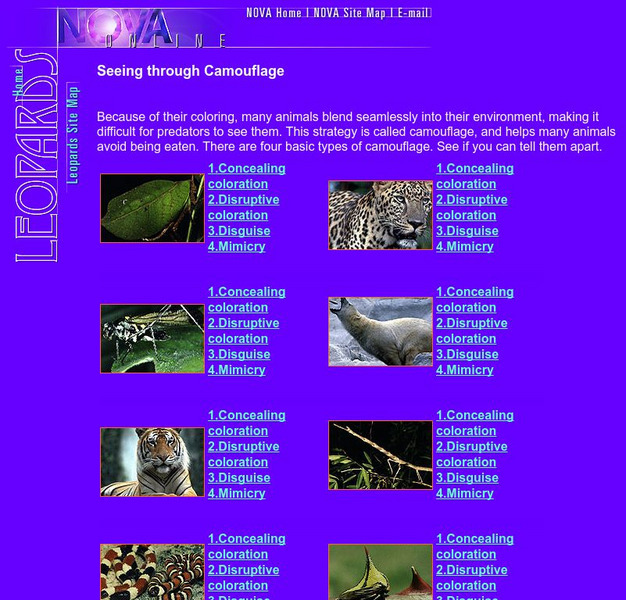
Seeing Through Camouflage
View the pictures of animals and decide if those use concealing coloration, disruptive coloration, disguise, or mimicry to blend into their environment.
Other
The Ambrose Bierce Site
Journalist Don Swaim has put together a collection of original art and writing about Bierce, as well as information about his life and work. Adaptations of his work are also featured.
Online Learning Haven
Adaptations: Penguins
An interesting look at the structural and behavioral adaptations of the penguin. Neat penguin facts are included at the end of the site.
Online Learning Haven
Adaptations: Sea Turtles
An interesting that examines the structural and behavioral adaptations of the sea turtle. The problems of survival faced by the hatchlings is also delved into in this site.
Other
Agriculture in the Classroom Sask: : How Plants Survive the Winter
A basic site that delves into how annuals, perennials and trees survive the winter. A test is provided to determine how well you have mastered the materials.

PBS
Pbs Teachers: A Giraffe Debate
Research, take and defend a position on the question of why the giraffe population is threatened and which is more important: survival in a wildlife sanctuary or quality of life in the wild.

PBS
Pbs Teachers: Scientific American: Spiders! Amazon Tales
Explore several spider species and learn about their adaptations to the world around them. Design a new species of spider, with adaptations required to survive in a particular habitat.