Hi, what do you want to do?






National High Magnetic Field Laboratory
Magnet Academy: Wheatstone Bridge 1843
Read about the device used for measuring resistance in a circuit which was discovered in 1843, but had been invented a decade earlier. The inventor's name was not Wheatstone.

National High Magnetic Field Laboratory
Magnet Academy: Wimshurst Machine 1880
In the modern world, virtually everyone is familiar with electricity as an accessible, essential form of energy. In electricity's earlier days, scientists used the buildup and release of static electricity.

National High Magnetic Field Laboratory
Magnet Academy: William Gilbert
William Gilbert was an English physician and natural philosopher who wrote a six-volume treatise that compiled all of the information regarding magnetism and electricity known at the time. The work included descriptions of many of...

National High Magnetic Field Laboratory
Magnet Academy: William Thomson, Lord Kelvin
William Thomson, known as Lord Kelvin, was one of the most eminent scientists of the nineteenth century and is best known today for inventing the international system of absolute temperature that bears his name. He made contributions to...

National High Magnetic Field Laboratory
Magnet Academy: Nikola Tesla
Awarded more than 100 patents over the course of his lifetime, Nikola Tesla was a man of considerable genius and vision. He was reportedly born at exactly midnight during an electrical storm, an intriguing beginning for a man who would...

National High Magnetic Field Laboratory
Magnet Academy: Wilhelm Weber
Find out more about German physicist Wilhelm Weber, who developed and enhanced a variety of devices for sensitively detecting and measuring magnetic fields and electrical currents.

National High Magnetic Field Laboratory
Magnet Academy: James Watt
The Scottish instrument maker and inventor James Watt had a tremendous impact on the shape of modern society. His improvements to the steam engine were a significant factor in the Industrial Revolution, and when the Watt engine was...

Exploratorium
Exploratorium: Science Snacks: Magnetic Pendulums
See how electricity and magnetism interact with this activity. Activity has students creating a current by swinging a copper coil through a magnetic field. The copper coil will start a second coil swinging as well.
Exploratorium
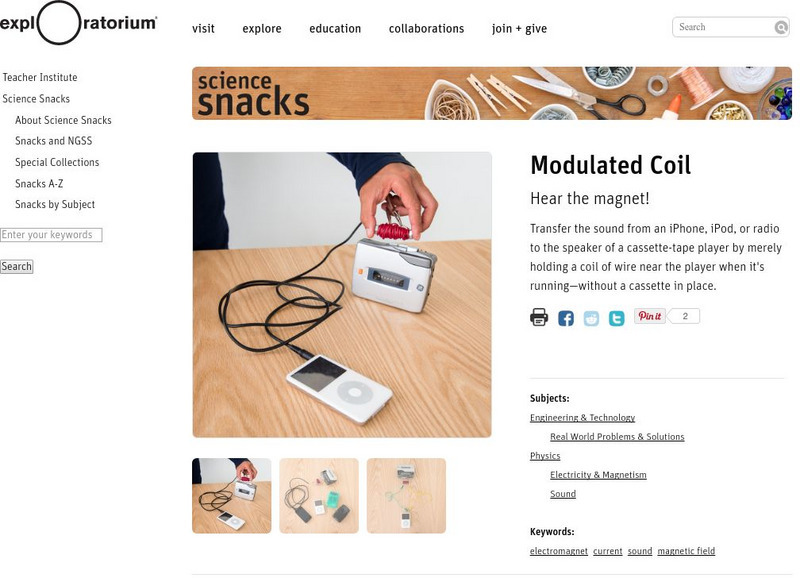
Exploratorium: Science Snacks: Modulated Coil
Can you hear a magnet? In this activity you will be able to transfer the sound from your iPhone, iPod or radio to a cassette-tape player.
Exploratorium
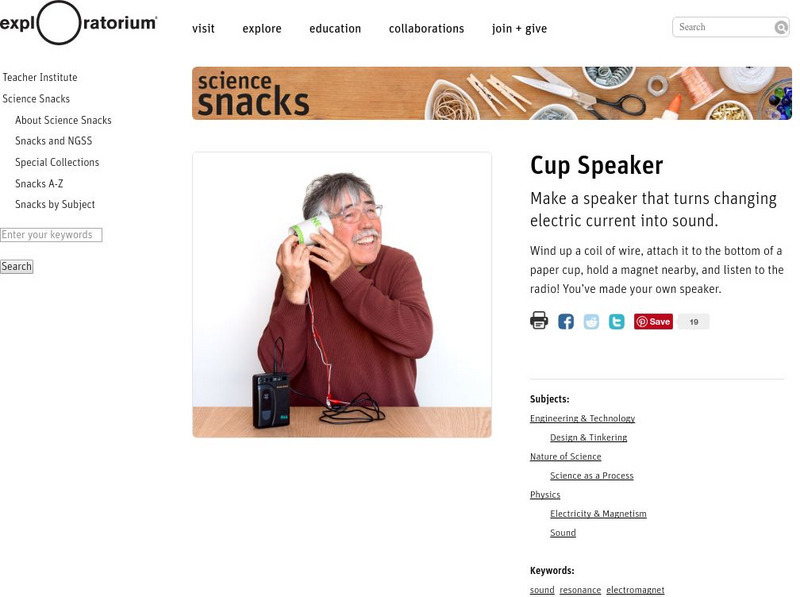
Exploratorium: Science Snacks: Cup Speaker
This activity will have students creating their own speaker with a paper cup, coil of wire, and magnet. The speaker operates by changing electric current into sound.

Other
Science Hobbyist: Sticky Electrostatics
A series of activities focusing on charge interactions, charging methods, and the conservation of charge. Activities utilize scotch tape and other readily available items. Includes explanations of what is happening.

Careers New Zealand
Career Nz: Electrician
This site contains information about becoming an Electrician in New Zealand. While some of the information is specific to New Zealand, there is also data that is uniform to the career.
Famous Scientists
Famous Scientists: Alessandro Volta
Learn how Alessandro Volta became a pioneer of electricity and power, and who is credited as the inventor of the electrical battery and the discoverer of methane.
Famous Scientists
Famous Scientists: Georg Ohm
Find out about the German physicist and mathematician whose work in the field of electrical current shaped the study of electricity.
Famous Scientists
Famous Scientists: Hans Christian Oersted
Learn how Hans Christian Oersted's discoveries in electricity led him to discover electromagnetism.
Famous Scientists
Famous Scientists: William Thomson
Learn about William Thompson's important work in the mathematical analysis of electricity and formulation of the first and second laws of thermodynamics, and did much to unify the emerging discipline of physics in its modern form.
TeachEngineering
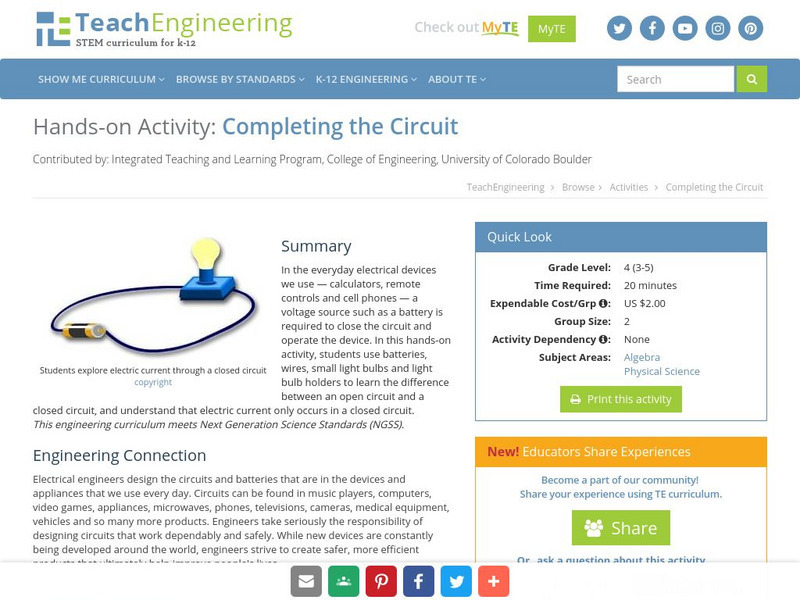
Teach Engineering: Completing the Circuit
In the everyday electrical devices we use - calculators, remote controls and cell phones - a voltage source such as a battery is required to close the circuit and operate the device. In this hands-on activity, students use a battery,...
TeachEngineering
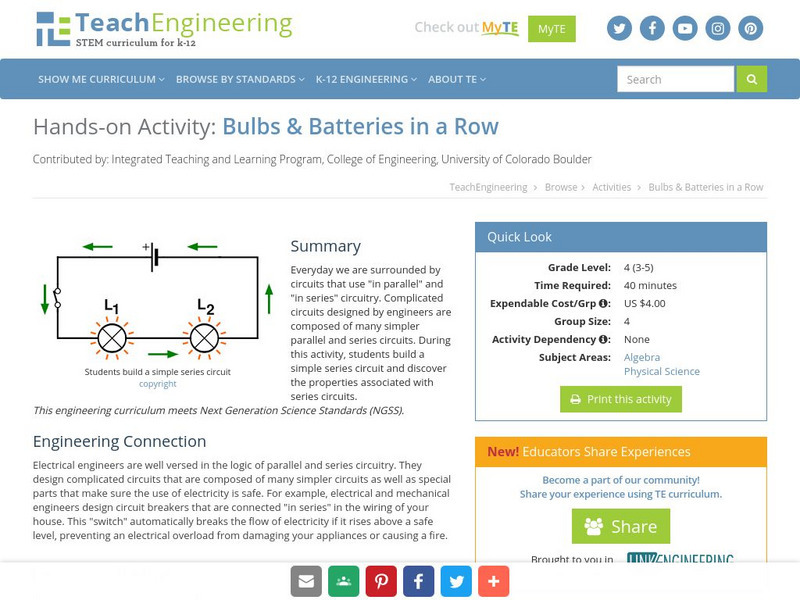
Teach Engineering: Bulbs & Batteries in a Row
Everyday we are surrounded by circuits that use "in parallel" and "in series" circuitry. Complicated circuits designed by engineers are composed of many simpler parallel and series circuits. During this activity, students build a simple...
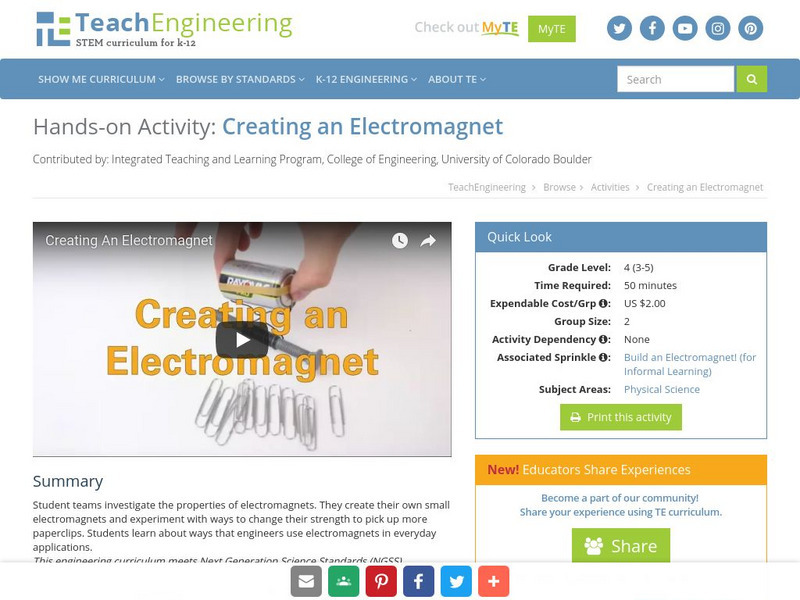
TeachEngineering
Teach Engineering: Building an Electromagnet
Student teams investigate the properties of electromagnets. They create their own small electromagnet and experiment with ways to change its strength to pick up more paper clips. Students learn about ways that engineers use...
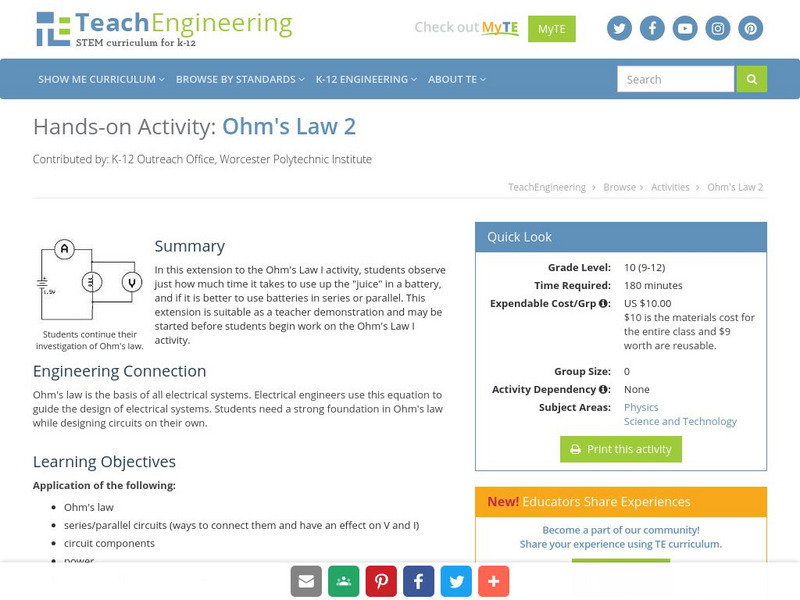
TeachEngineering
Teach Engineering: Ohm's Law 2
This extension to the Ohm's Law I activity, students will observe just how much time it takes to use up the "juice" in a battery, and if it is better to use batteries in series or parallel.

TeachEngineering
Teach Engineering: Lights Out!
This lesson introduces the concept of electricity by asking students to imagine what their life would be like without electricity. Two main forms of electricity, static and current, are introduced. Students learn that electrons can move...
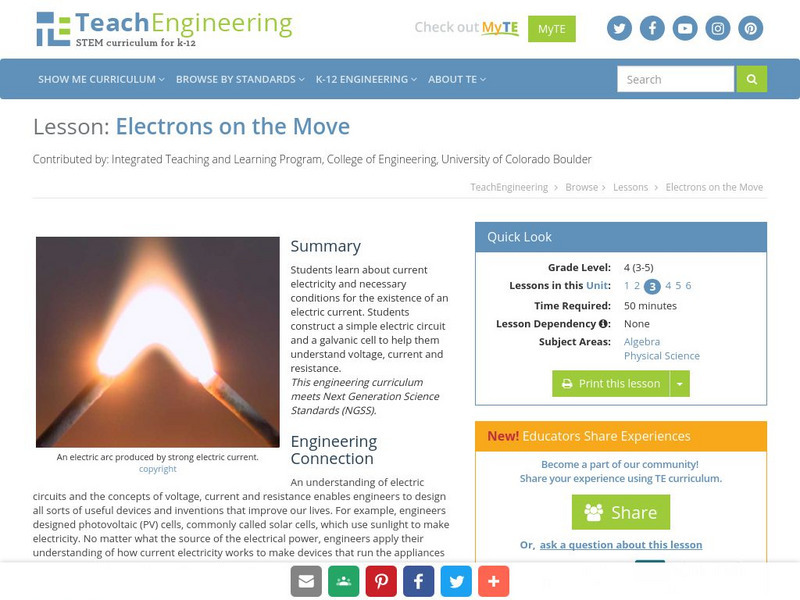
TeachEngineering
Teach Engineering: Electrons on the Move
Students learn about current electricity and necessary conditions for the existence of an electric current. Students construct a simple electric circuit and a galvanic cell to help them understand voltage, current and resistance.
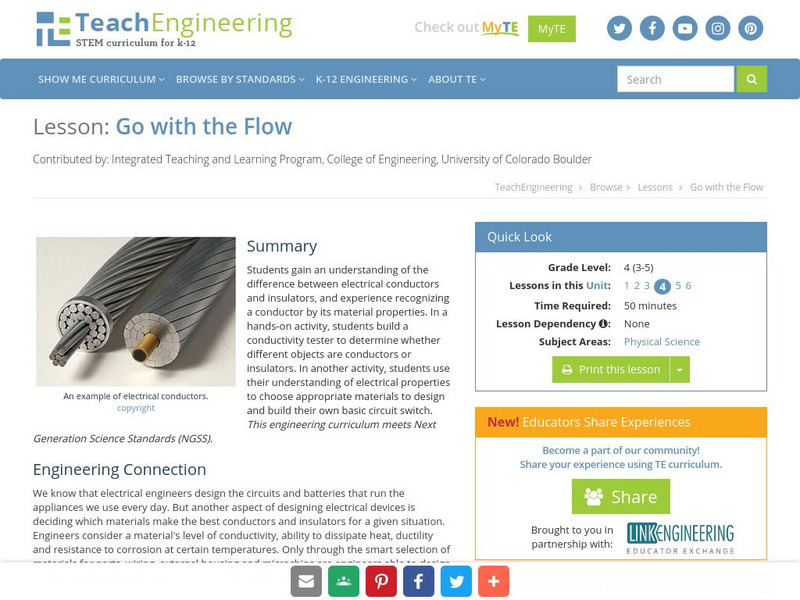
TeachEngineering
Teach Engineering: Go With the Flow
Students gain an understanding of the difference between electrical conductors and insulators, and experience recognizing a conductor by its material properties. In a hands-on activity, students build a conductivity tester to determine...

Other
About Tva (Tennessee Valley Authority)
A comprehensive site on the Tennessee Valley Authority. Includes history of the TVA from the 30's to the present with loads of other details. The FAQ is helpful. Includes the complete text of the act creating the TVA.