Hi, what do you want to do?





University of Virginia
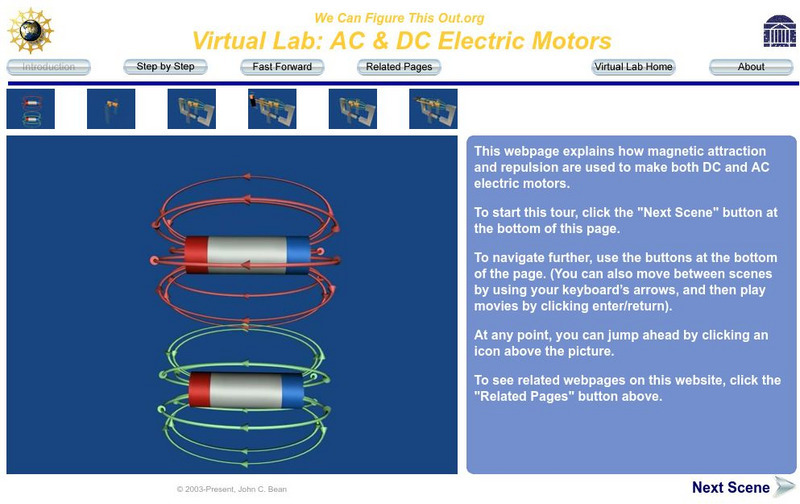
Uva Virtual Lab: Ac & Dc Electric Motors
An explanation of how magnetic attraction and repulsion are used to make both DC and AC electric motors. Check out the video clips for understanding

Khan Academy
Khan Academy: Electromagnetic Field (Loop)
This video demonstrates how to apply current in various directions to a single loop of wire. [1:12]

Khan Academy
Khan Academy: Spinning Compass
By pulsing the connection to the battery we can cause a compass to spin. Watch this video to figure out how this works. [0:47]

Khan Academy
Khan Academy: Build Your Own Motor
In this video, Khan Academy shows you how to build a simple motor using magnets. [7:18]

Khan Academy
Khan Academy: Electric Motors (Part 3)
The final video in a series of videos that finishes the explanation of how a commutator will allow a loop of wire to continue spinning in a magnetic field. Understand how this spinning magenta field allows work to be done known as an...

Khan Academy
Khan Academy: Electric Motors (Part 2)
A video exploring electric motors. This video is part 2 in a 3 part video series. This video shows that a commutator can be used in order to keep the loop of wire rotating in the magnetic field. [10:36]

Khan Academy
Khan Academy: The Dot Product
This video is an introduction to the vector dot product. [10:32]

Khan Academy
Khan Academy: Dot vs. Cross Product
Sal Khan helps you understand the differences between the dot and cross products.[10:45]

Khan Academy
Khan Academy: Electric Motors (Part 1)
Sal Khan shows that there will be a net torque on a loop of current in a wire in this video. He also shows that this net torque will cause the loop to rotate. [10:35]

Khan Academy
Khan Academy: Electromagnet: Electromagnetic Field (Loop)
A demonstration of the simplest electric motor showing current being applied to a single loop of wire. This is the principal observation leading to all electric motors. Based on actual observations from 1819 by Hans Christian Oersted....