Hi, what do you want to do?






Bozeman Science
Ecological Succession
Never trust a tree, they always look shady. The video explains both primary and secondary succession. It uses examples of volcanic activity, fires, and human disturbances. It is the seventh in an 18-part series.

Crash Course
Ecology - Rules for Living on Earth
Populations, communities, ecosystems, and biospheres are the subject of a video that investigates biomes and reveals that taigas, or boreal forests, are the largest biome, covering 17% of Earth's land surface. Viewers then explore how...

Crash Course
Conservation and Restoration Ecology
Address types of diversity, conservation biology, and restoration ecology. A video also includes small population conservation, declining population conservation, structural restoration, bioremediation, biological augmentation,...

Crash Course
5 Human Impacts on the Environment
It is estimated that within 100 years, there will be no rain forests. The video on ecosystems covers the impact humans have on the environment. It includes ecosystem services, the importance of biodiversity, deforestation,...

Crash Course
Nitrogen and Phosphorus Cycles: Always Recycle! Part 2
We wish you a happy, healthy, and phosphorus school year! A video explains the importance of getting the nutrients that are needed and focuses on the nitrogen and phosphorus cycles. It includes discussions on the importance of...

Crash Course
Ecosystem Ecology: Links in the Chain
A video starts by defining an ecosystem. It expands on the concept by covering trophic structure, primary producers, primary consumers, secondary consumers, tertiary consumers, detrivores, and bioaccumulation.

Crash Course
Ecological Succession: Change is Good
Discuss how communities and the ecosystem of the earth deal with change. An informative video includes primary succession, secondary succession, climax community model, and intermediate disturbance hypothesis.

Crash Course
Community Ecology: Feel the Love
Warblers are small birds that have been known to get caught in spider webs. The video covers community ecology, focusing on the Competitive Exclusion Principle using the example of warblers. It also includes fundamental versus realized...

Crash Course
Human Population Growth
The total world population is predicted to pass 8 billion by 2025, which is less than 10 years from now. The video focuses on human population growth and the impact it has had and is having on our planet and other populations. It...

Crash Course
The History of Life on Earth
The first life on Earth developed in the oceans. As an introduction to ecology, the video starts with the formation of the earth. It follows with the Archaean and Proterozoic Eons including protobionts, prokaryotes, and eukaryotes. It...

Crash Course
Pollution
An environmental science video covers natural and synthetic compounds and the impact they have on the environment. It includes carbon, nitrogen, phosphorous, cyanide, mercury, sulfur, nitrogen dioxide, and endocrine disruptions.

Crash Course
The Hydrologic and Carbon Cycles: Always Recycle!
Introduce biogeochemical cycles and goes into detail about the hydrologic and carbon cycles. A scientific video engages learners and teaches them at the same time.

Crash Course
Community Ecology II: Predators
The first examples of mimicry we have found date back to before flowering plants. The video goes in depth on predators at the community ecology level. It includes discussions of herbivores, parasitism, adaptations, cryptic coloration,...

Crash Course
Population Ecology: The Texas Mosquito Mystery
While 80 percent of people with West Nile Virus show no symptoms, in severe cases, it causes death by infecting the membranes around the spinal cord and brain. The video starts by making population ecology relevant. It includes density...

Amoeba Sisters
Ecological Succession: Nature's Great Grit
Your science class may not enjoy ecology yet, but after this video series they are sure to be lichen it! An educational video explains ecological succession at the community level. It includes primary succession starting with...

TED-Ed
Why Wildfires Are Necessary
Are wildfires necessary for some forests? Get the answer to this burning question with a short video that examines the role of fire in forest growth and health.

TED-Ed
When Will the Next Mass Extinction Occur?
Normal background extinctions and mass extinction events are examined in this short video that suggests that environmental change, naturally occurring and change caused by humans, is the key factor in such events.

TED-Ed
Why Is Biodiversity So Important?
There are millions of plant and animal species on the planet, but why do we need so many? Follow along with this short video as it explains how biodiversity helps strengthen ecosystems, allowing them to adapt to change so that life...

Curated OER
Biomes : Freshwater
About 70% of the earth's surface is covered in water, but how much of this water is fresh? Show this video to introduce your conservationists to the freshwater biome and the species that live there.

Curated OER
Biomes : Wetlands
Can you guess which biome used to be considered useless? Because of our ignorance, we destroyed it for development and agricultural purposes. Wetlands were viewed as wastelands until recently, when preservationists started to realize the...

Curated OER
Alala Ð An Endangered Species
What is an Alala? It is a crow native to the Hawaiian Islands, and it's endangered. Learn about what the Alala eats, when it breeds, and the startling fact that there are only 12 left in the world.
BioEd Online
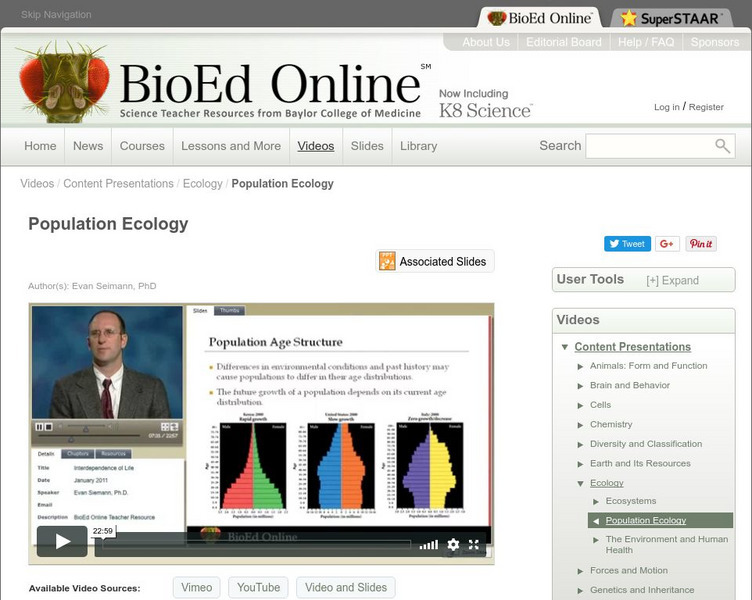
Bio Ed Online: Population Ecology
In the following video, Evan Seimann, PhD, defines key terms and concepts of ecology, basic characteristics of populations, population age structures and densities, and explains the dynamics of growth models within a population. [22:59]

PBS
Pbs Learning Media: Crash Course Ecology: Human Population Growth
Hank is here to tell us the specifics of why and how human population growth has happened over the past hundred and fifty years or so, and how those specifics relate to ecology. [10:53]
PBS
Pbs Learning Media: Crash Course Ecology: 5 Human Impacts on the Environment
Hank gives the run down on the top five ways humans are negatively impacting the environment and having detrimental effects on the valuable ecosystem services which a healthy biosphere provides. [10:37]