Hi, what do you want to do?





TeachEngineering
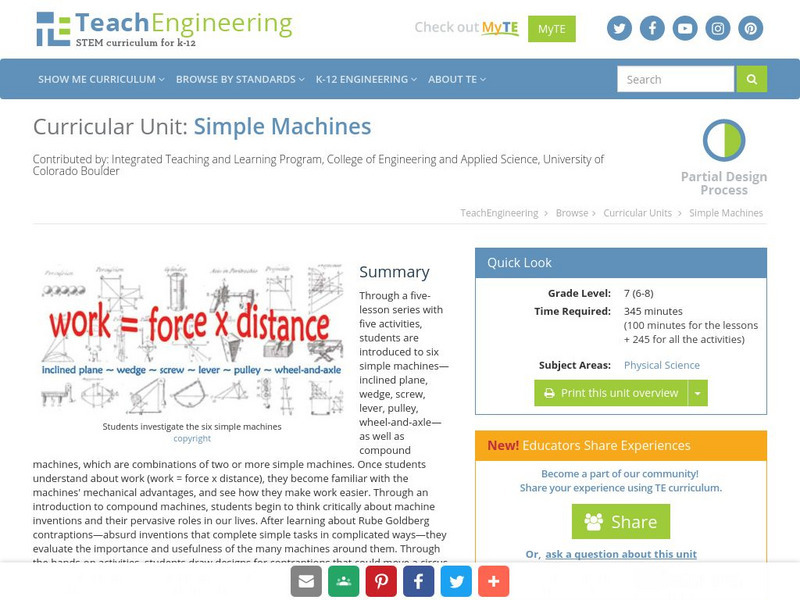
Teach Engineering: Simple Machines
Through a five-lesson series with five hands-on activities, students are introduced to six simple machines - inclined plane, wedge, screw, lever, pulley, wheel-and-axle - as well as compound machines, which are combinations of two or...

TeachEngineering
Teach Engineering: Simple Machines From Pyramids to Skyscrapers
Simple machines are devices with few or no moving parts that make work easier, and which people have used to provide mechanical advantage for thousands of years. Students learn about the wedge, wheel and axle, lever, inclined plane,...

Georgia Department of Education
Ga Virtual Learning: Physical Science: Work and Energy
Find out about simple machines, calculate the mechanical advantage and efficiency of machines, differentiate potential and kinetic energy, and learn ways to use energy more efficiently.
CK-12 Foundation
Ck 12: Physical Science: Simple Machines
[Free Registration/Login may be required to access all resource tools.] What a machine is, the three ways that machines make work easier and simple and compound machines.

TryEngineering
Try Engineering: Simple Machines
The purpose of this instructional activity is to learn about the different types of simple machines and their uses. PDF (requires Adobe Reader) and RTF (requires Word or Notebook).
CK-12 Foundation
Ck 12 Exploration Series: Simulations: Physics: Ramp and Piano
[Free Registration/Login Required] This module has students using a simple machine to learn about the relationship between work, force, and energy.
Texas Education Agency
Texas Gateway: Work and Force
Given descriptions, illustrations, graphs, or charts, students will contrast situations where work is done with different amounts of force to situations where no work is done, such as moving a box with a ramp and without a ramp or...
Ohio State University
Ohio State Univ.: Simple Machines & Mechanical Advantage [Pdf]
This site details how simple machines create a mechanical advantage for humans. Levers, theoretical mechanical advantage, actual mechanical advantage, and pulley systems are discussed.
TeachEngineering
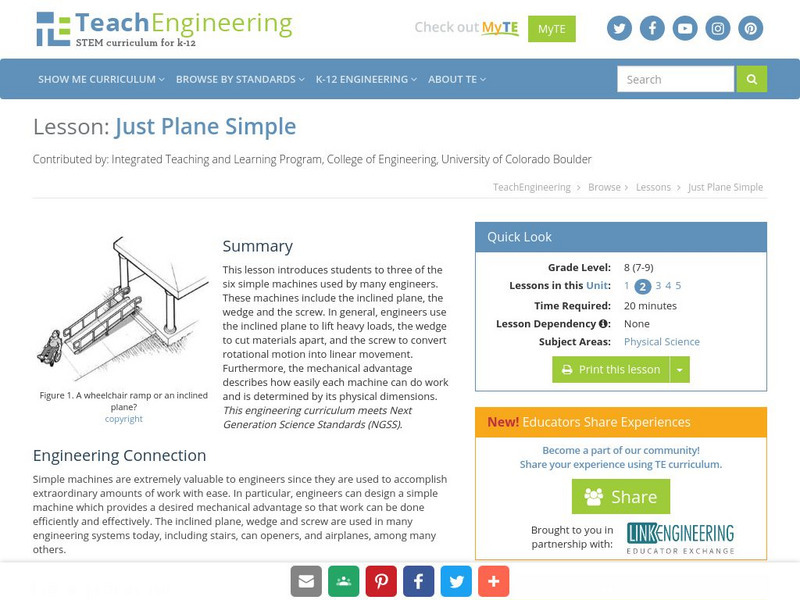
Teach Engineering: Just Plane Simple
This lesson introduces students to three of the six simple machines used by many engineers. These machines include the inclined plane, the wedge and the screw. In general, engineers use the inclined plane to lift heavy loads, the wedge...

Scholastic
Scholastic: Study Jams! Science: Force and Motion: Simple Machines
A slideshow and a short quiz on simple machines and how they reduce the amount of work or effort needed to complete a task.
CK-12 Foundation
Ck 12 Exploration Series: Simulations: Physics: Block and Tackle
[Free Registration/Login Required] A video module where students learn about the relationship between force, work, energy, and mechanical advantage using a simple machine.
TeachEngineering
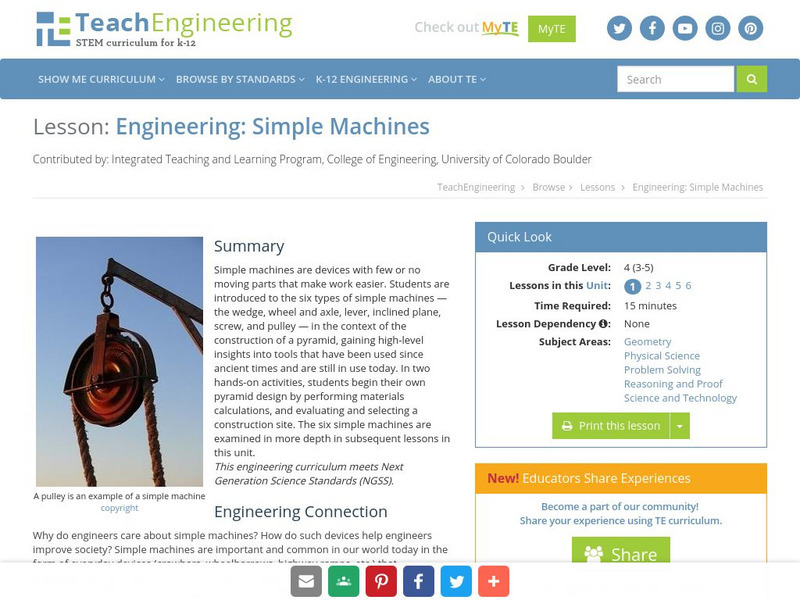
Teach Engineering: Engineering: Simple Machines
Simple machines are devices with few or no moving parts that make work easier. Students are introduced to the six types of simple machines - the wedge, wheel and axle, lever, inclined plane, screw, and pulley - in the context of the...
TeachEngineering
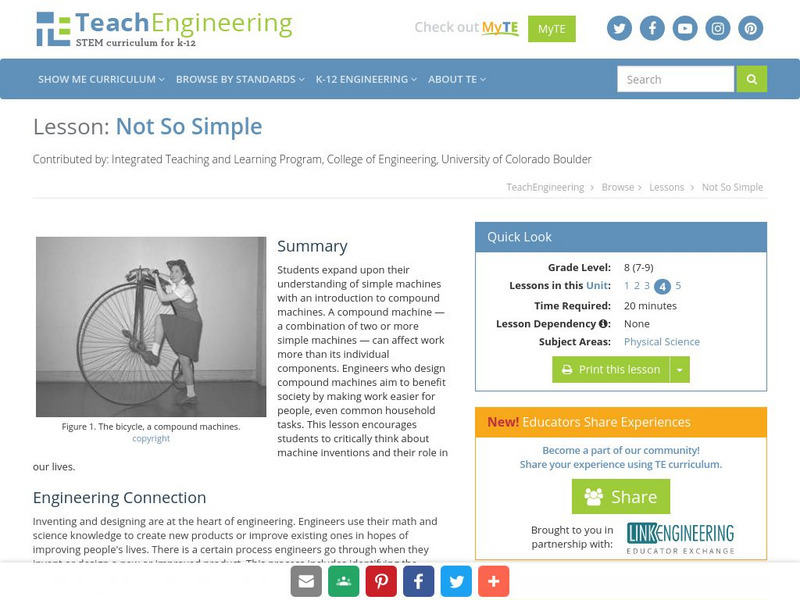
Teach Engineering: Not So Simple
Middle schoolers expand upon their understanding of simple machines with an introduction to compound machines. A compound machine - a combination of two or more simple machines - can affect work more than its individual components....

Science Buddies
Science Buddies: Balancing the Load: The See Saw as a Simple Machine
Have you ever tried to pull out a nail out of wood with your bare hands? Or have you tried to shove a staple through a stack of papers without a stapler? A hammer's claw, a stapler, a pair of pliers and a shovel are each examples of...
Other
Ontario Council for Technology Education: Designing and Testing a Crane [Pdf]
By the end of this project, young scholars will be familiar with the 6 different simple machines and will be able to identify how these machines are used in products and tools they use on a daily basis. They will investigate how...
Sophia Learning
Sophia: Simple Machines: Lesson 2
This lesson will introduce the six types of simple machines and show how machines can increase efficiency by reducing work input needed. It is 2 of 2 in the series titled "Simple Machines."
Sophia Learning
Sophia: Simple Machines: Lesson 1
This lesson will introduce the six types of simple machines and show how machines can increase efficiency by reducing work input needed. It is 1 of 2 in the series titled "Simple Machines."
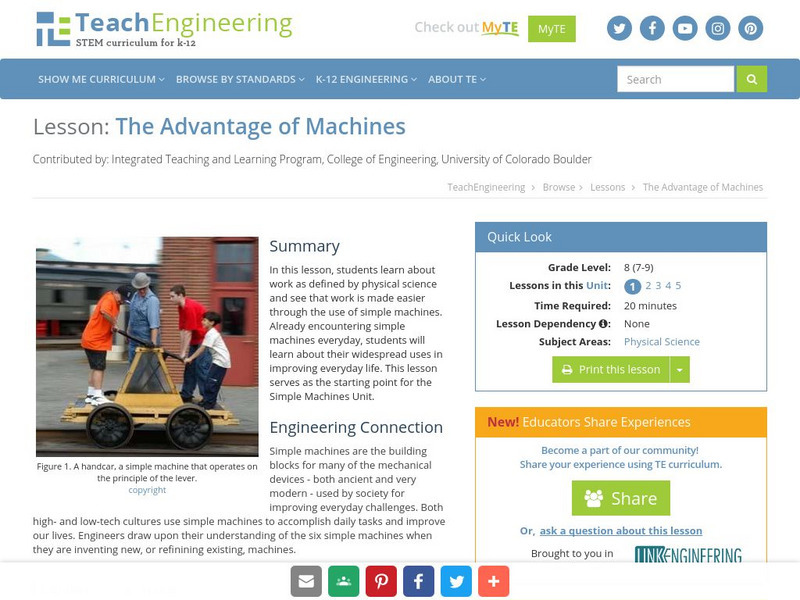
TeachEngineering
Teach Engineering: The Advantage of Machines
For this lesson, learners learn about work as defined by physical science and see that work is made easier through the use of simple machines. Already encountering simple machines everyday, students will be alerted to their widespread...
The Franklin Institute
Spotlighting Simple Machines
Simple machines such as inclined planes in wedges and screws are explained.
NASA
Nasa: Simple Machines
A lesson plan site that contains activities designed to give grades 3 and 4 experiences in using simple machines.

Ducksters
Ducksters: Physics for Kids: Simple Machines
Kids learn about the science behind simple machines such as levers, wheels, pulleys, inclined planes, and screws. How they work together to make complex machinery.
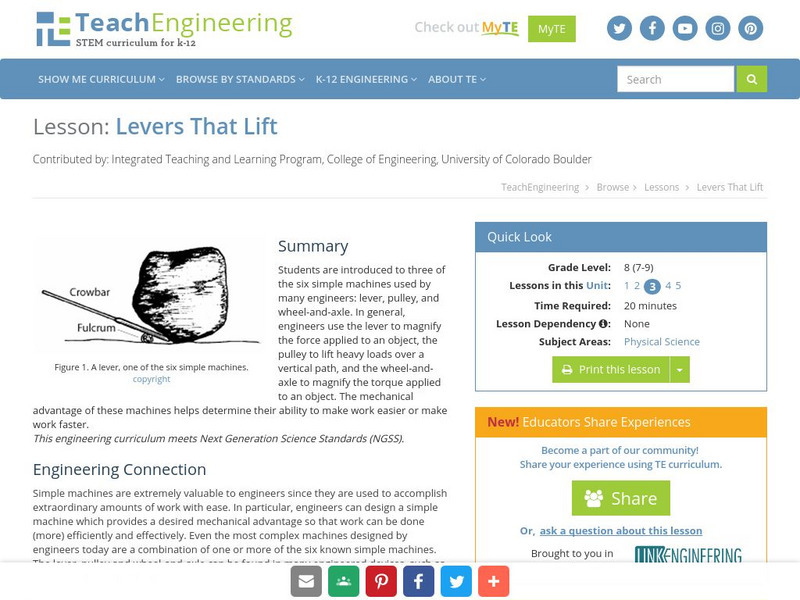
TeachEngineering
Teach Engineering: Levers That Lift
This lesson introduces learners to three of the six simple machines used by many engineers: the lever, the pulley, and the wheel-and-axle. In general, engineers use the lever to magnify the force applied to an object, the pulley to lift...
Science Struck
Science Struck: Simple Machines: The Wedge
Explains how a wedge works, the formula for calculating its mechanical advantage, and some common applications of wedges.
Science Struck
Science Struck: Simple Machine: Levers
Explains what a lever is, its history, how it works, the formula for calculating its mechanical advantage, classes of levers, and uses of levers.