Hi, what do you want to do?





Annenberg Foundation
Annenberg Learner: American Passages: Utopian Promise: William Penn
Quaker and son of the founder of Pennsylvania, William Penn's utopian dreams for America were compiled into a large collection highlighting his views of American ideals of politics. Click on "William Penn Activities" for related resources.
Library of Congress
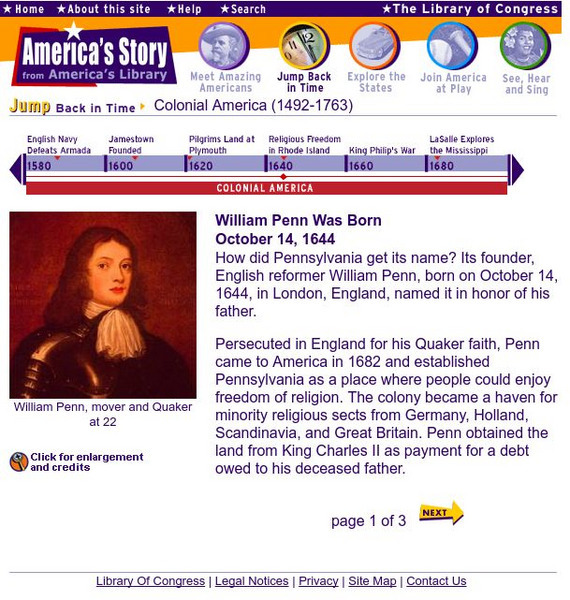
Loc: America's Story: William Penn
The Library of Congress presents this brief biography of William Penn, the founder of Pennsylvania. Provides photographs of his home and church, as well as a portrait of this famous Quaker.
Digital History
Digital History: The Middle Colonies: William Penn's Holy Commonwealth
The Quakers were persecuted in England and in many English colonies. Read about William Penn's establishment of the colony of Pennsylvania where Quakers and others could live with religious liberty.

Other
Religious Society of Friends: Willliam Penn: First Great Champion for Liberty
Abridged biography of William Penn, the founder of Pennsylvania responsible for establishing the notion of freedom of conscience in America.
Other
Pennsylvania Historical and Museum Commission: William Penn
This resource presents a biographical essay about William Penn that highlights his role in the establishment of Pennsylvania.
Siteseen
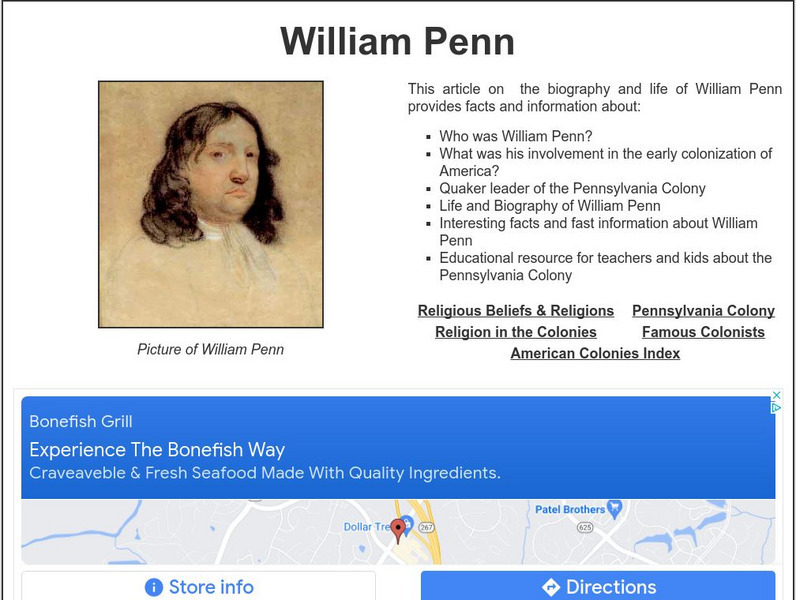
Siteseen: Land of the Brave: William Penn
Overview and biographical facts on the life of William Penn, the Quaker leader of the Pennsylvania Colony.
Other
State Museum of Pennsylvania: The William Penn Treaty Collection
An online exhibit featuring a collection of historical articles and pictorial images from the founding of Pennsylvania.

Independence Hall Association
U.s. History: Middle Colonies: Quakers in Pennsylvania and New Jersey
A good look at the philosophy of the Quakers who colonized William Penn's religious refuge in the colony of Pennsylvania. Read about Penn's liberal views about government, religious freedom, and relations with Native Americans.
Huntington Library
Huntington Library: Pennsylvania Colony: The Holy Experiment [Pdf]
For this lesson, 5th graders learn about the people who founded the Pennsylvania colony and the role that religion played in shaping it. Includes background information for the teacher. Students explore primary resource readings on the...
State Library of North Carolina
N Cpedia: Quakers
Read about the history of the Quakers, also called the Religious Society of Friends, who are the oldest organized Christian church in North Carolina.
Other
Pennsylvania General Assembly: The Quaker Province: 1681 1776
This resource presents an essay that describes the founding of Pennsylvania as a refuge for Quakers.
Library of Congress
Loc: America's Story: Pennsylvania
Can you name the "two major cities" that dominate the state of Pennsylvania? At this site from the Library of Congress you can learn about how William Penn named this state and find answers to many other questions, as this site takes a...

Other
Personal Site: Biography of Anthony Benezet
A short but good biography of the famous Quaker abolitionist who established a school for slaves in Philadelphia in 1770. He wrote a pamphlet in 1772 which led to the establishment of the anti-slave trade movement in England.
Curated OER
Educational Technology Clearinghouse: Clip Art Etc: William Penn
(1644-1718) "The founder of the state of Pennsylvania, and the most widely-known member of the Quakers." -Foster, 1921
Huntington Library
Huntington Library: American Indians and English Settlers in Colonial America
In this instructional activity, 5th graders examine the relations between Indians and the settlers in the 1600s and 1700s. Background information for teachers is included. Students will work in groups to look at three different colonies...

Independence Hall Association
U.s. History: Middle Colonies: City of Brotherly Love Philadelphia
Philadelphia was the colony of Pennsylvania forsome time. Read about what William Penn's vision was for the city and why the city became so important.

University of Groningen
American History: Outlines: The Middle Colonies
Society in the middle colonies was far more varied, cosmopolitan and tolerant than in New England. In many ways, Pennsylvania and Delaware owed their initial success to William Penn.